XRHealth, the Boston-area company best known for virtual reality therapy programs, announced on November 9, 2026 that it has acquired PursueCare, a virtual addiction treatment provider. It is the company’s second acquisition in a week. On November 2 it bought living brain, a Heidelberg startup that makes VR cognitive rehabilitation software. Together with July’s purchase of Swing Therapeutics, the deals show a VR health company turning itself into a broader digital care business in which the headset is only one of several devices.
What XRHealth Gets With PursueCare
PursueCare provides telehealth treatment for addiction to alcohol, opioids, cannabis, kratom and 7-OH, along with co-occurring mental health conditions. The deal includes its clinical services, with licensed clinicians, therapists, counselors, psychiatrists and case managers reached through secure telehealth and a smartphone app. It also includes two FDA-authorized prescription digital therapeutics, RESET and RESET-O, which deliver cognitive behavioral therapy and contingency management through a phone.
According to the release, RESET is indicated to increase abstinence and treatment retention in adults with substance use disorder, as an adjunct to contingency management. RESET-O is indicated to increase retention in outpatient treatment for adults with opioid use disorder, used alongside buprenorphine and contingency management under clinician supervision. The XR angle is that PursueCare patients will join an ecosystem that already includes XRHealth’s VR support groups, where people take part as avatars for more privacy. XRHealth did not disclose terms.
What It Got With living brain
The living brain deal is the more purely immersive one. Its flagship product, teora mind, lets patients practise everyday activities such as cooking, sorting groceries or shopping in virtual kitchens, gardens and stores. It includes 25 everyday-life scenarios with adjustable difficulty. XRHealth also gets teora body for upper-limb motor rehabilitation, teora platform for therapists to manage patients and track progress, and teora Supervisor, which streams a patient’s headset view to a therapist’s tablet in real time.
Teora mind is certified as an MDR Class IIa medical device in Europe, and XRHealth says it has been evaluated at seven clinical sites in Germany. The release cites a 2023 randomized trial in JMIR Serious Games in which teora mind beat conventional computer-based cognitive training in several cognitive domains. Two caveats matter. As JBizNews notes, the European certification is not a U.S. FDA decision, and the deal came with no new trial data. The local paper Rhein-Neckar-Zeitung also reports that living brain was insolvent when XRHealth bought it. That makes this deal look more like an asset rescue than a premium purchase, which matches XRHealth’s own wording about acquiring “living brain assets.”
The Pattern: Buying Reimbursable Care, Not Just VR Content
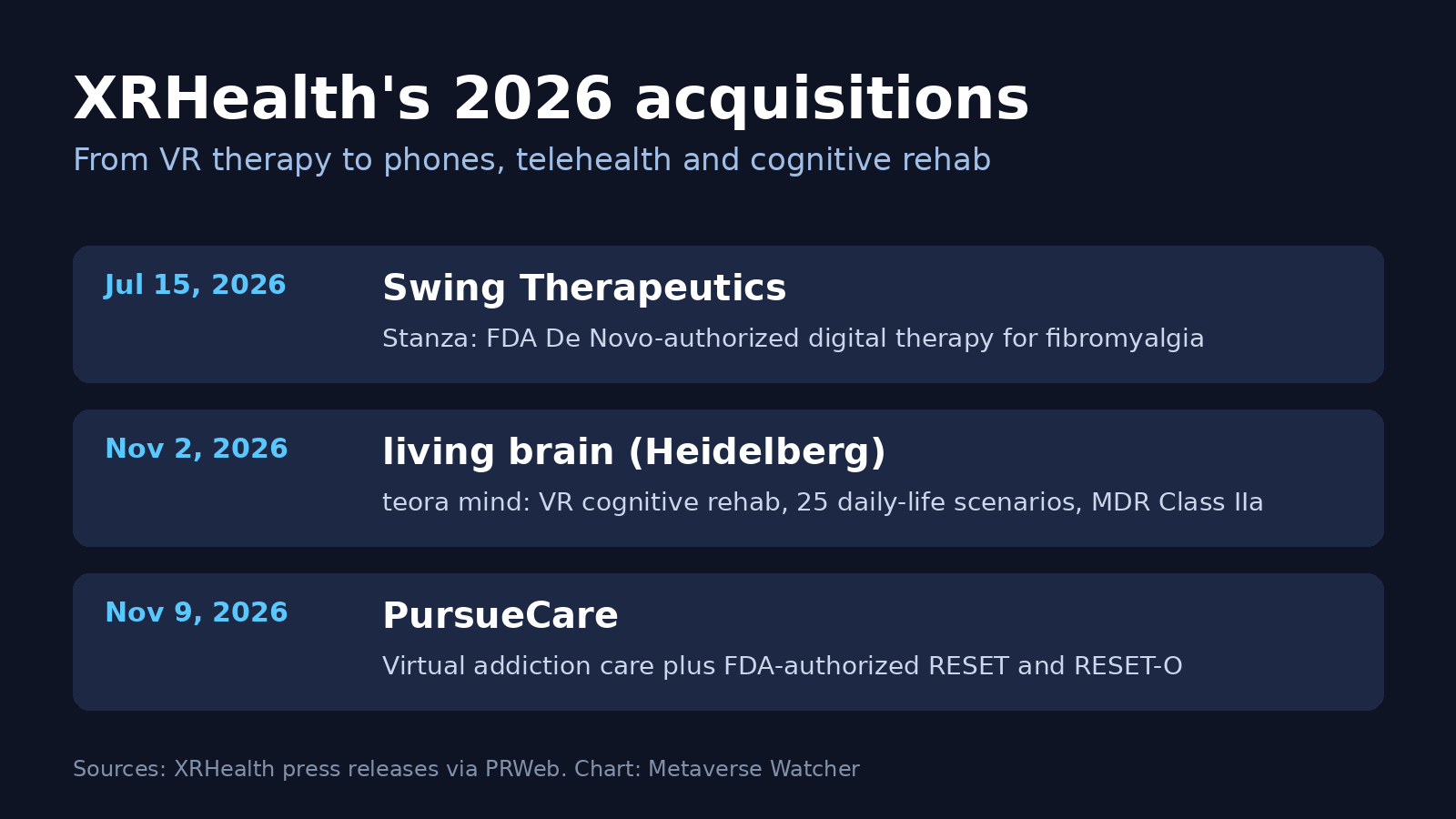
| Announced | Company | What it adds | Main device |
|---|---|---|---|
| July 15, 2026 | Swing Therapeutics | Stanza, an FDA De Novo-authorized digital therapy for fibromyalgia, plus the Swing Care virtual clinic | Smartphone |
| November 2, 2026 | living brain | teora suite for VR cognitive and motor rehabilitation (MDR Class IIa in Europe) | VR headset |
| November 9, 2026 | PursueCare | Virtual addiction treatment and the FDA-authorized RESET and RESET-O apps | Smartphone and telehealth |
Two of the three 2026 deals are not VR products at all. The Boston Globe reported in July that Swing was XRHealth’s sixth acquisition in two years and its first move into smartphone-based treatment. The Globe also noted that XRHealth had raised about $50 million and that its large packages of VR treatments are registered with the FDA but not cleared. CEO Eran Orr told the paper that Swing “won’t be the last” deal, and the last week has proved him right.
The logic is reimbursement. XRHealth says it is licensed in 22 U.S. states and serves patients through Medicare Part B, VA programs and commercial insurance. FDA-authorized prescription apps and established telehealth practices are easier to bill than VR wellness content. In practice, VR becomes the differentiating layer, such as avatar-based support groups and immersive rehab, on top of care that insurers already understand.
Why It Matters for Medical XR
Medical XR has had no shortage of promising pilots. Our coverage of the AdaptRehab VR stroke pilot in Ethiopia is one recent example. What the field has struggled with is building businesses that last. XRHealth’s answer is consolidation: buy specialist tools, including from startups that ran out of money, and sell them through one platform that covers headsets, phones and, as we reported in September, AR glasses for clinician-guided telehealth.
Questions remain. XRHealth has not said when teora mind will reach U.S. patients, what regulatory path it would need, or whether PursueCare’s patients will actually be offered headsets. Watch for U.S. availability of the living brain products, any FDA filings, and whether the next acquisition adds more immersive tools or more conventional telehealth. For the wider context on where XR hardware is heading, see our XR device sales forecast to 2030.
Sources: XRHealth press releases for PursueCare (November 9, 2026), living brain (November 2, 2026) and Swing Therapeutics (July 15, 2026); Boston Globe; JBizNews; Rhein-Neckar-Zeitung.