Samsung Research and Pohang University of Science and Technology (POSTECH) have published a prototype AR glasses lens that is just 1.5 mm thick and still bright enough to show readable white text outdoors. The work, titled “Metasurface waveguides for all-day augmented reality glasses”, appeared in Nature on November 11 (local time), and Korea’s Ministry of Science and ICT announced it the next day. It goes straight at the hardest trade-off in smart glasses: thin lenses usually mean dim images.
What Samsung and POSTECH Actually Built
Most display glasses today use a diffractive waveguide: a thin, clear plate that takes light from a tiny projector near the hinge, bounces it along inside the lens, and sends it out toward the eye. The paper’s abstract describes the core problem plainly. These waveguides “face inherent trade-offs among field of view, optical efficiency and eyebox size” because there are few ways to steer the light. Make the image wider or the viewing zone bigger, and brightness drops.
The team’s answer is a metasurface, an array of nanostructures smaller than the wavelength of light. According to The Korea Times, the researchers etched silicon nitride structures across 29 distinct zones of the lens, changing their shape and spacing by position so stray light is redirected back toward the eye along several paths instead of being lost. The paper calls these “spatially varying, interwoven metasurfaces” that provide several grating vectors for light control in more than one direction.
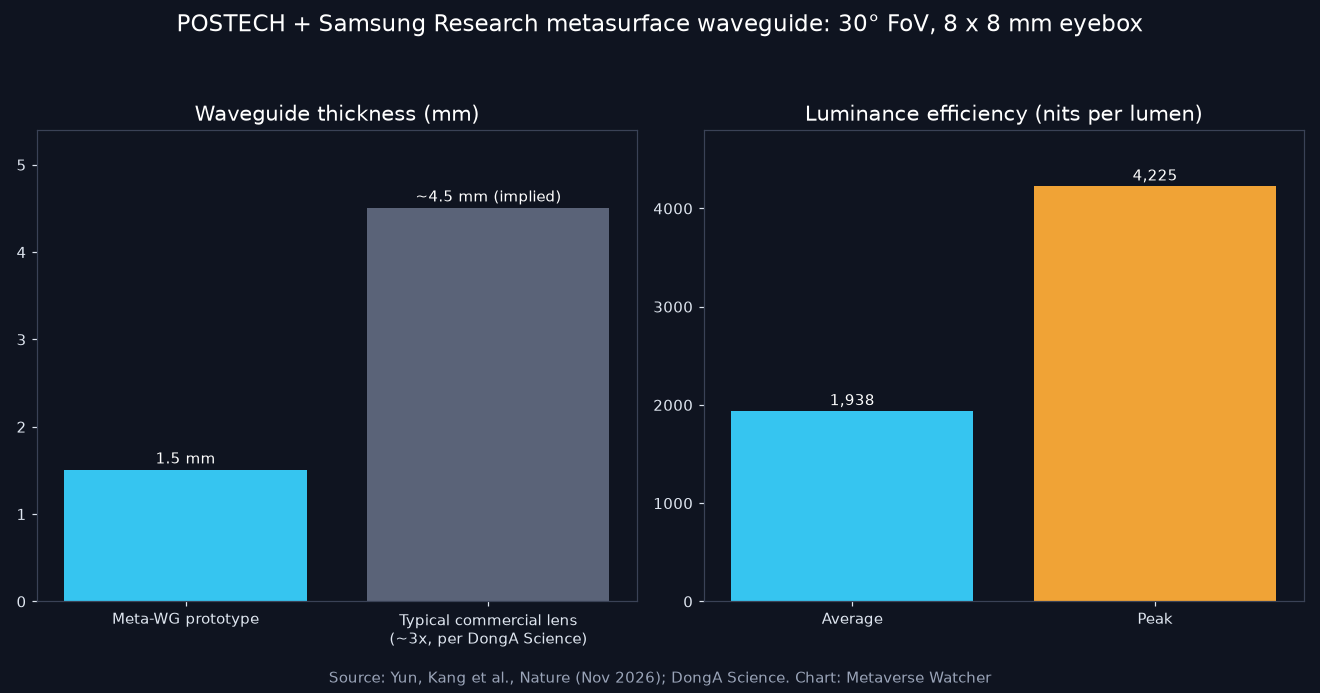
For color, the prototype stacks two waveguide layers. One mainly carries blue and green light, the other red and green. Together the two layers make up the full 1.5 mm assembly. DongA Science reports that this is about one-third the thickness of lenses in current commercial products.
The Key Numbers
| Spec | Prototype result | Why it matters |
|---|---|---|
| Waveguide thickness | 1.5 mm (two layers) | Closer to a normal prescription lens; less weight at the front of the frame |
| Field of view | 30° diagonal | Enough for notifications, captions, navigation and short text |
| Eyebox | 8 × 8 mm, two-dimensional | The image stays visible if the glasses slip down the nose or sit at a different angle |
| Average luminance efficiency | 1,938 nits per lumen | More brightness from the same projector power |
| Peak luminance efficiency | 4,225 nits per lumen | Shows what the design can reach in its best zones |
| Field tests | White text readable outdoors; full-color images indoors at 30% display power | Outdoor readability is where most thin waveguides fail |
The power figure is worth noting. DongA Science says the prototype produced full-color images indoors with display output reduced to 30%, and that the design delivers brighter images at a power level similar to current devices. In glasses, display power is one of the biggest drains on a battery that has to fit in a temple arm. Efficiency gains in the optics can turn directly into longer battery life or a smaller battery.
What It Does Not Solve Yet
This is a research prototype, not a product, and the team was clear about the gaps. Reports from The Herald Business and The Korea Times list the same remaining work:
- Brightness: average brightness still has to rise to industry-standard levels.
- Rainbow artifacts: sunlight hitting the nanostructures can cause rainbow-like glare, a known issue with diffractive optics.
- Uniformity: color and brightness need to be even across the whole image.
- One layer, not two: the researchers want to combine the two layers into a single sheet.
- Manufacturing: nanoimprint production has to be adapted for mass volumes.
A 30° field of view is also modest next to a headset. It suits heads-up information, not immersive 3D scenes. That is the use case the current wave of display glasses is chasing anyway.
Why It Matters for Samsung’s Glasses Plans
The timing is telling. Samsung supplies the hardware for Google’s first Android XR Intelligent Eyewear, which opened pre-orders on November 12 starting at $395 and goes on sale December 10. Those first frames have cameras, speakers and Gemini, but no display in the lens. We covered the lineup in Google Intelligent Eyewear: price, specs and supported phones and how it stacks up in Samsung smart glasses vs Ray-Ban Meta.
Adding a display without making the frames thick, heavy or dim is the next step for every company in this race. Meta’s Ray-Ban Display uses a single-eye display, and Apple’s first glasses are expected to ship without an AR display at all, as we noted in our Apple smart glasses release date and rumors tracker. A 1.5 mm waveguide that stays readable in daylight would help Samsung close that gap. It would also help prescription wearers, since thinner optics are easier to combine with corrective lenses, a topic we covered in the best smart glasses for prescription wearers.
Neither Samsung nor POSTECH has tied this research to a product or a date. Publication in Nature does not mean it is headed to stores next year. It does show where Samsung Research’s Reality Media Lab, credited on the paper alongside Professor Junsuk Rho’s POSTECH group, is putting its optics work.
The Bottom Line
The Samsung and POSTECH metasurface waveguide does not solve AR glasses, but it moves the three numbers that matter most (thickness, brightness and eyebox) at the same time instead of trading one for another. If the rainbow glare and manufacturing problems can be solved, it is the kind of optic that makes display glasses look like ordinary glasses. Until then, it is a strong signal of where Samsung’s display-glasses roadmap is heading.
Sources: Nature, The Korea Times, DongA Science, The Herald Business, Digital Today.