The Cyberpunk 2077 VR mod from developer dariulone now gives players physics-based hands and motorcycle handlebars they steer with both controllers. Both features arrived in version 0.2.4 of the open-source CyberpunkVR Port, published on GitHub on November 14, 2026, followed the same day by a 0.2.45 hotfix. MIXED reported the update on November 21.
The project is an unofficial community mod. Its README states that it is “not affiliated with CD PROJEKT RED” and describes it as experimental, with a recommendation to keep backups of save files. CD Projekt Red has not announced a VR mode for the game.
What version 0.2.4 adds
The 0.2.4 release notes list a dozen new features. The main changes are:
- Physics hands: each hand is now a physical body that follows the controller. According to the notes, hands stop at walls and tables instead of passing through them, push loose objects, and grip props by their shape, such as a bottle by its neck or a box by its corners. Players can also take hold of characters by an arm or by their clothing, pull out loot, and climb ledges with their hands. The feature is on by default and can be switched off with the “Hand physics” option in the launcher or the settings.
- Carrying bodies: a body can be held by a limb or by its clothing. It hangs from the point held and drags with its weight, and two hands can hold one body.
- Motorcycle steering: players push one hand forward and pull the other back to turn the handlebars, and lean into turns. The default bar lock is 40 degrees and can be changed under Settings, Controls, Driving. The notes credit contributor EffinexX for the feature.
- Map while driving: the minimap is projected over a car’s hood, similar to a head-up display, or over a motorcycle’s handlebars, with the current quest shown below it.
- Frame generation: a fourth frame generator, ANR FG (Apex Neural Rendering), is included in beta for recent NVIDIA, AMD and Intel GPUs.
- Quality-of-life changes: selling several items at once, changing V’s appearance at mirrors from the VR menu, and finger tracking on Quest that also works while holding the controllers.
The release also fixes a bug that, according to the notes, meant fixed foveated DLSS never ran on most systems. With the fix in place, the developer reports DLSS cost per eye falling from 1.40 ms to 1.18 ms in the same scene. The 0.2.45 hotfix addresses a blinking HUD that appeared without frame generation on every runtime except SteamVR, including Virtual Desktop and Quest Link.
Requirements and supported headsets
The mod runs only with the PC version of the game. The project’s README lists two requirements:
| Item | What the README says |
|---|---|
| Game version | Cyberpunk 2077 for PC, version 2.5. Version 2.31 no longer works. |
| Framework | RED4ext 1.31.0 or newer, installed first |
| Other frameworks | Cyber Engine Tweaks, ArchiveXL, TweakXL, Input Loader, Codeware and redscript are not needed for the port itself |
| Headset profiles | 19 headsets and 188 resolutions, including Quest 2, 3 and 3S, Pico 4 and 4 Ultra, Valve Index, PS VR2, Steam Frame, Bigscreen Beyond 2 and 2e, Samsung Galaxy XR and several Pimax models |
| Developer’s test rig | Pico 4 via VDXR; Meta Quest 3 via Steam Link and VDXR; AMD Ryzen 7 5800X; NVIDIA RTX 5070 Ti; 32 GB RAM; Windows 11 |
| License | MIT (open source) |
The developer’s test rig is not an official minimum specification, but it indicates the class of PC the project is built on. Quest owners will need a PC streaming connection such as Steam Link, Virtual Desktop or a cable. Our guide to USB streaming on Quest 3 and 3S covers the wired options. Valve’s new headset is also on the supported list; our Steam Frame specs and price guide has its full spec sheet.
Inside the headset, the VR menu opens by holding both thumbsticks down (L3 and R3), and an in-headset settings overlay opens with F10.
What the GitHub numbers show
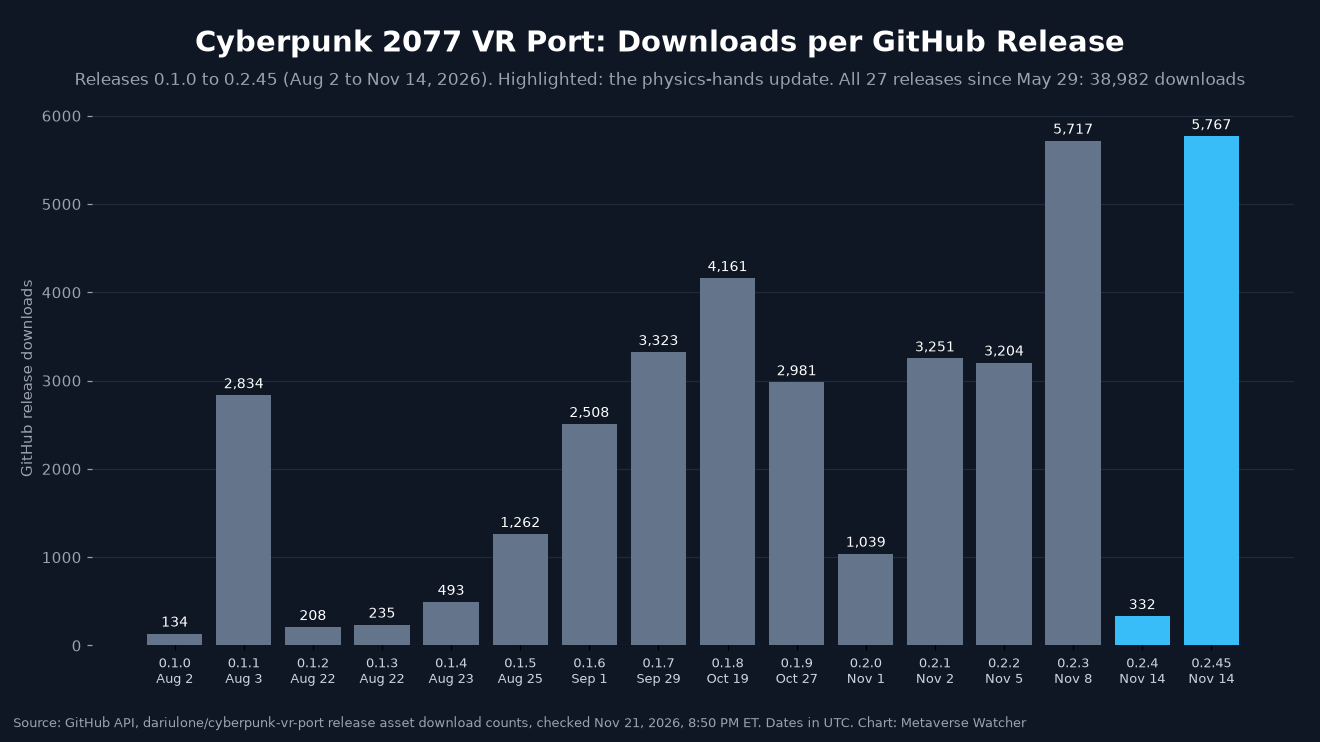
We pulled release data from the GitHub API on November 21, 2026, at about 8:50 PM ET. The repository was created on May 28 and has had 27 releases since the first build on May 29. Those releases have been downloaded 38,982 times in total. The 0.2.45 package alone accounts for 5,767 downloads since November 14, the highest of any release and slightly ahead of 0.2.3, which recorded 5,717 since November 8. The short-lived 0.2.4 package was downloaded 332 times before the hotfix replaced it.
These figures count file downloads, not unique players, and include repeat downloads by the same person. They also exclude copies obtained through the project’s Nexus Mods page. The repository had 718 stars, 75 forks and 120 open issues and pull requests at the time of our check. Even with those caveats, interest is rising: the two most-downloaded packages are the two newest full builds, 0.2.3 and 0.2.45, and the pace of updates has increased, with six releases in November so far.
Why the update matters
Large flatscreen games converted with community mods remain one of the main draws of PC VR, and the debate over their value is active. In a November 20 column, Road to VR used Cyberpunk 2077 as an example of a game built around menus, dialogue choices and conventional shooter controls, which it said “kind of works, and kind of doesn’t” in VR. Physical interaction is the area where native VR games usually have the advantage, and it is exactly what version 0.2.4 targets.
The CyberpunkVR Port joins other ambitious flatscreen conversions we have covered, such as the Gears of War: E-Day VR mod. For native games with similar themes, see our rankings of the best VR shooters of 2026 and the best VR RPGs of 2026.
Before you install
As with any community mod, compatibility can change when the game updates. The README notes that if redscript compilation fails, every redscript mod is disabled, not only the one that failed, and it points users to the RED4ext logs folder to diagnose problems. It also asks users to keep only one DLL in each CyberpunkVR plugin folder. We have not tested version 0.2.45 ourselves; the feature descriptions above come from the developer’s release notes and README.
Sources: CyberpunkVR Port releases and README on GitHub (checked November 21, 2026); GitHub API release and repository data (checked November 21, 2026, about 8:50 PM ET); MIXED (November 21, 2026); Road to VR (November 20, 2026).