South Korea’s most widely taken English test now treats every pair of eyeglasses as a possible computer. At the regular TOEIC session on Sunday, November 29 (Korea time), proctors at 188 test sites inspected each test-taker’s glasses and fixed a tamper-evident security seal to the frame, so that a candidate cannot swap in smart glasses once the test begins. Radio-frequency detectors were added at every site the same day, according to Financial News and Yonhap.
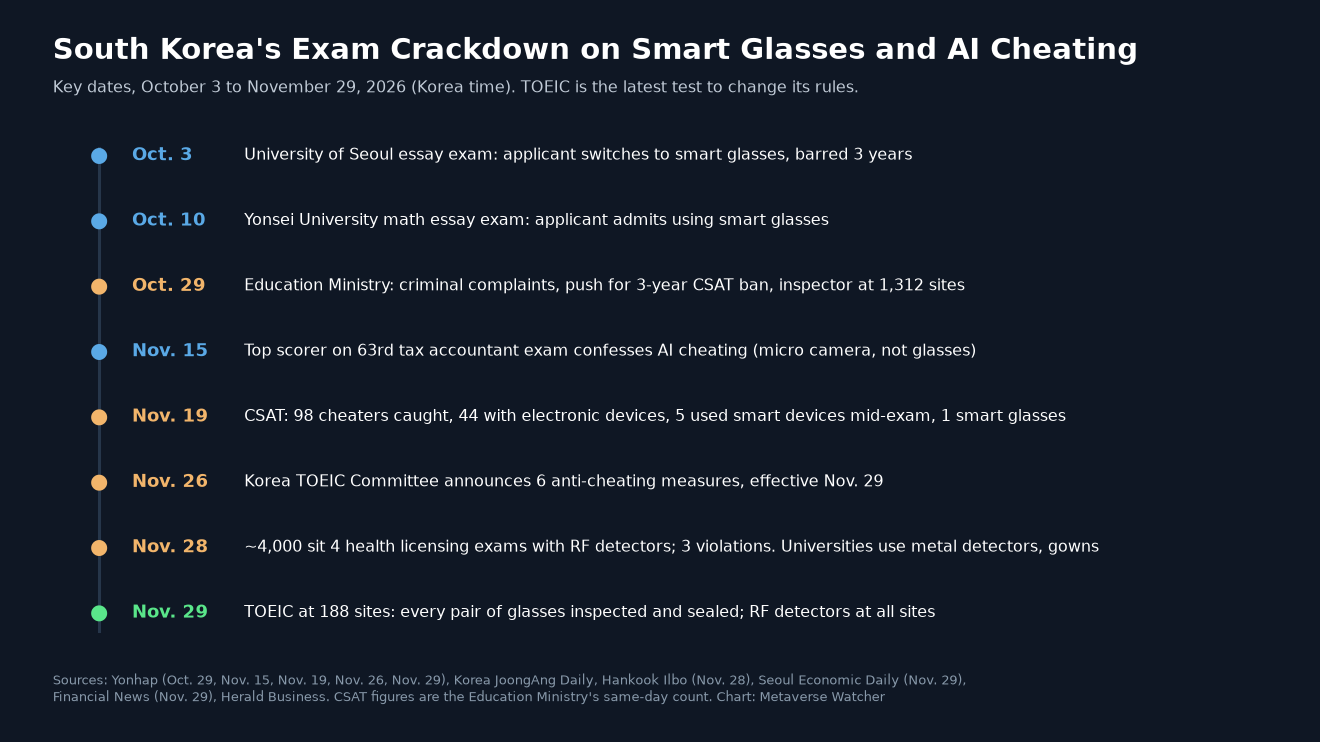
The change comes from the YBM-run Korea TOEIC Committee, which announced six anti-cheating measures on November 26. It is the latest step in a national crackdown that began with smart-glasses incidents at university entrance exams in October and widened after the top scorer on this year’s tax accountant exam confessed to using generative AI during the test.
The Six TOEIC Measures
The committee’s November 26 announcement, as reported by Yonhap, lists six measures. All applied from the November 29 session.
| Measure | What changes for test-takers |
|---|---|
| Glasses inspection and seal | A proctor checks every pair of glasses and attaches a security sticker to the frame. Removing it leaves a visible mark. The sticker’s color and size will change from test to test so old seals cannot be reused. |
| Desk items limited to four | Up to two pencils, one eraser with its cover removed, a valid ID and an analog watch, which must sit on the desk rather than the wrist. Mechanical pencils are no longer allowed. |
| Metal and RF detectors | Metal detectors are still used on candidates who leave for the restroom or are suspected of cheating. Radio-frequency detectors are now added at every site. |
| Button stickers, no hats | Wide stickers go over clothing buttons to block hidden micro cameras. Hats are banned because they hide where a candidate is looking. |
| After-the-fact detection | Score processing will be used to flag cheating that was missed on the day. |
| Reporting and monitoring | A cheating report center on the TOEIC website, plus monitoring of social media and portal ads that recruit or broker cheating. Problem ads go to Korea’s broadcasting and communications standards regulator. |
Signs posted at test sites warned that carrying or using AI glasses or other smart devices would void the score and bar the candidate from the test for four years, Yonhap reported from Daeshin High School in Seoul.
How the First Day Went
Yonhap reporters at three Seoul sites found most candidates accepted the rules, though not without complaint. One proctor said glasses were checked three times: once before the test, once by the hallway proctor and once by the chief proctor. The same proctor noted that each room still has a single supervisor, who now handles glasses checks inside the same window used for ID checks.
Some test-takers said the seals kept peeling off, and one worried that touching her glasses to fix the sticker might look suspicious. Another called the sticker check pointless. Others said a single proctor, winter coat pockets and simple ID matching still leave room for cheating. The candidates and proctors Yonhap spoke to said no cheating was caught in their rooms. The committee has not published a national count for the session.
Why the Seal Targets the Swap
The sticker is aimed at a specific tactic. In both university cases we reported in October, the applicant wore ordinary glasses through the ID check and switched to smart glasses afterward: at the University of Seoul essay exam on October 3 and at Yonsei University’s math essay exam on October 10. A seal that shows tampering turns that swap into visible evidence.
The approach also reflects how hard camera glasses have become to spot. Gentle Monster’s Samsung-built, Gemini-powered frames weigh about 41 grams and go on sale in Korea and the United States on December 10, Money Today reported. We covered the second pre-order round in Gentle Monster smart glasses open second pre-order. For the signs that a pair contains a camera, see our guide on how to tell if smart glasses are recording.
A Weekend of Tightened Exams
TOEIC was not alone. On Saturday, November 28, about 4,000 candidates sat four health-care licensing exams at 23 sites in nine regions: level 1 and 2 emergency medical technician, dental technician, and prosthetist and orthotist. The Ministry of Health and Welfare and the Korea Health Personnel Licensing Examination Institute collected all electronic devices, ran radio-frequency detectors and phoned candidates at random to confirm their phones were switched off, the Hankook Ilbo reported.
The ministry found three violations: one iPad and two pairs of wireless earbuds left in bags rather than handed in. None was on a candidate’s body, but the ministry said the exams would be voided, according to Seoul Economic Daily. The ministry plans to apply lessons from the day to the doctor, Korean medicine doctor and nurse licensing exams early next year.
| Exam (date) | Scale | Key measures | Reported result |
|---|---|---|---|
| CSAT (Nov. 19) | National university entrance exam | Smart-glasses inspector at each site; emergency alert test messages; Wi-Fi signal detection | 98 cheaters; 44 with electronic devices; 5 used smart devices mid-exam, 1 of them smart glasses |
| Health licensing exams (Nov. 28) | About 4,000 candidates, 23 sites | Devices collected; RF detectors; random phone calls; gowns first for computer-based tests | 3 violations (1 iPad, 2 earbuds in bags); exams to be voided |
| Pusan National University essay exam (Nov. 28) | 10,291 applicants | All devices banned, including smart glasses; metal detectors; disposable gowns; hallway RF checks | 2 devices found in hallway belongings; 2 candidates with paper materials |
| TOEIC (Nov. 29) | 188 sites | Glasses seals; RF detectors at all sites; button stickers; hat ban; four desk items | No national figure published |
Universities holding early-admission essay exams went further. Pusan National University barred phones, smart glasses, smartwatches, jewelry, hats and clothing with buttons or zippers. Kyungpook National University ran metal detectors on every applicant, checked glasses and analog watches for tiny devices or speaker holes, and handed out button stickers and its own pens. Sejong University used radio-frequency detectors, metal detectors and a thermal camera, test-takers told Yonhap TV.
The Cases Behind the Rules
At the College Scholastic Ability Test on November 19, the Education Ministry counted 98 cheaters in its same-day tally, Yonhap reported. Five used smart devices during the test: one smart-glasses case in South Chungcheong, one micro camera with wireless earbuds, one candidate who photographed the question paper with a phone, and two who used phones in restrooms.
The case that pushed the issue beyond schools did not involve glasses at all. On November 15 the top scorer on the 63rd tax accountant exam confessed to police that he had used electronic devices and generative AI during both rounds, Yonhap reported. Police later said he described a micro camera attached to correction tape, a modified calculator used to send questions via a phone to a laptop at home, and a tiny monitor for reading answers, according to Yonhap. The same Yonhap report from November 15 said national qualification exams had recorded five smart-glasses cheating cases this year.
That case explains why TOEIC did not stop at eyewear. Button stickers, the hat ban, the four-item desk rule and RF scans all address hidden cameras and receivers, not just glasses.
What It Means
Most public rules on smart glasses so far have been about privacy: the Dutch court case against Meta’s glasses, Manitoba’s school ban and the state rules in our smart glasses recording laws guide. Korea’s exam rules are about integrity, and they treat any eyewear as a possible device until a person checks it.
For test-takers, the practical advice from Korean coverage is simple: wear glasses without electronics, avoid clothes with buttons and zippers where rules restrict them, bring wooden pencils, and expect extra checks. For glasses makers, the episode shows a real cost of making AI frames look ordinary. The closer they get to regular eyewear, the more often institutions will ask wearers to prove they are not wearing a computer.
For background on the hardware, read our guide to what smart glasses are and our list of the best smart glasses of 2026.