Galaxy XR vs Meta Quest 3 is the comparison many shoppers reach when they decide whether to stay with Meta’s mainstream headset or move to the first Android XR headset. The two devices are not priced as rivals: Samsung’s Galaxy XR costs about three times as much as Quest 3 once controllers are counted. They do overlap in what they offer, though. Both are standalone mixed reality headsets with color passthrough, hand tracking and a Snapdragon XR2-class chip, and both can stream PC VR games. This comparison sets out where the extra money goes, where Quest 3 remains the better buy, and which questions to answer before choosing. Prices were checked on Samsung.com and Meta.com on November 28, 2026.
The Short Answer
- Buy Meta Quest 3 if you mainly want to play VR games, exercise or use social apps. It costs $599.99 with Touch Plus controllers included, it has the larger dedicated VR game store, and it supports wired PC VR through Meta Quest Link.
- Buy Galaxy XR if you mainly want to watch video, browse, work across multiple windows or use Google apps and Gemini in a headset. Its micro-OLED displays have about three times as many pixels per eye as Quest 3, and it adds eye tracking and iris recognition.
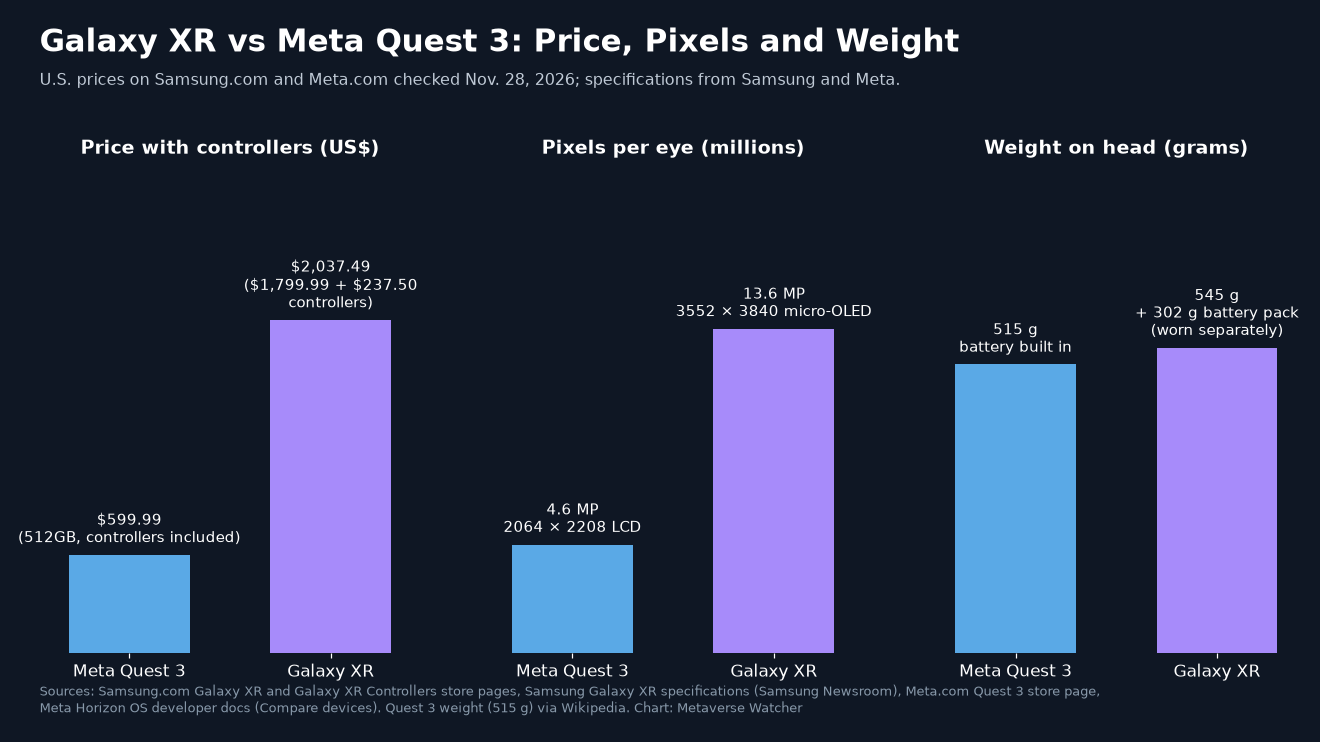
- Budget for the difference. Galaxy XR costs $1,799.99 without controllers. Adding Samsung’s controllers at today’s $237.50 store price brings it to $2,037.49, about $1,437 more than Quest 3.
If you are still deciding between Meta’s two current headsets, our Quest 3 vs Quest 3S comparison covers that choice.
Galaxy XR vs Meta Quest 3 at a Glance
| Spec | Samsung Galaxy XR | Meta Quest 3 |
|---|---|---|
| U.S. price (checked Nov. 28, 2026) | $1,799.99 (256GB, only model), in stock | $599.99 (512GB) |
| Controllers | Sold separately: $249.99 list, $237.50 on Samsung.com today | Touch Plus controllers included |
| Platform | Android XR (Google Play) | Meta Horizon OS (Meta Horizon Store) |
| Chip and memory | Snapdragon XR2+ Gen 2, 16GB RAM | Snapdragon XR2 Gen 2, 8GB RAM |
| Display | Micro-OLED, 3552 × 3840 per eye, 95% DCI-P3 | LCD with pancake lenses, 2064 × 2208 per eye (25 PPD) |
| Refresh rates | 60, 72 (default), 90Hz | Up to 120Hz |
| Field of view | 109° horizontal × 100° vertical | 110° horizontal × 96° vertical |
| Eye tracking | Yes, four eye-tracking cameras; iris recognition | No |
| Passthrough | Two high-resolution color cameras, depth sensor | Color stereoscopic, 4MP (18 PPD), depth sensor |
| IPD | 54–70mm | Continuous adjustment (53–75mm per UploadVR) |
| Battery | External 302 g pack; up to 2 hours general use, 2.5 hours video | Built in; about 2 hours |
| Weight | 545 g with forehead cushion, plus 302 g battery | 515 g |
| Wireless | Wi-Fi 7, Bluetooth 5.4 | Wi-Fi 6E, Bluetooth 5.2 |
| PC VR | Wireless only (Samsung Game Link or Virtual Desktop) | Meta Quest Link over cable or Air Link |
Sources: Samsung Galaxy XR specifications, Meta Horizon OS developer documentation (updated October 23, 2026), UploadVR Quest 3 specs and Wikipedia for Quest 3 weight, plus the Samsung and Meta U.S. store pages.
Price and What You Get
Quest 3 is sold in one 512GB configuration at $599.99 on Meta.com, with two Touch Plus controllers in the box. Meta has not announced a Black Friday price for Quest 3 this year; its holiday promotions have centered on Quest 3S and its AI glasses, as covered in our Meta Black Friday deals roundup.
Galaxy XR is listed at $1,799.99 for its single 256GB model on Samsung.com, which showed it in stock on November 28 with no Black Friday discount on the headset itself. The box includes the headset, a battery pack and a USB-C wall charger, but not controllers. Samsung’s Galaxy XR Controllers list at $249.99 and were $237.50 on Samsung.com on the same day. Hand and eye input cover the Android XR interface, so controllers are optional for apps and video, but many games need them.
| Cost | Galaxy XR | Meta Quest 3 |
|---|---|---|
| Headset | $1,799.99 | $599.99 |
| Controllers | $237.50 (Samsung.com, Nov. 28) | Included |
| Total for a gaming-ready setup | $2,037.49 | $599.99 |
| Storage | 256GB | 512GB |
Retail prices can change during the Cyber Monday period on November 30. The figures above are the prices displayed on the two makers’ own stores when we checked; we did not find a lower price on either store page.
Displays and Image Quality
This is Galaxy XR’s clearest advantage. Samsung specifies micro-OLED panels at 3552 × 3840 pixels per eye, which is about 13.6 million pixels per eye and 27 million in total, with a 6.3-micron pixel pitch and 95% DCI-P3 color coverage. Quest 3 uses LCD panels at 2064 × 2208 per eye, about 4.6 million pixels, which Meta rates at 25 pixels per degree. Samsung does not publish a pixels-per-degree figure, so a direct sharpness number is not available, but with a similar field of view (109° × 100° against 110° × 96°), Galaxy XR spreads roughly three times as many pixels over the same area.
Micro-OLED also produces true blacks, which helps films and dark game scenes. Quest 3’s LCD panels use a backlight, so blacks appear dark gray. Quest 3 does run at up to 120Hz, against Galaxy XR’s 90Hz maximum, which some players prefer for fast games. For a fuller explanation of these numbers, see our guide to VR headset specs.
Comfort and Battery
The two headsets take different approaches to weight. Quest 3 keeps the battery in the headset, which weighs 515 g. Galaxy XR moves the battery to a separate 302 g pack connected by a cable, which keeps the head-worn part at 545 g with the forehead cushion. Samsung says the frame distributes pressure across the forehead and the back of the head, and the light shield is detachable for a more open view.
Battery life is similar on paper. Meta lists about two hours for Quest 3. Samsung lists up to two hours of general use and up to 2.5 hours of video for Galaxy XR, and says the headset can be used while the battery charges. The external pack means you need somewhere to put it, such as a pocket, but it does not add weight to your head.
Glasses wearers should check fit before buying. Galaxy XR’s IPD range is 54–70mm and it uses separately sold prescription inserts; Quest 3 has a wider continuous IPD adjustment. Our prescription lens inserts guide compares the options.
Apps, Games and Software
Software is the deciding factor for most buyers. Quest 3 runs Meta Horizon OS and the Meta Horizon Store, Meta’s established store for standalone VR games, fitness and social apps, which has been building its catalog since the original Quest.
Galaxy XR runs Android XR, built by Google with Samsung and Qualcomm. Samsung says Android apps from Google Play work on the headset, alongside XR-optimized Google Maps, YouTube and Google Photos, and Gemini is integrated at the system level. That makes it stronger for media, browsing and productivity. Its store of dedicated XR games is newer, since the platform launched with Galaxy XR in October 2025, and some apps require a separate download or subscription. Our Android XR guide explains the platform in more detail.
| Use case | Better fit | Why |
|---|---|---|
| Standalone VR games | Meta Quest 3 | Meta Horizon Store VR catalog; controllers included |
| Fitness and social VR | Meta Quest 3 | Meta Horizon Store fitness and social apps; up to 120Hz |
| Films and video | Galaxy XR | Higher-resolution micro-OLED with true blacks |
| Browsing and multitasking | Galaxy XR | Higher-resolution displays; Android apps from Google Play |
| Google apps and AI assistant | Galaxy XR | Gemini built in; Maps, YouTube and Photos XR apps |
| PC VR | Meta Quest 3 | Wired Quest Link option; no wired mode on Galaxy XR |
PC VR Streaming
Quest 3 connects to a Windows PC through Meta Quest Link, either with a USB-C cable or wirelessly with Air Link. Galaxy XR is wireless only. According to Spacebar News‘ Galaxy XR PC VR guide, last updated November 20, 2026, Samsung’s built-in option is the Game Link app, there is no wired VR mode, and the Play Store version of Steam Link did not support VR as of November. The same guide recommends Virtual Desktop, a paid Play Store app, as the most capable option. Quest owners can also use our guide to Mixed Reality Link and USB streaming for Windows features.
If PC VR is your main goal, a headset built around it may suit you better than either of these; see our Steam Frame vs Galaxy XR comparison.
Mixed Reality and Tracking
Both headsets offer full-color passthrough and a depth sensor for room mapping. Meta rates Quest 3’s passthrough at 4MP and 18 pixels per degree; Samsung describes two high-resolution passthrough cameras but does not publish a comparable figure. Galaxy XR adds four eye-tracking cameras, which it uses for input (look and pinch), and iris recognition for unlocking the device and entering passwords in some apps. Quest 3 has no eye tracking and relies on hand and controller input.
Who Should Buy Which
Choose Meta Quest 3 if
- Games, fitness or social VR are your main reasons for buying a headset.
- You want controllers included and the lowest total cost.
- You want a wired PC VR option.
- Your budget is under $1,000.
Choose Galaxy XR if
- You will use the headset mostly for video, browsing or work.
- Display sharpness and contrast matter more to you than the game library.
- You already rely on Google apps and want Gemini in the headset.
- You are comfortable paying about $2,000 for a setup with controllers.
If you buy Galaxy XR, our Galaxy XR setup guide walks through the first steps. Buyers considering Apple’s headset can read our Galaxy XR vs Apple Vision Pro comparison, and our best VR headsets of 2026 list covers the wider market.
FAQ
Is Galaxy XR better than Quest 3?
It has higher-resolution micro-OLED displays, eye tracking, more memory and Google’s app ecosystem. Quest 3 has a larger game library, higher maximum refresh rate, included controllers and wired PC VR, at about a third of the price. Which is better depends on whether you prioritize media and productivity or games.
Does Galaxy XR come with controllers?
No. Samsung sells Galaxy XR Controllers separately, listed at $249.99 and priced at $237.50 on Samsung.com on November 28, 2026. Quest 3 includes Touch Plus controllers.
Can Galaxy XR play Quest games?
Not directly. Quest games are sold through the Meta Horizon Store, which runs only on Meta’s headsets. Some developers publish the same title on both stores, so check Google Play for each game you want.
Which has better battery life?
They are similar. Meta lists about two hours for Quest 3. Samsung lists up to two hours of general use and 2.5 hours of video for Galaxy XR, using an external battery pack.
Prices checked on Samsung.com and Meta.com on November 28, 2026. Specifications from Samsung’s Galaxy XR announcement and Meta’s developer documentation. This article contains no affiliate links.