Xiaomi’s second-generation AI glasses could go on sale within three weeks. According to an exclusive report published on Friday, November 27, by STAR Market Daily, the technology title of Shanghai-based Cailian Press, Xiaomi AI Glasses 2 may be announced in mid-December alongside the standard Xiaomi 18 smartphone and go on sale the same day. The reported lineup includes, for the first time, a model with a built-in display.
Xiaomi has not confirmed the date, the lineup or any prices. Everything below about the second generation comes from reporting and leaks, and we label it that way. The first-generation figures are Xiaomi’s own launch specifications.
What the Report Says
The STAR Market Daily item, posted at 10:16 a.m. Beijing time on November 27 (9:16 p.m. ET on November 26), is short. Its reporter writes that Xiaomi AI Glasses 2 “may” launch in mid-December together with the standard Xiaomi 18, with sales starting on launch day. It gives the phone’s starting price as 5,699 yuan, about $800, and lists three glasses models:
- Q95 Pro, the top model.
- Q95 Pro multicolor version, with electrochromic lenses that offer four tint levels.
- Q95 display version, a model with a display. No display type, resolution or field of view was given.
The report was picked up the same morning by MyDrivers and Sina Tech, and in English by TechNode, which notes that Xiaomi has not announced specifications or pricing. Hong Kong’s etnet, carried by Longbridge, also states that Xiaomi has not confirmed the report.
“Q95” appears to be the internal code name for the second generation, not a retail name. A November 19 report by XR Vision, republished by OFweek, says it obtained an internal Xiaomi document that uses the Q95 code name and describes the same three versions. The final product names may differ.
Xiaomi AI Glasses 2: Reported Specifications
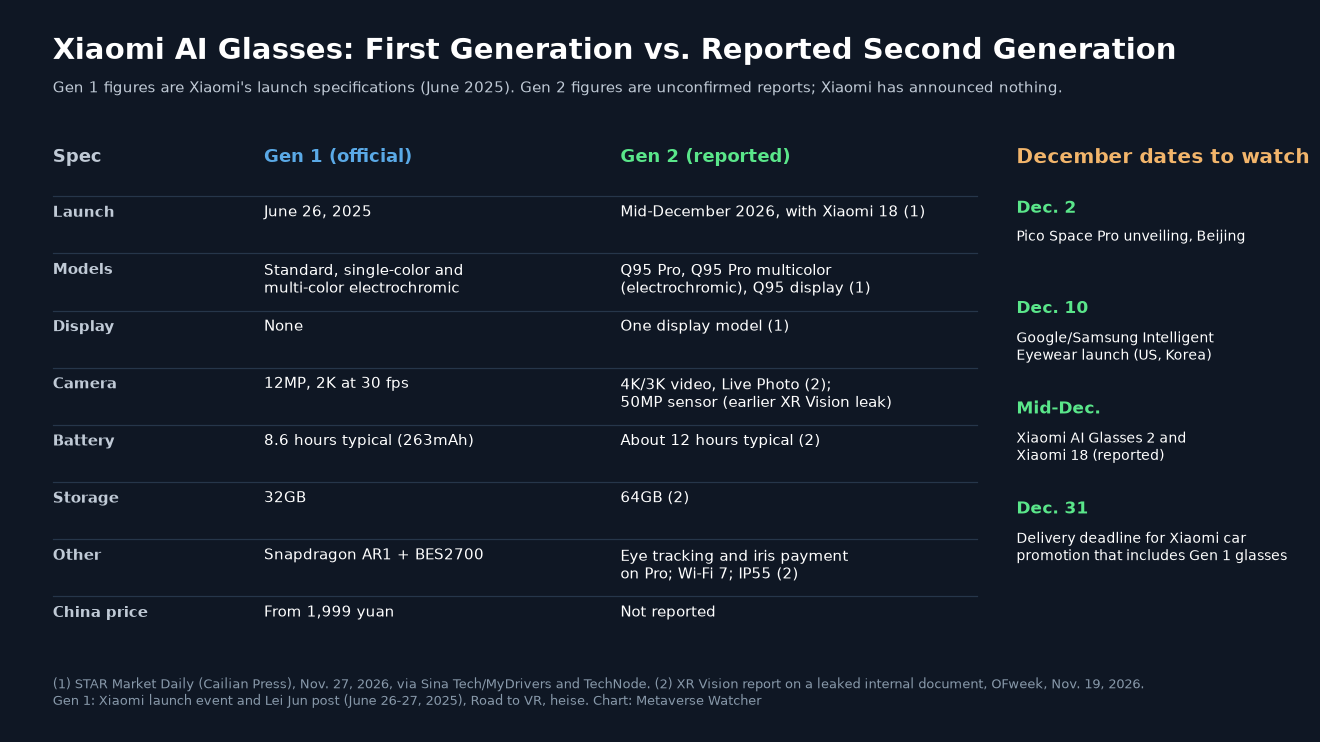
Most of the detail comes from the XR Vision document report, not from STAR Market Daily. We cannot verify the document, so treat these as leaks until Xiaomi publishes a spec sheet. The table compares them with the first generation, which Xiaomi launched on June 26, 2025.
| Item | Xiaomi AI Glasses (Gen 1, official) | Xiaomi AI Glasses 2 (reported) |
|---|---|---|
| Launch | June 26, 2025, China only | Mid-December 2026, with Xiaomi 18 (STAR Market Daily) |
| Models | Standard, single-color electrochromic, multicolor electrochromic | Q95 Pro, Q95 Pro multicolor (electrochromic), Q95 display version |
| Display | None | One display model; no specs reported |
| Camera and video | 12MP, f/2.2, 105-degree lens; 2K at 30 fps | Up to 4K/3K video, 120 fps slow motion, Live Photo (XR Vision); 50MP sensor per an earlier XR Vision leak |
| Battery life | 8.6 hours typical use (263mAh) | About 12 hours typical use; full charge in 45 minutes (XR Vision) |
| Storage | 4GB RAM, 32GB | 64GB (XR Vision) |
| Connectivity and durability | Not detailed in launch materials; USB-C charging | Bluetooth 5.4, Wi-Fi 7, IP55 (XR Vision) |
| New input and AI | Voice (Super XiaoAi), touch; Alipay QR payment | Eye tracking and iris payment on Pro; nod/shake head gestures; “Xiaomi Live AI” camera-based assistant (XR Vision) |
| China price | 1,999 / 2,699 / 2,999 yuan | Not reported |
Two items stand out. First, XR Vision says eye tracking and iris-based payment are limited to the Pro model and are the “core highlight” of the update. It compares the module to the one in Alibaba’s Qwen N1 Pro, which went on sale in October with the same pair of features; we covered how Alibaba prices and implements iris payment. Second, the leaked document describes Xiaomi Live AI, in which the camera keeps capturing images during a voice conversation so the assistant can answer questions about what the wearer sees. XR Vision says looking at a landmark or exhibit for six to eight seconds can trigger an audio guide.
Continuous camera capture will raise the same privacy questions that camera glasses face in Europe and North America. XR Vision says Xiaomi’s online FAQ for the Pro confirms that the assistant can still be woken while recording video or audio. For background on recording indicators, see our guide on how to tell if smart glasses are recording.
What the First Generation Offered
Xiaomi founder Lei Jun introduced the original Xiaomi AI Glasses at the company’s “Human x Car x Home” event in June 2025, alongside the YU7 SUV. The glasses weigh 40 grams, have no display and pair a Qualcomm Snapdragon AR1 with a low-power BES2700 chip. Road to VR’s launch report listed a 12MP camera, 2K video at 30 fps, five microphones and an 8.6-hour mixed-use rating from a 263mAh battery. heise noted that the frame was designed for Asian face shapes and that no Western launch was planned.
Prices started at 1,999 yuan, about $280 at the time, rising to 2,699 yuan for single-color electrochromic lenses and 2,999 yuan for the multicolor version. That undercut Meta’s glasses by a wide margin, a gap we examined in our September report on China’s smart glasses sales surge.
The first generation is still being used as a sales tool. Sina Tech reports that buyers who lock in an order for an in-stock Xiaomi car between November 24 and November 30 and take delivery by December 31 receive a pair of Xiaomi AI Glasses valued at 1,999 yuan.
Why a Display Model Matters in China
The display version is the most significant part of the report, because China’s market is moving toward glasses with screens. CINNO XResearch data for the third quarter of 2026, which we analyzed in China smart glasses sales: AR up 116%, AI glasses down 40%, shows:
- Consumer AI and AR glasses sales in mainland China reached 240,000 units, up 10% year over year.
- Display devices accounted for 187,000 units, or 78% of sales, up 45%. Standalone AR glasses with displays rose 116%.
- Display-less AI glasses, the category that includes Xiaomi’s first generation, fell 40% to 53,000 units.
- Xiaomi did not appear among the top five brands. RayNeo led with 34%, followed by Rokid, XREAL, VITURE and Huawei. Xiaomi was grouped with “other” brands at 23% combined.
Seen in that light, a camera-only refresh would put Xiaomi in the shrinking part of its home market. A display model would let it compete with RayNeo’s iO line and Rokid’s waveguide glasses, while the Pro model’s eye tracking and iris payment would match Alibaba’s Qwen N1 Pro. Same-day sales with a flagship phone also give Xiaomi a retail channel that most glasses startups lack.
December is already crowded. ByteDance’s Pico unveils the Space Pro headset in Beijing on December 2, and Google and Samsung’s Android XR Intelligent Eyewear is scheduled to launch on December 10 in the US and South Korea, as covered in our report on the Gentle Monster sell-out. Our upcoming smart glasses release tracker lists the other launches due before mid-2027.
A Launch That Has Already Slipped Once
The timing should be read with some caution. OFweek’s archive shows an August 4, 2026 XR Vision report saying the second-generation glasses had been delayed to the fourth quarter or the following year. The November report says the signs now point to an imminent launch, and STAR Market Daily’s mid-December date fits inside the fourth-quarter window. Neither outlet cites a Xiaomi statement, and the phrasing in both reports is conditional.
What We Do Not Know Yet
- Prices. No report gives a price for any of the three models. China’s national subsidy for smart glasses, 15% of the price capped at 500 yuan, would apply only to eligible models and channels.
- Display hardware. Nothing is known about the display model’s screen type, whether it is monocular or binocular, its field of view or its weight.
- Exact date. “Mid-December” is the only timing given.
- Markets. The first generation was sold only in China. There is no report of a global launch for the second generation.
- Privacy controls. The reports do not describe how Live AI’s continuous camera capture is signaled to people nearby, or where iris data is stored.
We will update our coverage when Xiaomi confirms the event. If you are comparing what is available now, our best smart glasses of 2026 list covers the models on sale in the US and Europe, and our explainer on what smart glasses are explains the difference between camera-only AI glasses and display glasses.
Sources: STAR Market Daily/Cailian Press (Nov. 27, 2026); Sina Tech/MyDrivers (Nov. 27, 2026); TechNode (Nov. 27, 2026); XR Vision via OFweek (Nov. 19, 2026); Lei Jun’s launch post via Tencent News (June 27, 2025); Road to VR and heise (June 26, 2025); CINNO XResearch Q3 2026 data. Dollar conversions are approximate. All sources accessed November 28, 2026.