
By Metaverse Watcher staff. Published October 22, 2026.
Meta’s voice assistant is finally leaving North America on Quest. In its official Horizon OS v2.9 release notes, Meta says Meta AI is now available on Quest headsets in six more countries: Australia, Japan, Mexico, the United Kingdom, South Korea and Singapore. The assistant also picks up seven languages, so it is no longer English-only. The update is rolling out gradually to Quest 3, Quest 3S, Quest Pro and Quest 2 starting the week of October 19, 2026.
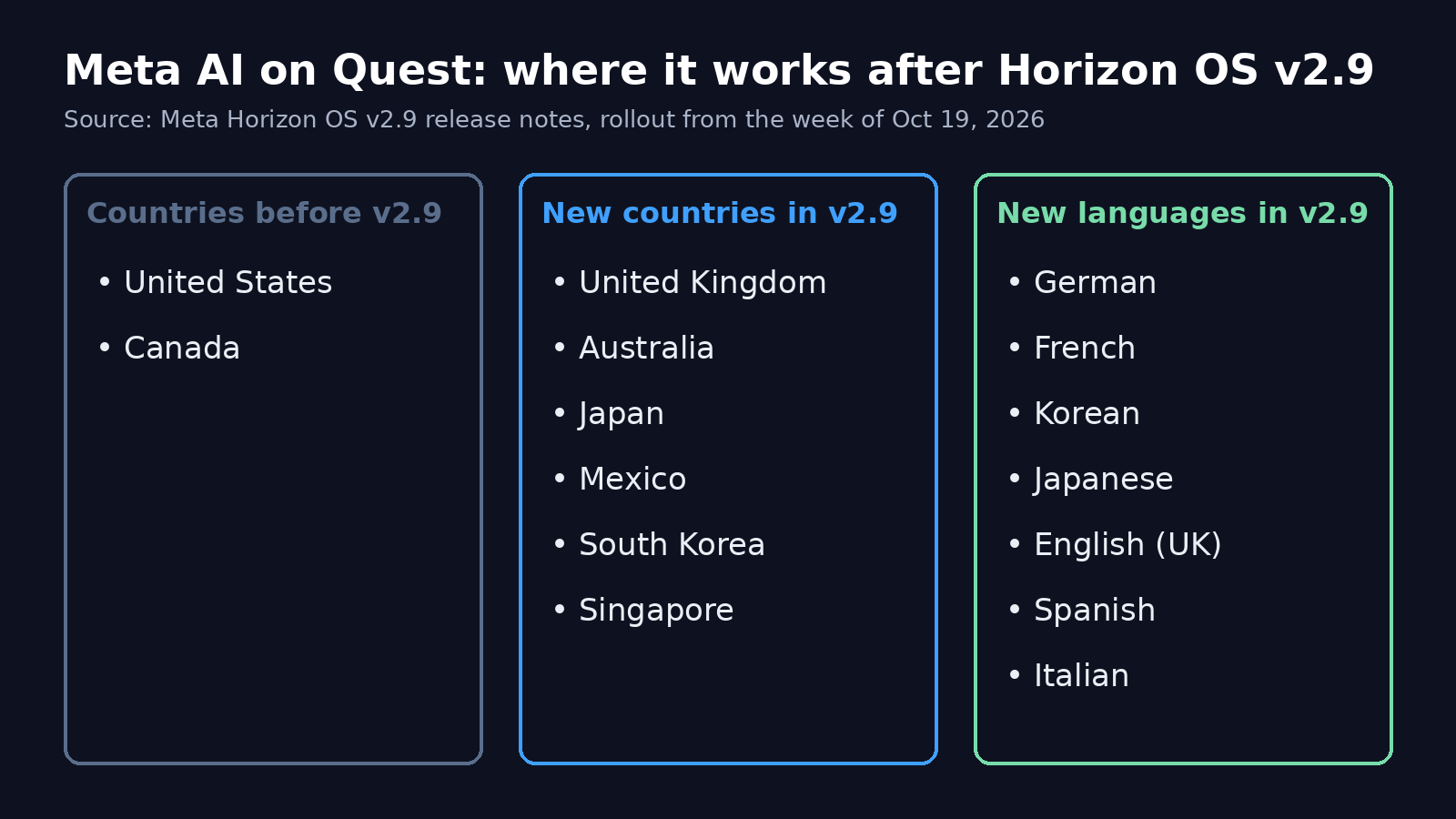
What changes for Meta AI on Quest
Meta first brought its assistant to Quest in the US and Canada in 2024 as an experimental, English-only feature. Owners in the UK and Australia have now waited more than two years, as MIXED notes. With v2.9, Meta lists the new supported languages as German, French, Korean, Japanese, English (UK), Spanish and Italian.
The feature is opt-in. According to Meta, owners enable Meta AI from System settings on the headset. Because v2.9 is pushed in batches, the toggle will not appear until the update actually reaches a given headset, so some owners in the new countries will wait days longer than others.
The language list is wider than the country list
The most important caveat is easy to miss. German, French, Spanish and Italian are now supported languages, but Germany, France, Spain and Italy are not among the six new countries. A Quest owner in Berlin or Paris gets no new access from this update, and Meta has not said when more European markets will follow. Meta’s notes also do not explain the gap. Regulatory caution in the EU is a plausible factor given how Meta has staged other AI launches there, but Meta has not confirmed that for Quest.
The expansion also skipped the beta. Per Bolverk Games, citing MIXED, the Meta AI country expansion and the new input-switch notifications were not part of the v2.9 Public Test Channel build. That means the stable release is the first broad test of the feature outside North America.
Everything else in Horizon OS v2.9
Meta AI is the headline for international owners, but v2.9 is a broad update. Most of these features went through the Public Test Channel starting the week of September 28, and Metaverse Watcher tracked several of them in testing, including the three-window manager and the QR code scanner. Per Meta’s release notes, the public build includes:
- Window manager: windows now launch spatially, and you can place three side by side or stack them, then cycle through a stack by clicking the top of each window. It is reached from Quick settings and shows every open window.
- Wall snapping: windows attach to surfaces more reliably, snapping to a wall when moved close. The standalone anchoring option has been removed from the control bar, which now has a dedicated grab handle per window.
- Surface Keyboard and Touchpad: now works in fully virtual environments as well as passthrough, on Quest 3 and 3S, enabled under Settings > Experimental.
- QR code scanner: built in on Quest 3 and 3S, launched from Quick controls, the Camera app, Navigator search, or by saying “Hey Meta, open QR code scanner.”
- Controller troubleshooting: a new option under Settings > Devices > Controllers.
- Classic VR Home environments: some older environments return, rebuilt for the current Home.
- Boundary recovery: if setup or space scanning is interrupted, the headset reverts to the previous boundary or a Stationary boundary.
- Offline settings search: type Wi-Fi, Bluetooth, Travel mode, Passthrough and similar terms to jump straight to those settings, even offline.
- Input-switch notifications: a prompt when an immersive app needs you to move between controllers and hand tracking.

Why it matters
Voice is becoming a core input on Meta’s platform rather than an add-on. The same assistant runs on Ray-Ban Meta glasses, and Meta’s coming Meta VR Glasses, priced at $1,299.99 for spring 2027, have a reported list of 25 launch countries, including the UK, Japan, Germany and France, according to Road to VR. If Meta AI is part of that pitch, the current Quest map, with major European markets still excluded, shows how much ground remains. Horizon OS should not be confused with Horizon Worlds, Meta’s social games platform, which our Horizon Worlds guide explains.
Competition is also sharpening. Google is building Gemini into Android XR headsets and glasses, a platform we explain in our Android XR guide. For a buyer in London or Tokyo, an assistant that finally works in their country and language narrows one practical gap between Quest and rivals. Shoppers comparing headsets can see where Quest stands in our best VR headsets of 2026 guide.
How to get it
Check for v2.9 under the headset’s software update settings. Once it is installed and you are in one of the eight supported countries, enable Meta AI from System settings, per Meta’s notes. If the toggle is missing, the update has not reached your headset yet, or you are outside the supported regions.
Sources: Meta Quest release notes; MIXED; Bolverk Games; Meta Community Forums v2.9 PTC thread.