
Meta AI Research (Sep 23) introduced Muse Realtime Avatar, an audio-driven model that turns Muse Realtime Voice into LIVE, expressive characters. TechCrunch and Runtime Wire both covered the Connect-week drop: the faceless agent gets a FACE, BODY, and synchronized VOICE for real-time video chat.
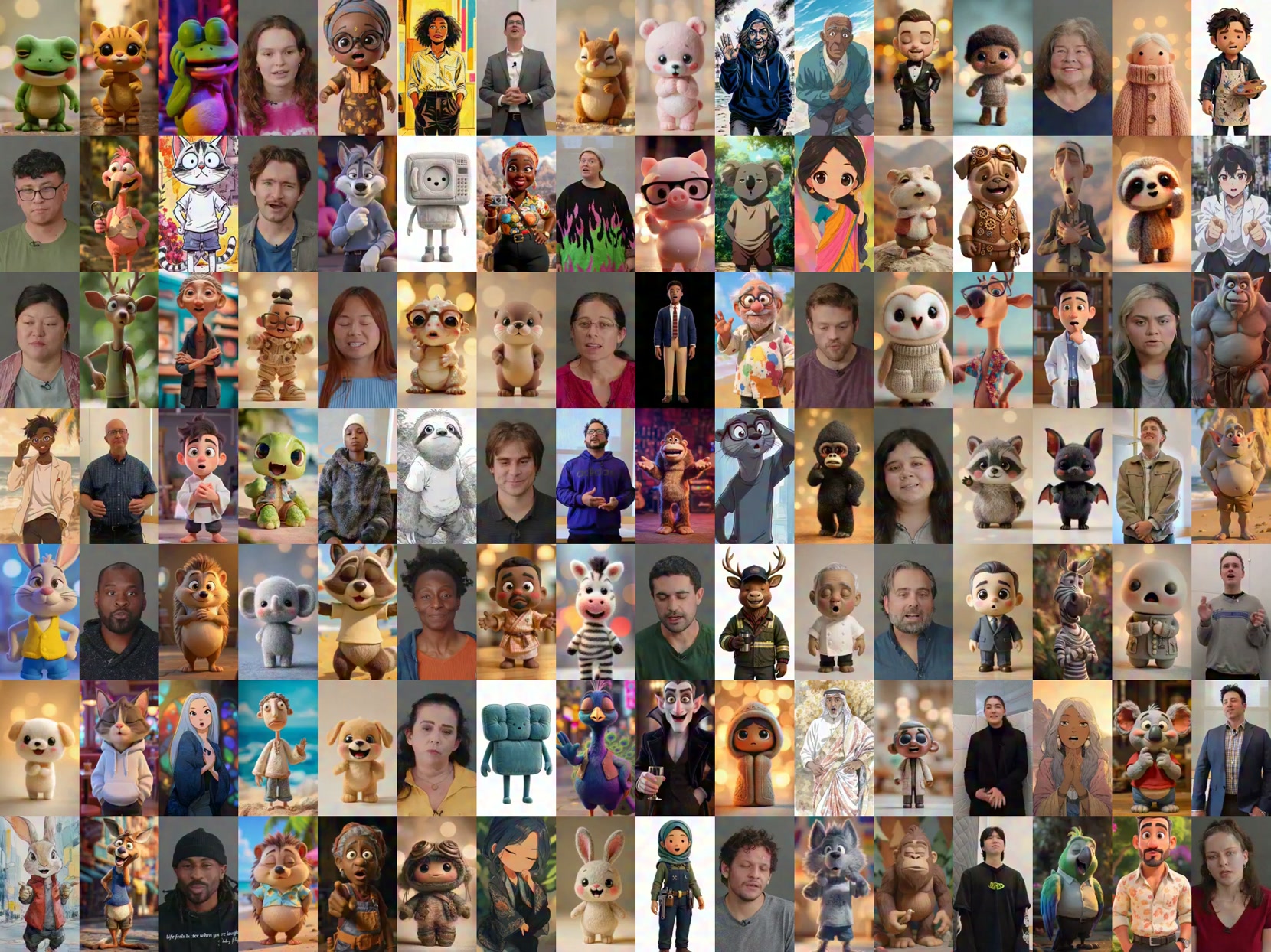
This is NOT the same stack as Meta’s HOLOGRAM for Ray-Ban Display and Meta VR Glasses. Hologram aims at photorealistic CALLING presence. Muse Realtime Avatar aims at CONVERSATIONAL embodiment for Meta’s personal agent — any REFERENCE image, kept COHERENT turn after turn.
Shared Speech Tokens Keep Voice and Face Locked
Meta’s research post describes a SINGLE streaming path. Muse Realtime Voice emits speech tokens that carry BOTH what is said and HOW it is delivered. An audio decoder turns those tokens into sound. Muse Realtime Avatar consumes the SAME stream, so lip motion, expression, and delivery stay ALIGNED without a separate lip-sync pass.

The video model is an audio-driven DIFFUSION Transformer conditioned on the speech-token stream, the reference media, and a rolling window of recent video latents. It generates short CAUSAL chunks. Each finished chunk feeds the NEXT, which is how appearance and mannerisms SURVIVE long conversations without unbounded memory growth.
120 Evaluations Distilled to Two
Live streaming has to be FAST and STABLE. Meta starts with a high-quality bidirectional teacher, then trains a causal student with a fixed-length cache through self-forcing and distribution matching distillation. The teacher needs 40 diffusion steps with three-way classifier-free guidance — 120 model evaluations per chunk. The student reproduces that quality in TWO unguided evaluations, a DRAMATIC CUT Meta reports while preserving near-parity preference in its own tests.
Serving numbers are CONCRETE. Meta cites 448×768 portrait video at 25 FRAMES per second, with roughly 870 MILLISECONDS from the end of a user’s turn to the first byte of the synchronized voice-and-video RESPONSE. On a single NVIDIA accelerator, Meta says the stack holds 12 CONCURRENT video sessions — an EIGHTFOLD gain versus its two-step baseline after quantization, fused kernels, graph capture, and cache-aware ROUTING.

Company Preference Test, Watermarked Output
Meta compared Muse Realtime Avatar against Runway Characters and HeyGen LiveAvatar in each product’s NATIVE live-call experience, with matched identities and two- to three-MINUTE conversations. Raters preferred Muse OVERALL and across visual quality, synchronization, character consistency, and mannerisms — though mannerisms versus Runway were statistically indistinguishable from PARITY. Those are Meta’s OWN evaluations, not an independent lab BENCHMARK.
Provenance is BAKED in. Generated video uses Meta’s VIDEO SEAL for a durable, invisible watermark Meta says adds NO measurable latency. The research post also stresses SAFETY limits, marks Muse as adults-only, and notes that demo characters do NOT all ship in the Muse app TODAY.
Why It Matters for Glasses and Spatial Agents
TechCrunch’s Connect recap places the avatar beside Muse on META smart glasses, Mac computer use, and shopping connectors. For Metaverse Watcher readers, the DISTINCT beat is EMBODIMENT: an agent that can APPEAR while you talk, not only speak through open-ear audio. Subsecond first-byte latency is the PRODUCT test. Whether that PRESENCE stays useful on Ray-Ban Meta, Display, and future glasses depends on ROLLOUT — Meta has not published a hard glasses ship date for the avatar itself.
Sources: Meta AI Research — Bringing Your Muse to Life; TechCrunch — Everything new coming to Meta’s AI agent Muse; Runtime Wire — Meta gives Muse a live avatar.