SlimeVR’s long-promised SERVER REWRITE is FINALLY in users’ hands, and it is a BIGGER change than the version number suggests. SlimeVR Server v22.0.0-rc.1, tagged on GitHub on October 9, 2026 at 11:55 p.m. ET and announced in a Steam devblog the same evening, is the “FIRST public beta” of a backend REBUILT from SCRATCH. It adds STEP MOUNTING, TOE TRACKING and a SINGLE page for ROUTING bone data to SteamVR, VRChat and VMC. The catch: the team says EVERY feature from the old server is now in the rewrite EXCEPT AUTOBONE, its automatic body-proportion tool, and the pull request that carries the work is STILL OPEN a WEEK later.
What the beta actually changes
SlimeVR builds LOW-COST IMU trackers for full-body tracking in VR, and its server is the desktop software that turns those trackers into a SKELETON for SteamVR and other apps. The rewrite’s HEADLINE features are aimed at everyday FRICTION:
- Step Mounting. Users calibrate tracker mounting by taking a STEP forward instead of holding the familiar SKI POSE. The release notes say it “doesn’t work on all trackers/firmware yet” and call it a work in progress.
- Toe tracking. Toe trackers now OUTPUT over VRChat OSC, VMC and BVH, but VRChat use NEEDS a CUSTOM avatar.
- Bone Routing. One page controls WHAT bone data goes WHERE, across SteamVR, VRChat and VMC.
- Spine and mocap. An EXTRA spine bone and a “more realistic spine model,” plus a Mocap Mode with LESS jitter that “allows some jumping thanks to dead reckoning.”
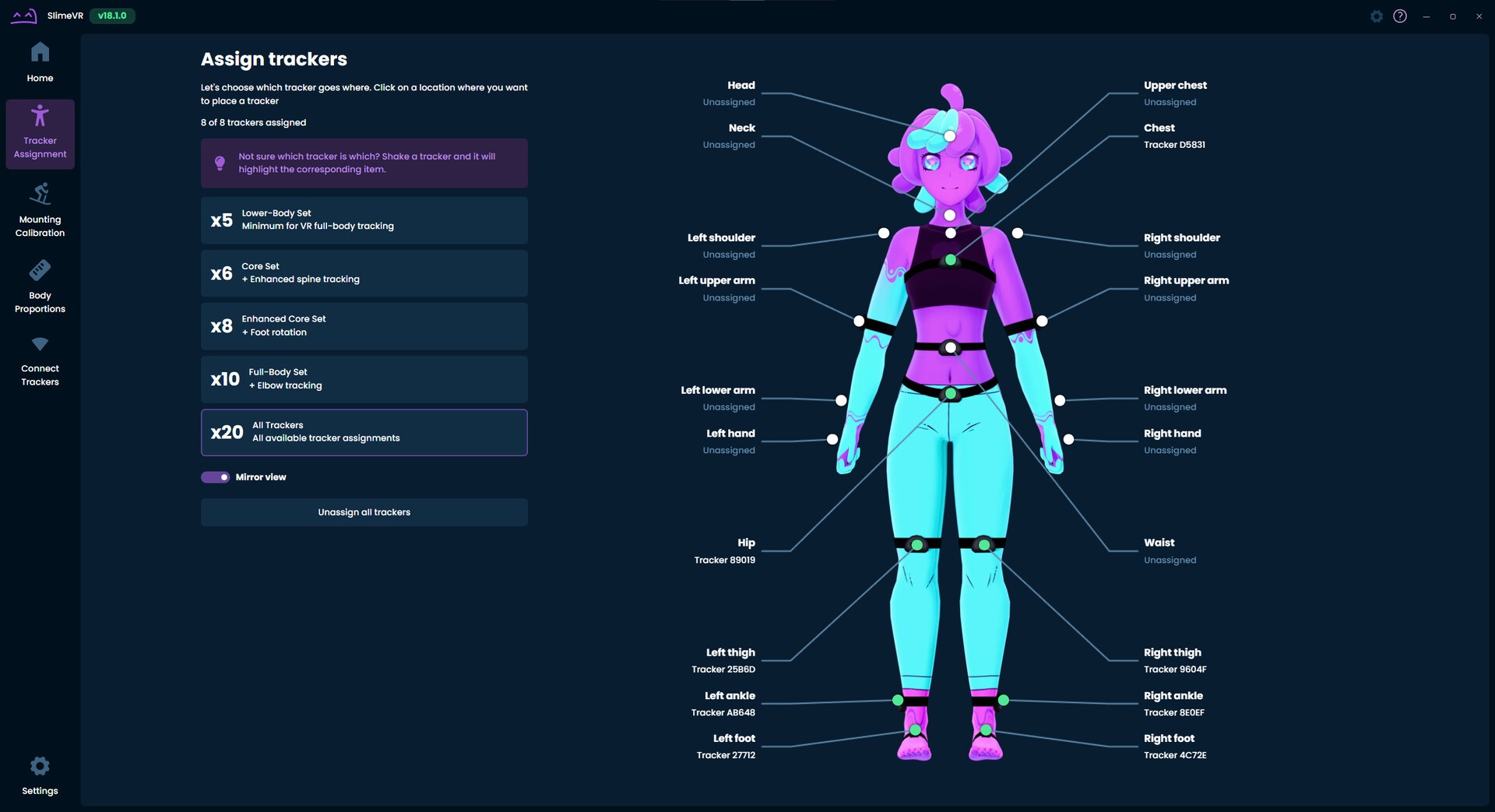
- Setup tools. Faster Wi-Fi provisioning for SEVERAL trackers at once, a redesigned assignment page with finger and toe tabs, customizable keybindings that now work on LINUX, and CONTROLLER navigation of the interface (Xbox only tested).
There are REMOVALS too. Head Shift is GONE, replaced by per-tracker Bone Offsets. The built-in OSC Router is gone (“use VOR if you really need one”), and the T-Pose (Down) option was CUT because it “was never working properly.” For Linux users on Monado or WiVRn, the server can now RESTART without restarting everything else.
Why a rewrite, and how big it is
The team has been CANDID about the OLD code. In its September 16 devblog, developer Erimel described an architecture of “everything being public and anything reading and calling anything else,” which made it hard to change one part WITHOUT breaking another. The new backend is written in KOTLIN and organized into modules that each hold their own state. The skeleton, the CORE of SlimeVR, went from four large files of roughly 400 to 1,800 lines each to 16 PROCESSORS of 40 to 200 lines, and the team says it now has “HUNDREDS of unit tests compared to a couple dozens.”
The SCALE shows on GitHub. Pull request #1798, opened on March 27, 2026, stood on October 17 at 112,341 lines ADDED and 102,876 REMOVED across 1,391 files and 988 commits. It has not been MERGED into the main branch. DEVELOPMENT is clearly ACTIVE: the rewrite branch picked up 61 commits between October 10 and the evening of October 17, including fixes such as “Reduce CPU usage on UDP” and “Slower skeleton rate at idle.”
What the beta still lacks
THREE caveats deserve WEIGHT. FIRST, AUTOBONE is MISSING, so users who rely on AUTOMATIC proportion tuning stay on the STABLE v21 line for now. SECOND, two of the new tools lean on hardware work that is NOT finished: support for the company’s BUTTERFLY trackers is “still a WIP until new protocol,” and the new tracker telemetry graph is “innacurate until new protocol” (the misspelling is SlimeVR’s). THIRD, the performance pitch is HEDGED in the team’s own words, which promise “very probably” LOWER memory, CPU use and latency, “not tested against previous versions.”
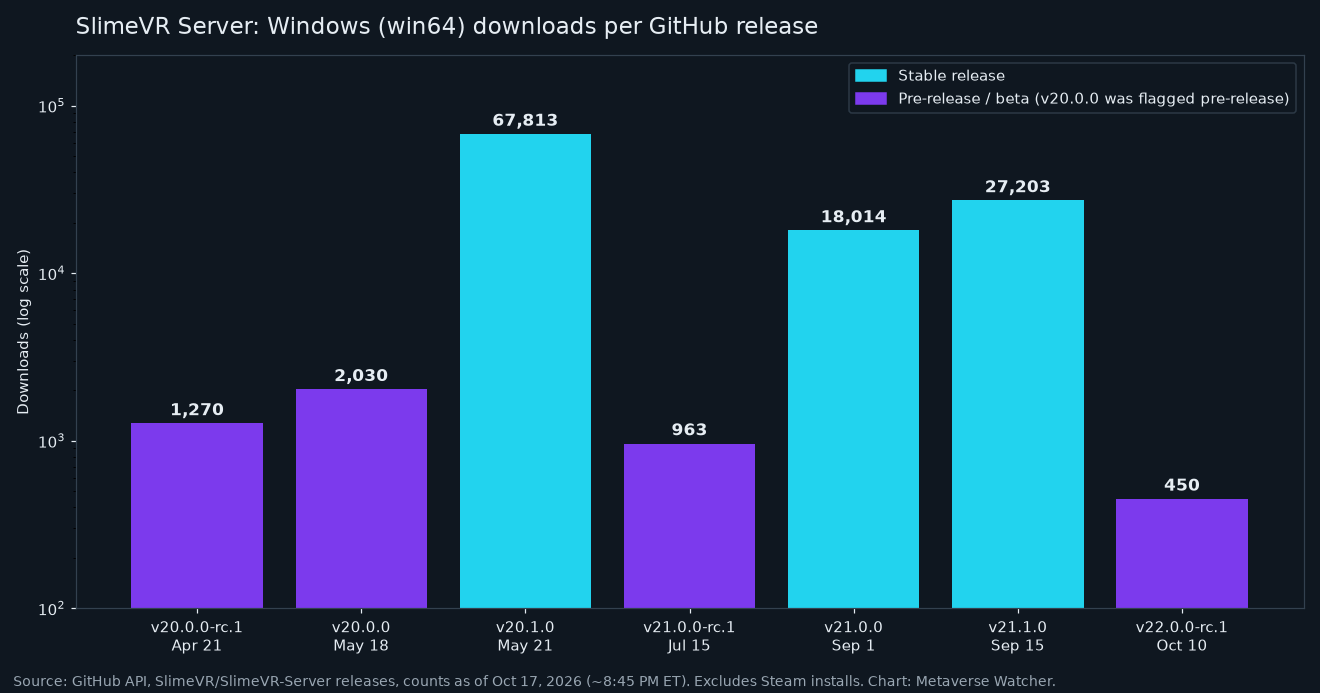
The REACH is also MODEST so far, at least where it can be measured. As of October 17, the beta’s Windows build had 450 DOWNLOADS on GitHub, against 27,203 for the stable v21.1.0 released September 15. That is NOT a verdict: SlimeVR’s devblog points users to the release-candidate branch on Steam for the beta, and Steam does NOT publish those numbers.
A growing hardware ecosystem is WAITING
The server matters BEYOND SlimeVR’s own trackers, because third-party makers BUILD on its stack. EKE Universe, for example, opened orders this month for a SlimeVR-compatible six-tracker set it describes as 8.5 mm thin and 10.9 g per tracker:
EKE Tracker BV、BOOTHでも予約受付を開始しました!🎉
— 에케 유니버스 (@eke_universe) October 8, 2026
薄さ8.5mm・1個10.9gのSlimeVR対応フルトラ6点セット💙
発売記念価格36,800円は10/15(木)昼12時まで!
日本向け送料・関税・輸入消費税は当社負担。
10/20(火)より順次発送予定📦
#EKETracker #SlimeVR #VRChat
SlimeVR’s own ROADMAP is also SPREADING across platforms. Its September 23 devblog said both Wi-Fi and Butterfly trackers work STANDALONE on Valve’s Steam Frame, and showed a PROTOTYPE glove board with 16 IMUs built on Nordic’s nRF54L15 chip. Earlier, in September, the project announced contributing guidelines that BAN AI-generated code across its repositories.
The Metaverse Watcher read
This is the RIGHT kind of rewrite: a MESSY, contributor-built codebase replaced with something TESTABLE BEFORE a new tracker generation ships, with the public beta arriving once almost every old feature was ported. But it is a BETA in the PLAIN sense. Autobone is ABSENT, step mounting does NOT work with every tracker, two features wait on a PROTOCOL that has not SHIPPED, and the speed claims are UNTESTED by the team’s own admission. Full-body tracking users who DEPEND on a STABLE setup for VRChat or streaming should STAY on v21.1.0. TINKERERS on Steam can FLIP to the release-candidate branch and help SlimeVR find the BUGS. The milestone to WATCH is the merge of pull request #1798, and whether AUTOBONE is BACK when it lands.
Sources: SlimeVR Server v22.0.0-rc.1 release notes; SlimeVR Server releases on GitHub; GitHub pull request #1798, “Server rewrite”; SlimeVR devblogs #1 to #4 on Steam; SteamDB, Devblog #4 patch notes; SlimeVR on Steam; @eke_universe on X.