An open-source Quest 3 room scanner has QUIETLY picked up its FIRST headline CUSTOMER. On October 16, 2026, Genesis Interactive said on X that the ROOM-SCAN update for CoasterMania, the mixed reality roller-coaster builder from 4th Wall Breakers, “runs on” QuestRoomScan, its MIT-licensed UNITY package for REAL-TIME 3D room reconstruction. The same day, the project MERGED a FIX for a bug that, in one downstream scan, caused ALL 964 camera records to be REJECTED by a PC refiner. That fix is on the MAIN branch, but it is NOT yet in a tagged release.
What QuestRoomScan actually does
The package, maintained by developer Arghya Sur under the Genesis name, takes the Quest 3’s DEPTH sensor and passthrough camera feed and turns a ROOM into a TEXTURED, PERSISTENT mesh while you look around. According to its README, the live scan runs ENTIRELY on the GPU: depth frames are fused into a 256-cubed TSDF volume, and a Surface Nets pass extracts the mesh with compute shaders. COLOR comes from the passthrough CAMERA, and saved scans are PINNED to the room with Meta spatial anchors so a game can RELOAD them in later sessions.
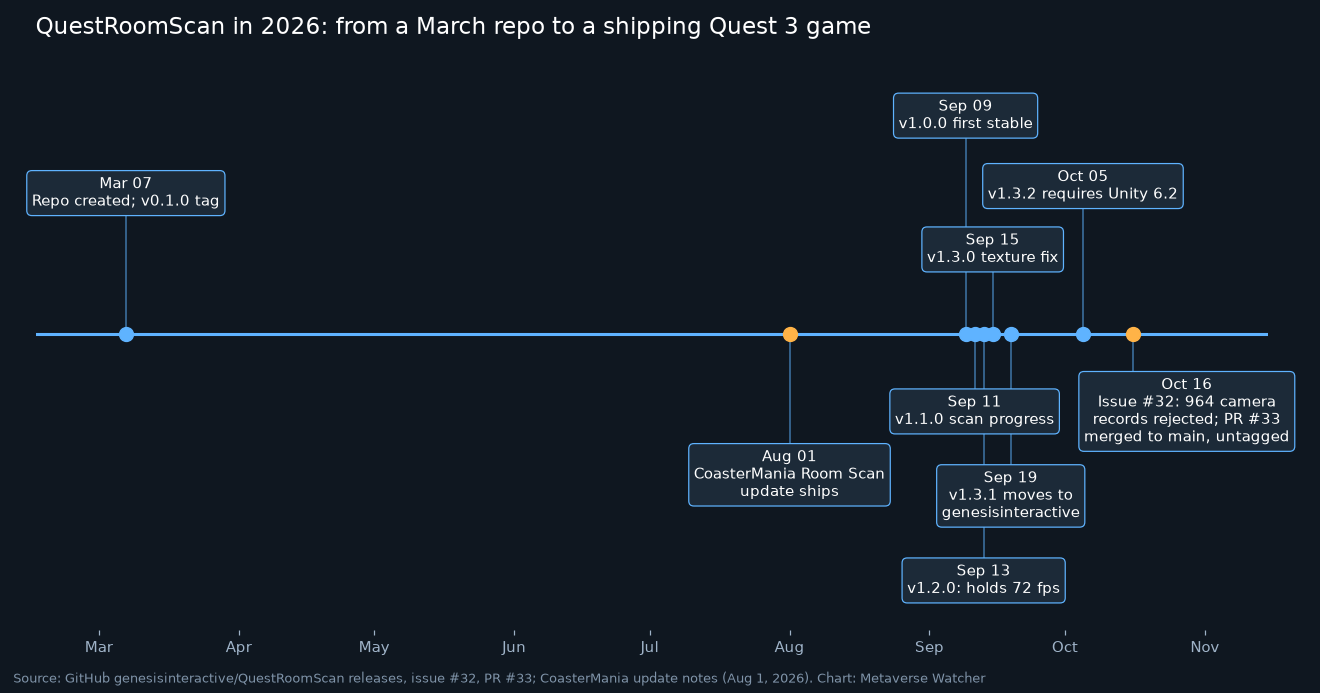
Version 1.0.0, tagged on September 9, was the first STABLE release and FROZE the RoomScanSession API for GAME developers. FIVE more tags followed by October 5. The most CONSEQUENTIAL was v1.2.0, which says texture REFINEMENT now HOLDS 72 fps on Quest 3 after previously dropping “into the 30s.” The latest, v1.3.2, RAISES the minimum to Unity 6.2 because the VR debug menu would not COMPILE on Unity 6.0.
CoasterMania is a real deployment, with a caveat on splats
CoasterMania’s Room Scan update, dated August 1, 2026 on its store listing, added “Environmental Scanning” so PLAYERS can SHRINK down and ride their coasters in first person through a TEXTURED copy of their own living room. That FIXED a LONG-STANDING gap: when the game first used Quest 3’s built-in room mesh in 2023, UploadVR noted that the headset captured only GEOMETRY, so first-person mode painted a GENERIC terrain texture over the room.
Genesis’ October 16 post is a QUOTE of the game’s developer, Stephen Rogers, from the WEEK the update SHIPPED:
Proud moment: CoasterMania's room-scan update runs on QuestRoomScan, our open-source room reconstruction for Quest 3. Thanks @TheCaptainSpain for building with it 🎢 github.com/genesisinteractive/QuestRoomScan #MetaQuest #MixedReality
— Genesis Interactive (@genesisin2026) October 16, 2026
Rogers’ ORIGINAL reply is the more REVEALING line. Asked whether the scan was a Gaussian splat, he wrote that it was “not a splat,” because “rendering the splat was super HEAVY on quest,” so CoasterMania uses “a standard mesh and color texture captured from the Depth API & Camera data.” He ADDED that he WORKED with the repo’s creator to implement it:
Thanks Juan! Not a splat but similar technology. Rendering the splat was super heavy on quest, so it’s a standard mesh and color texture captured from the Depth API & Camera data.
— Stephen Rogers (@TheCaptainSpain) August 1, 2026
I worked with the creator of this repo to implement it in my game: github.com/arghyasur1991/QuestRoomScan
That MATTERS because Gaussian SPLATS are the HEADLINE feature in the project’s GitHub description, yet the one SHIPPING game cited by Genesis does NOT use them. The repository’s own comparison with Meta Horizon Hyperscape is CANDID on QUALITY, saying Meta’s CLOUD-processed captures are “significantly higher visual quality” and that Hyperscape “is the BETTER choice today” if looks are all you want. QuestRoomScan’s pitch is CONTROL: RAW PLY point clouds, JPEG keyframes and camera poses, all EXPORTABLE, inside your OWN app.
“Fully on-device,” with a PC in the loop
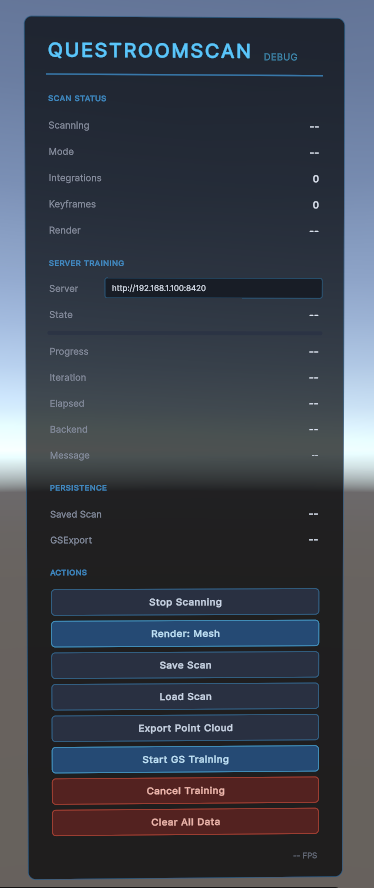
The README describes the project as “fully on-device,” and the real-time textured mesh IS. But splat TRAINING does NOT happen on the HEADSET. The Quest zips keyframes and a point cloud, UPLOADS them to a companion RoomScan-GaussianSplatServer on a PC, and DOWNLOADS the trained PLY for on-device RENDERING. The optional HQ Refine and Enhance Mesh steps also run SERVER-side, using Real-ESRGAN super-resolution, LaMa inpainting and mesh filtering. The setup wizard even writes a manifest that allows CLEARTEXT HTTP for the LAN server. One more DETAIL for STUDIOS: the main package carries an MIT license, but GitHub’s API reports NO license for the server repository, and its root has no license file.
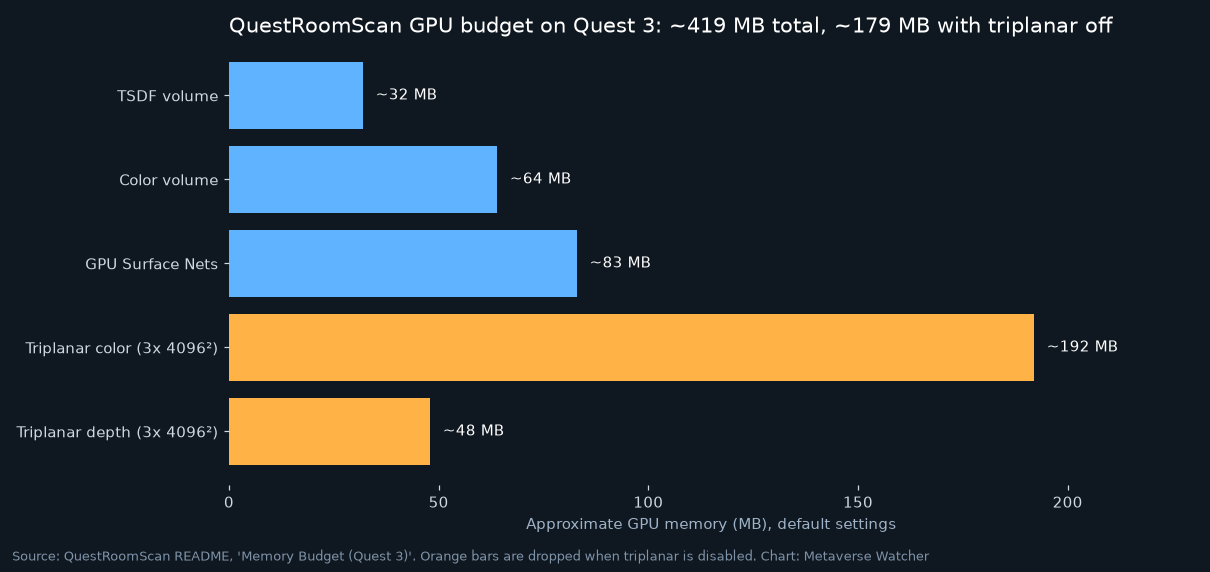
MEMORY is the OTHER constraint. The README’s own budget puts default GPU use on Quest 3 at about 419 MB, with the triplanar color and depth textures ALONE taking about 240 MB. Turning triplanar OFF drops the total to about 179 MB, at the COST of falling BACK to roughly 5 cm vertex colors during the live scan.
The bug that threw away 964 camera records
The NEWEST change is the most PRACTICAL. Issue #32, filed late on October 15 ET, reported that the KEYFRAME collector wrote JSON numbers using the device’s REGIONAL format. On a decimal-comma locale, a timestamp like 1.250 came out as “1,250,” which STRICT JSON parsers reject. In a downstream Quest 3 scan, the reporter said, all 964 camera records were DISCARDED by the PC refiner even though all 964 matching JPEGs EXISTED, leaving a SPARSE vertex-color atlas instead of a proper texture.
Pull request #33 FORCED culture-invariant formatting and was MERGED at about 8:39 a.m. ET on October 16. The author TESTED the before-and-after code in a .NET harness under en-US, es-CO, de-DE and fr-FR, but STATED that no full Unity build or on-device test was run. The fix does not REWRITE manifests that are ALREADY BROKEN. And as of this writing, the latest tag is STILL v1.3.2, so developers who PIN to a release, as the install instructions recommend, do NOT have it.
The Metaverse Watcher view
QuestRoomScan is a USEFUL signal for the Quest PLATFORM: an INDEPENDENT, permissively licensed ALTERNATIVE for developers who want room capture INSIDE their own app rather than in Meta’s CLOSED Hyperscape. CoasterMania shows the mesh-and-texture path is SHIPPABLE today. But the evidence so far supports a NARROWER claim than the MARKETING: ONE deployment, one that SKIPPED splats for performance, with splat training TIED to a PC and a data-loss fix that is not yet in a release. With 73 stars and 17 forks on GitHub as of October 17, the project is still EARLY. The next thing to WATCH is a v1.3.3 tag that carries the locale fix, and whether a SECOND studio SHIPS on it.
Sources: QuestRoomScan on GitHub; QuestRoomScan releases; issue #32; pull request #33; RoomScan-GaussianSplatServer; CoasterMania store listing and update notes; UploadVR, October 2023; @genesisin2026 on X; @TheCaptainSpain on X.