VRChat is preparing to leave Unity’s Built-in Render Pipeline behind. In its Developer Update for November 5, 2026, the company said an upcoming Creator SDK will include an Android-to-iOS transpile option — and that the same pipeline is a dry run for an eventual move to Unity’s Universal Render Pipeline (URP). No URP ship date was announced.
That matters for the largest social VR platform still running a heavy creator economy on Quest, PC VR, and iOS. Unity 6 already made URP the standard path and deprecated Built-in. VRChat’s June stance was that a pipeline change was NOT planned. Five months later, the dry-run language is the clearest public signal that BiRP will not be the forever default.
What the Nov 5 Update Actually Says
The headline for creators is the transpile path, not a finished URP rewrite. When you build for Android — alone or as part of a multi-platform upload — the SDK can queue a cloud conversion that produces an iOS build by converting Android shaders. The point is to stop forcing a separate manual iOS publish for correct rendering, and to stop leaning only on the “experimental loading” fallback that sometimes paints pink shaders.
VRChat is explicit about the limits:
- Transpilation is pass/fail. If any shader fails, the whole conversion fails. There is no partial result.
- Early failure dialogs will not show deep transpiler error detail. Local iOS builds remain supported as the escape hatch.
- If conversion fails, iOS users can still enter through the existing experimental-loading fallback.
- Only the latest submission for a world is built; older queued jobs for that world are superseded. History is kept for 30 DAYS.
The company asked creators to report worlds that fail to transpile, or that still show pink shaders on iOS after a successful conversion, via a dedicated Canny board once the SDK hits open beta.
Why This Is a URP Test
Buried under the iOS section is the line that turns a tooling note into platform news:
“This is also a dry run for the upcoming URP work. A large migration like BiRP to URP needs a production world transpilation pipeline, which this will test.”
VRChat Developer Update — 5 November 2026
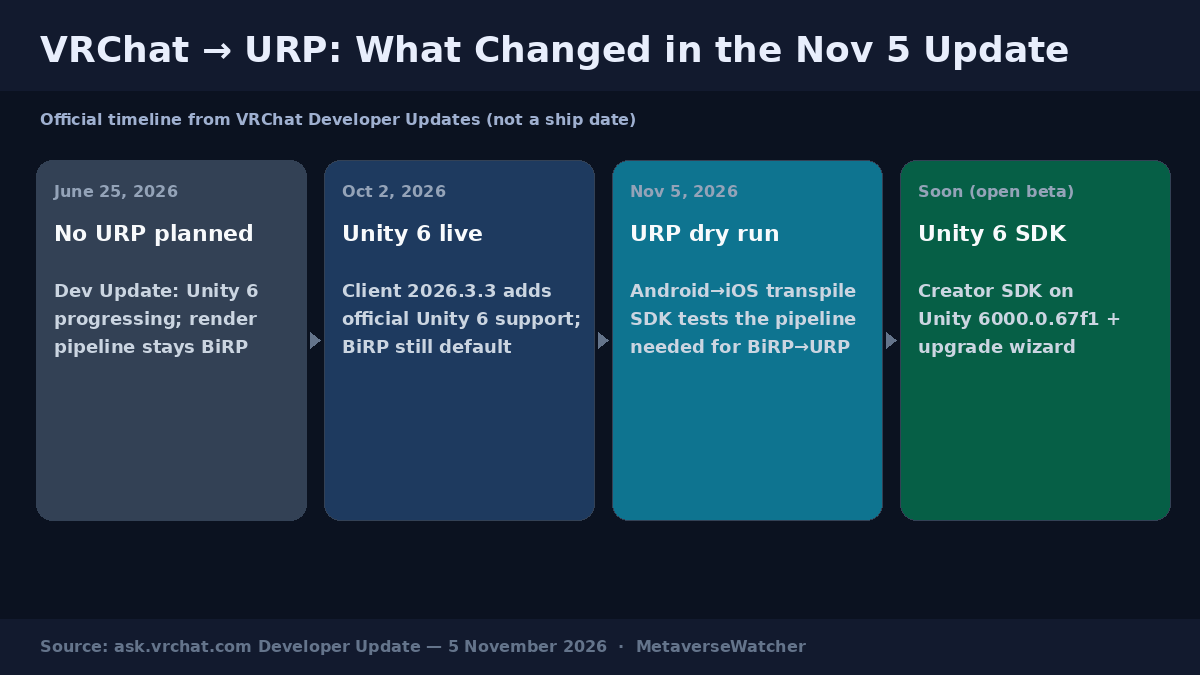
That is a reversal of tone, not a schedule. On June 25, 2026, VRChat’s developer update said Unity 6 work was progressing but that the render pipeline would not change and a URP migration was not yet planned. Client version 2026.3.3 then added official Unity 6 support on October 2, 2026, while Built-in remained the content path creators actually ship on. November’s transpile system is the production pipeline you would need before you ask millions of worlds and avatars to survive a BiRP→URP conversion.
| Date | Signal | What creators got |
|---|---|---|
| June 25, 2026 | No URP planned | Unity 6 progress; pipeline stays Built-in |
| Oct 2, 2026 | Unity 6 in client | 2026.3.3 official Unity 6 support |
| Nov 5, 2026 | URP dry run | Android→iOS transpile SDK tests the conversion pipeline |
| Soon | Unity 6 SDK beta | Creator SDK on Unity 6000.0.67f1 with upgrade wizard |
Unity 6 SDK Open Beta Is Next
Separately, VRChat said it is “almost ready” to publish the Unity 6 Creator SDK for open beta. The editor build is 6000.0.67f1. Creator Companion will install it during migration and, by default, migrate a copy of the project rather than upgrading in place. An Upgrade Wizard will offer guided auto-fixes. The company still tells creators to back up projects before touching a new Unity version — standard advice, still worth repeating for avatar and world repos that have lived on older editors for years.
A snappier editor is the near-term win. The longer-term risk is shader and material breakage when URP eventually becomes the content target. The transpile dry run is how VRChat finds out how real worlds behave before that cutover.
Public Instances Get Owners
The same update changes a long-standing social rule. Starting with the 2026.4.2 open beta, the user who creates a public instance becomes its owner — bringing publics in line with other non-group instance types. Owners can warn, force-mute mics, kick, change content settings, close the instance, and see users who are blocking them.
Two details matter for Udon and for moderation culture:
IsInstanceOwner/InstanceOwnerwill no longer return false/null on publics when an owner is present. Group instance behavior is unchanged.- If the original owner leaves, moderation privileges do NOT transfer. VRChat says original owners are active in only about 1 PERCENT of active public instances today, so most publics will still behave as unmoderated once that creator leaves.
World authors keep moderation privileges in instances of their own worlds even when they are not the instance owner. Staff framed the change as a way to give publics some user-serviced moderation instead of relying almost entirely on vote-kick. Community replies on the update thread already split between “finally” and “power-trip risk,” and VRChat said it is willing to revert if the live test looks harmful.
What Creators Should Do Now
You do not need to rewrite materials for URP today. You do need a backup habit before the Unity 6 SDK lands, and you should treat the Android→iOS transpile beta as a canary: if a world fails conversion or stays pink on iOS after success, report it. That feedback is exactly what the URP dry run is for.
Desktop users also get a smaller quality-of-life change in the same notes: hold middle mouse and drag to drive avatar arms, including with held items. Quick Menu “Here” and Quick Profile layouts refresh in 2026.4.2, and a new default UI theme rolls out feature by feature — with a free Teal legacy theme under Inventory → Cosmetics → UI Themes for anyone who wants the old colors.
Related Coverage
For context on how social VR fits the wider stack, see our plain-English metaverse guide. We previously covered VRChat’s native face-tracking open beta in SDK 3.10.6. If you play VRChat on Quest among other free titles, our best free Quest games list still ranks it among the default social picks. Creators watching adjacent platforms after Resonite’s recent Steam Frame work can compare notes in our Resonite Steam Frame tracking update.