By Metaverse Watcher Staff · Analysis · November 7, 2026
Smart glasses are no longer just a consumer privacy story. In 2026 they became an employment-policy problem. An airline, a regional health department, UK courts and pubs, and at least one national telecom company have restricted or are reviewing camera glasses at work. The latest is the Northern Territory’s health department in Australia, which on November 4 barred staff from using smart glasses at its clinical sites. This analysis looks at who has acted, why employment lawyers say most existing phone policies don’t cover the devices, and what a workable policy looks like if your organisation hasn’t written one yet.
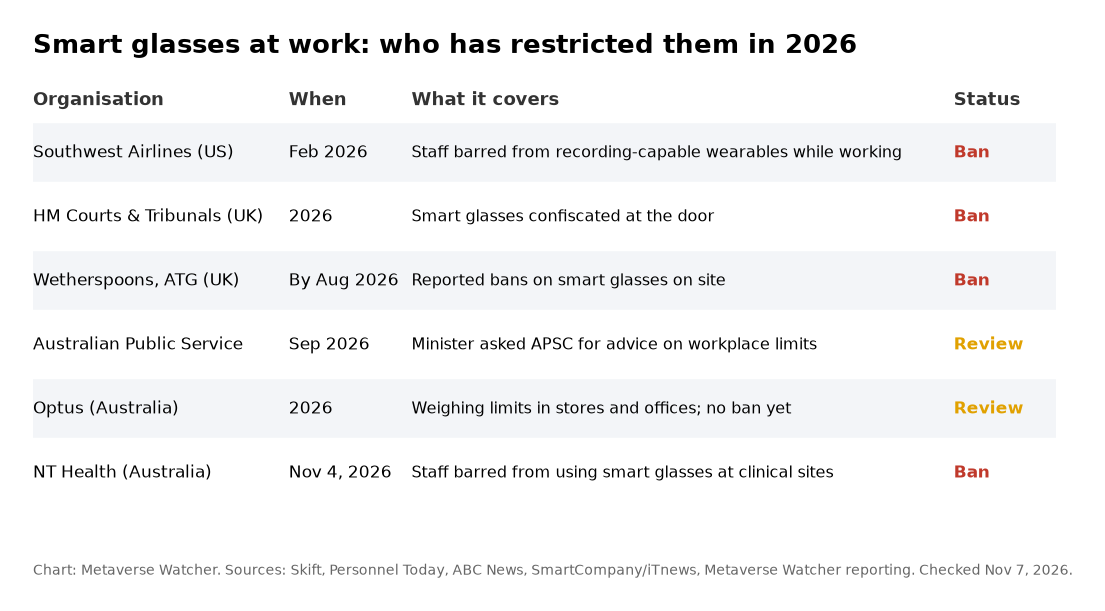
Who Has Restricted Smart Glasses at Work
The restrictions so far share a pattern. They target RECORDING capability, not the glasses as eyewear, and they leave room for approved exceptions.
- Southwest Airlines. A February 2026 employee memo seen by Skift barred staff from wearing smart glasses or other wearables with recording capability during working hours, on or off company premises. The rule also covers wireless earbuds that can record. Passengers aren’t affected.
- NT Health (Australia). According to ABC News, chief executive Susan Bowden told all staff that “recording-capable wearables, particularly smart glasses” were an “elevated risk to patient privacy and confidentiality.” The move followed a breach at Royal Darwin Hospital, where a visiting medical observer posted images and videos containing confidential information about 12 pregnant patients to Instagram. Staff can still use the devices if NT Health explicitly approves them for a clinical, accessibility, safety or operational purpose.
- UK courts, pubs and theatres. Personnel Today reported in August that HM Courts and Tribunals Service confiscates the glasses at the door, and that pub chain Wetherspoons and theatre group ATG have also banned them. We covered the US version of the courthouse trend in our breakdown of courthouse rules in New York, Maryland and Illinois.
- Australian Public Service. In September, Finance and Public Service Minister Katy Gallagher asked the Australian Public Service Commission for advice on whether the devices should be limited in Commonwealth workplaces, as covered in our report on the federal review.
- Optus. SmartCompany, citing iTnews, reported that the Australian telecom company is weighing limits in its stores and offices. An executive said restricting the glasses “would absolutely be a possibility,” but a flat ban isn’t under active discussion.
Governments are moving in parallel. The UK and Pakistan are both weighing wider curbs, as we detailed in our UK and Pakistan report. Pakistan’s federal step specifically asked provinces to draft workplace rules.
Why Phone Policies Don’t Cover Smart Glasses
Most employers already restrict phones in sensitive areas. The problem is that those rules assume you can see the device. In an October 13 note, employment law firm Ogletree Deakins wrote that AI glasses “look like ordinary eyewear” and can photograph, record, livestream, transcribe and send what they capture to an AI assistant, “often with little more than a small indicator light.” The firm warned that many recording policies refer to “cameras” or “recording devices” in ways that may not clearly reach a pair of glasses. When the wording doesn’t cover the device, enforcing the rule turns into an argument.
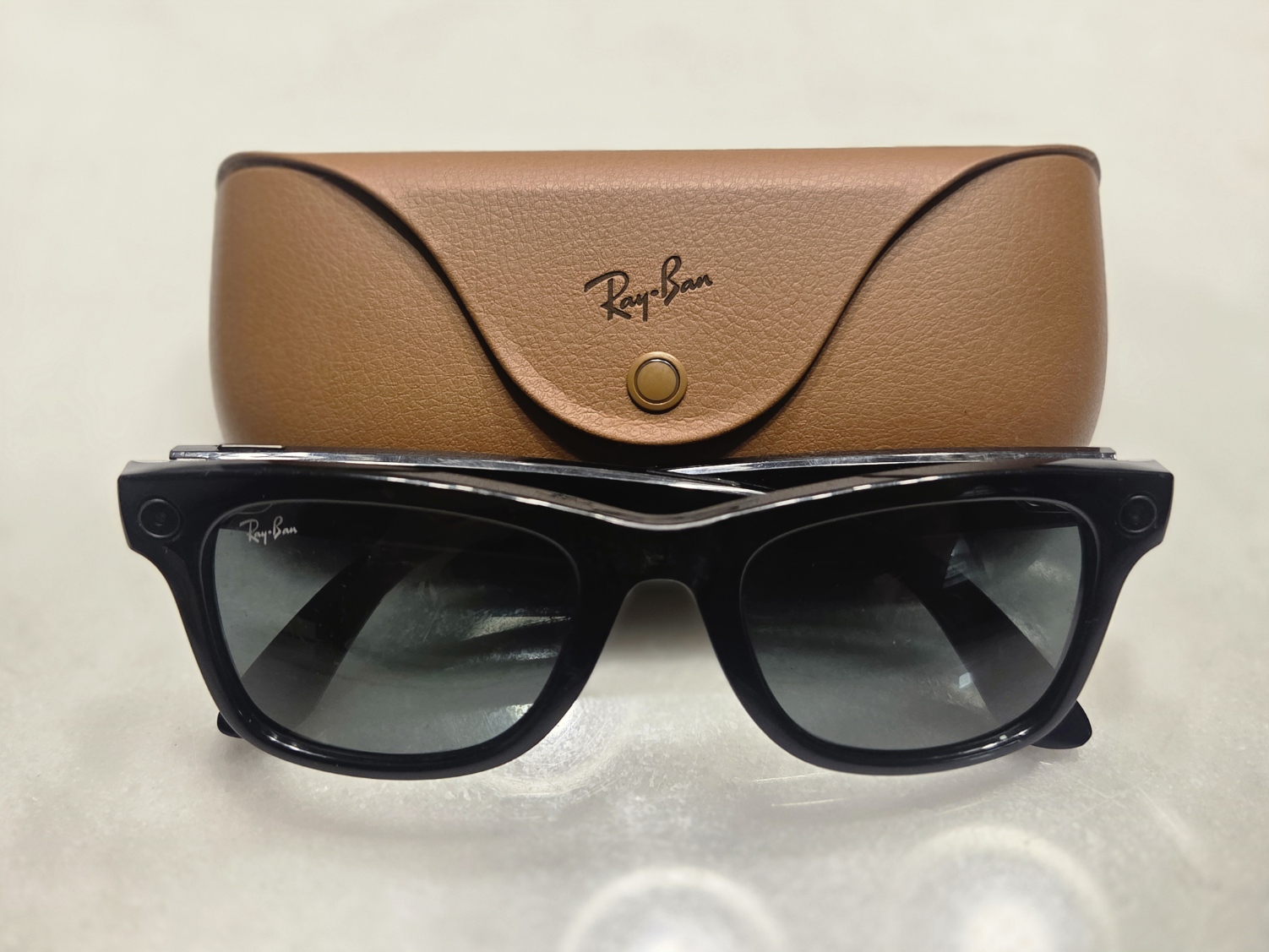
Meta’s glasses have an LED that lights up while recording, and the company says it limits recording when the light has been tampered with. Security advisers quoted by InformationWeek still argue that an LED isn’t a meaningful control in a conference room full of whiteboards and screens, and that some users have found ways around it. We explain why the next wave of sensors, especially eye tracking, raises the stakes further in our eye-tracking privacy analysis.
The Legal Risks Employers Are Weighing
| Risk | What it means in practice | Where it bites hardest |
|---|---|---|
| Recording consent | Federal law and most US states require only one party’s consent. A minority, including California, Florida, Illinois, Maryland, Massachusetts, Montana, New Hampshire, Pennsylvania and Washington, generally require every party’s consent. | Multistate teams and video calls that cross state lines |
| Trade secrets | Courts look at whether a company took reasonable steps to keep information secret. A device that captures everything in view tests that. | Factory floors, strategy meetings, pricing and deal work |
| Biometric data | Facial or voice recognition on captured footage can trigger laws like Illinois’ BIPA, which lets individuals sue. | Illinois, Texas, Washington and states with broad privacy laws |
| Health data | Capturing identifiable patient information can be an impermissible disclosure under HIPAA, presumed to be a breach unless a risk assessment shows otherwise. | Hospitals, clinics, pharmacies |
| Data protection (UK/EU) | Where an employer deploys or permits glasses for business, it’s usually the data controller, needs a lawful basis, and will likely need a data protection impact assessment. | Field service, warehouses, remote assistance |
| Third-party harassment | A new UK duty to prevent third-party harassment took effect in October, which may require limits on customers filming staff. | Retail, hospitality, leisure |
The healthcare row in that table is exactly what NT Health ran into. CEDR Solutions, which advises US medical practices, says posting identifiable patient information without authorization should immediately start the practice’s HIPAA incident-response process. For European employers, Slaughter and May notes that the GDPR’s household exemption won’t apply once glasses are used for work, and that manufacturers may use recordings for their own purposes. That makes due diligence on the vendor part of the policy.
Why Blanket Bans Carry Their Own Risk
The reflex is to ban the glasses outright. Lawyers on both sides of the Atlantic warn AGAINST it, for two reasons.
Labor law. In the US, Section 7 of the National Labor Relations Act protects employees’ right to act together for mutual aid, unionized or not, and the NLRB has recognized that recording can sometimes be part of that activity, such as documenting unsafe conditions. Under the Board’s 2023 Stericycle decision, a rule that could reasonably chill that activity is presumed unlawful unless it advances a substantial business interest that a narrower rule couldn’t achieve. Ogletree notes the standard may be revisited, but advises drafting with it in mind.
Disability. Live captions, text reading and scene description make some smart glasses genuine assistive technology. In the US, a request to use them should start the ADA’s interactive process. In the UK, TWM Solicitors told Personnel Today that the glasses could be a reasonable adjustment under the Equality Act 2010, and that a blanket ban “could create discrimination risks.” This is why both Southwest’s and NT Health’s rules target recording, and why NT Health kept an approval route for accessibility and clinical use.
What a Workable Smart Glasses Policy Includes
The guidance from Ogletree, the employer association MRA and Recording Law converges on a short list.
- Define devices by function. Cover any wearable that can capture, livestream, transmit or transcribe audio or video, and name smart glasses explicitly. Include both personal and company-issued devices.
- Restrict by place and activity. Name restricted zones such as patient areas, R&D labs, client rooms and HR meetings, rather than banning recording everywhere at all times.
- Require approval and consent. Make recording for work depend on advance written approval and any notices or consents the law requires, and default to all-party consent for multistate or EU teams.
- Control where the data goes. Approved captures should live only in company systems, never in personal cloud accounts, social media or outside AI tools.
- Add the legal safeguards. Include NLRA savings language, a clear path to request an accommodation, and BIPA-style consent if facial or voice recognition is involved.
- Train managers and HR. Teach staff to recognize the devices, and open every interview, investigation or disciplinary meeting by asking whether anything is recording.
What This Means for Buyers and Brands
For people buying smart glasses, the practical takeaway is simple: expect to be asked to take them OFF. If you rely on prescription lenses in your smart frames, keep a camera-free backup pair for work and courthouses. Camera-free audio models like Ray-Ban Meta Audio, covered in our best smart glasses ranking, are likely to face fewer restrictions. If you already own a pair, our Ray-Ban Meta setup guide shows where the capture and privacy settings live.
For Meta, Google, Samsung and Snap, workplace rules are a quieter threat than regulation, but a real one. Glasses only become a daily habit if people can wear them all day, including at work. Each new ban that targets the camera makes a stronger case for designs with a clear physical camera shutter, enterprise management modes that turn off capture at work, and camera-free models. We’ll keep tracking employer and government rules as they land. For the wider policy picture, see our coverage of the US senators’ letter to Meta on smart glasses privacy.
This article is analysis, not legal advice. Employers should consult counsel on the laws in their jurisdictions.