Blackmagic Design has announced the Blackmagic Ambisonic Microphone, its first standalone microphone, built to capture spatial sound for Apple Immersive Video on Apple Vision Pro. The palm-sized sphere packs 108 digital MEMS capsules, encodes them to 7th-order ambisonics inside the microphone, and sends audio and power over a single USB-C cable. Blackmagic quotes US$1,695 excluding local duties and taxes, with availability in December through its resellers.
The announcement came during the same week Apple used a special “Meet with Apple” visionOS session to tell developers it remains committed to the platform. For anyone who wants to know whether Apple’s immersive format has a future, the hardware being built for it is a useful signal.
What Blackmagic Announced
According to Blackmagic’s announcement, as published by TV Tech, the 108 MEMS microphones sit flush in a solid, faceted metal body that is small enough to hold in one hand or mount on top of a camera. An internal processor runs Apple’s encoding filters and converts the signal from all 108 capsules to 7th-order ambisonics in real time. That removes the breakout box and the separate encoding software that ambisonic recording usually needs. The microphone is USB class compliant, so it needs no drivers or plug-ins.
The product page sums up the headline specification as 108 microphones, 64 channels and 32-bit audio. Blackmagic names three ways to record:
- On the URSA Cine Immersive camera: mount the microphone on top, plug in the USB-C cable, and the spatial audio records straight into the camera’s immersive files, in sync with the picture.
- On a computer: record and mix in real time with Fairlight Live, Blackmagic’s live mixing software.
- On an iPhone: record directly through the Blackmagic Camera app.
Blackmagic also says a USB to SMPTE-2110 converter will be offered for broadcast workflows, but it has not given that product a price or date.
Why 7th-Order Ambisonics Matters for Vision Pro
Ambisonics records a full sphere of sound so it can be decoded later for whichever way the viewer turns their head. That is the right fit for a headset, where the audio has to stay locked to the scene as you look around. The number of channels grows with the square of the order plus one, so a first-order recording carries 4 channels and a 7th-order recording carries 64. More channels mean a more precise position for each sound source.
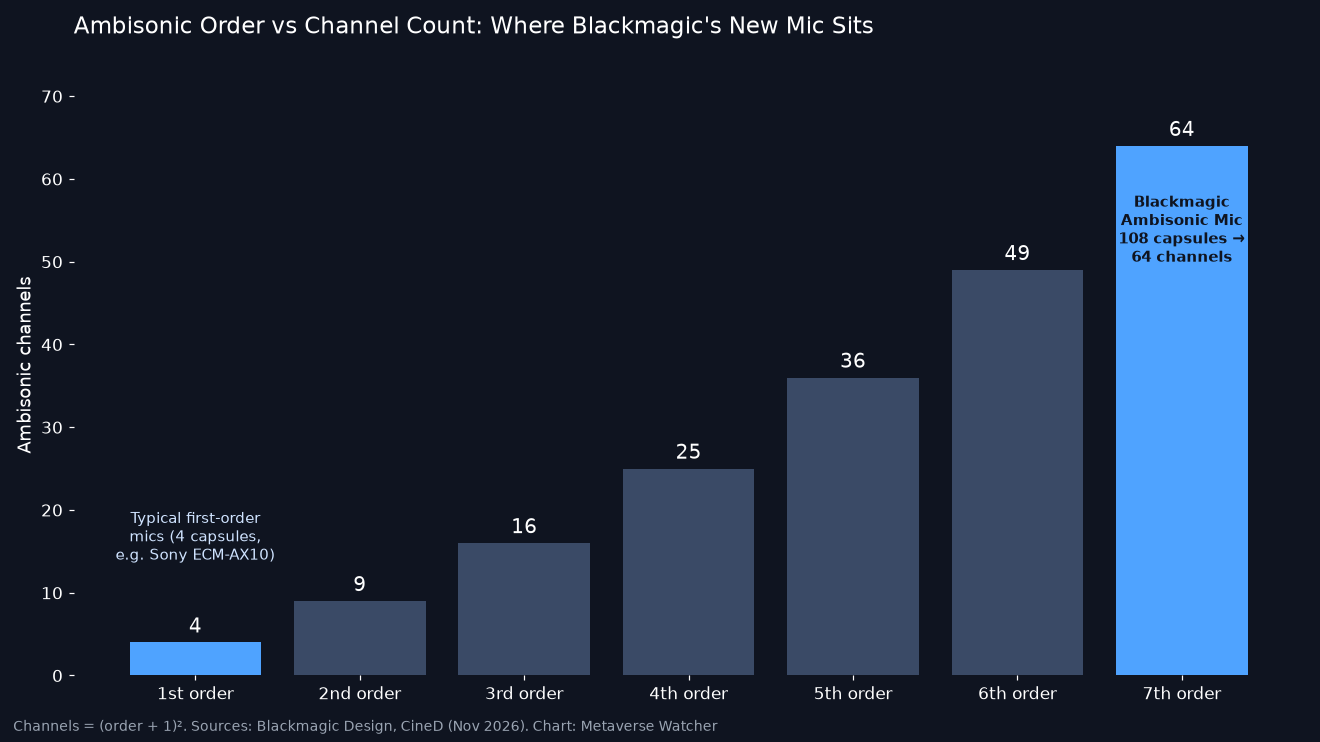
For comparison, CineD notes that most ambisonic microphones filmmakers use are first order, including Sony’s ECM-AX10, which has four capsules and records four channels of first-order AmbiX. Blackmagic is moving straight to the top of the scale while also removing the post-production conversion step.
Price and Availability
There are two prices in circulation, and both are correct. The announced figure is $1,695 before duties and taxes. When we checked Blackmagic’s US product page on November 14, 2026, it listed the microphone at $1,909, and B&H listed it at the same $1,909 as “Coming Soon.”
| Product | What’s included | Blackmagic US page (Nov 14, 2026) |
|---|---|---|
| Blackmagic Ambisonic Microphone | Microphone and Blackmagic Ambisonic Microphone Mount | $1,909 |
| Blackmagic Ambisonic Microphone Kit | Microphone, mount, windshield for location wind noise, locking USB-C cable | $2,405 |
| Blackmagic URSA Cine Immersive | Dual 8K stereoscopic immersive cinema camera for Apple Immersive Video | $30,375 |
Set against a $30,375 camera, the microphone is a small extra cost for productions already shooting Apple Immersive Video. CineD described the price as far below what it expected for a product built with Apple’s licensed technology.
Blackmagic Announces Ambisonic Microphone for Immersive Audio on Apple Vision Pro
— Road to VR (@RtoVR) November 13, 2026
What Is Still Unknown
Blackmagic has not yet published a full technical specification. CineD points out that self-noise, maximum SPL, frequency response, dimensions and weight are all missing. The microphone does not record on its own, so it always needs a camera, a computer or an iPhone as a host. CineD also reports that the Blackmagic Ambisonic Recorder software is a macOS beta with no Windows version mentioned. How well DaVinci Resolve Studio handles 64-channel ambisonics in post-production is another open question until units ship.
What It Means for Apple’s Immersive Ecosystem
Apple Immersive Video has had a dedicated camera since Blackmagic and Apple developed the URSA Cine Immersive, which PetaPixel notes was announced in June 2024 and has since been used for basketball games and rocket launches. Sound has lagged behind, with productions relying on separate ambisonic microphones, separate recorders and extra post work. This microphone closes that gap with a capture tool that writes spatial audio into the same file as the picture.
That matters because the content pipeline is Vision Pro’s real bottleneck. Viewers have a capable headset, which we break down in our Apple Vision Pro 2026 price and specs guide, but immersive films and live events remain scarce. Cheaper, simpler capture gear lowers the cost of each production. That benefits Apple and also rivals courting the same live-event producers, such as Meta, whose Meta VR Glasses are lined up for live immersive sports in 2027.
For buyers, nothing changes today. You do not need this microphone to enjoy Apple Immersive content, and the headset decision still comes down to price and use case, which we compare in Galaxy XR vs Apple Vision Pro and Meta Quest 3 vs Apple Vision Pro. For creators, a 7th-order spatial microphone that plugs into an iPhone is the more important development. It brings high-end spatial audio within reach of smaller productions. For the latest platform changes, see our rundown of what’s new in visionOS 27.2.