Vuzix has introduced Ultralite Color, a reference design for full-color, binocular smart glasses that weighs under 40 grams. It is not a product you can buy. Ultralite Color is a template that other eyewear brands can license, restyle and ship under their own names. The design was named a CES 2027 Innovation Awards Honoree in the Fashion Tech category, and Vuzix says it will show it at CES in Las Vegas on January 6–9, 2027.
The announcement came in a PR Newswire release on November 18, 2026, which Vuzix also posted to its investor site. What the release says is useful. What it leaves out matters just as much, because the display-glasses market is getting crowded quickly.
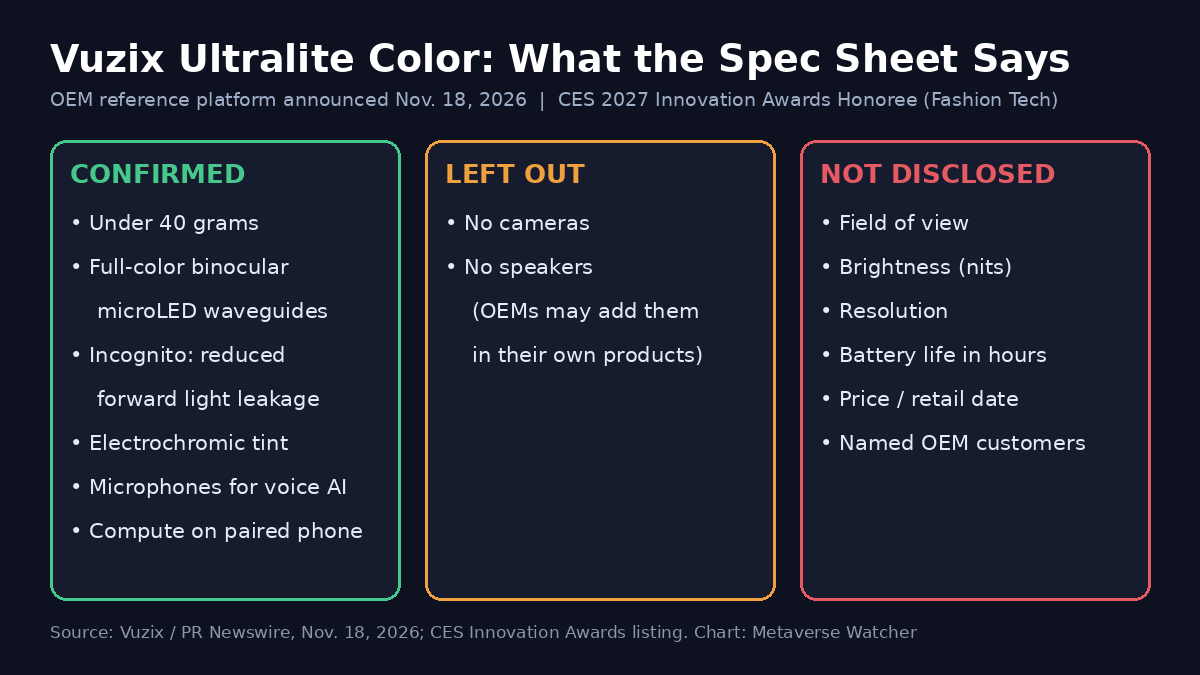
What Vuzix Confirmed
According to Vuzix, the reference platform combines:
- Full-color binocular displays driven by microLED projectors and delivered through Vuzix’s own transparent waveguides, so the wearer still sees the room normally.
- Vuzix Incognito, a technology Vuzix says reduces forward light leakage, so people nearby are less likely to see the display glowing on the lens.
- Electrochromic tinting, which lets the lenses darken to keep the display readable as lighting changes.
- Microphones for talking to AI assistants. Processing and apps run on a wirelessly connected smartphone or other device, not on the glasses.
- A weight of under 40 grams, which Vuzix calls suitable for all-day wear.
The CES Innovation Awards listing adds a little. It describes a “full-color binocular 3D display” with “vibrant reds and blues,” dual microphones, and “all-day battery power.” Red and blue matter here because they have historically been the hardest colors for microLED waveguide systems to render well. That is a big part of why many lightweight display glasses today show monochrome green.
What Is Deliberately Left Out
The reference configuration has no cameras and no speakers. Vuzix says that choice keeps the frame slim, and that OEM partners may still add those parts in their own products. That decision sets Ultralite Color apart from the camera-first category led by Ray-Ban Meta and from the new Android XR glasses from Samsung, Gentle Monster and Warby Parker.
Leaving out the camera also matters for regulation. Covert recording is the issue driving most smart glasses policy debates, including the ban proposal in Ireland. Glasses with no camera and reduced front-facing light leakage avoid much of that problem, both for the wearer and for anyone nearby. For workplaces weighing smart glasses privacy rules, a display-only design is simply easier to approve.
What Vuzix Did Not Disclose
The release gives no field of view, brightness in nits, display resolution, battery life in hours, price, or retail date. Most important, Vuzix states plainly that “no specific customer contracts or production commitments are being announced in connection with this release.” The platform is “currently available only to OEM partners pursuing branded, purpose-built AI smart glasses.”
That fits a familiar Vuzix pattern. In October we covered a partnership built on its Ultralite Pro reference design, which also came without a contract value, unit count or deployment date. Vuzix makes money supplying waveguides, optical parts and engineering work. A reference design is a sales tool for that business, not a consumer launch.
| Item | Ultralite Color (per Vuzix) |
|---|---|
| Product type | OEM reference design, not a retail product |
| Weight | Under 40 g |
| Display | Full-color, binocular, microLED-driven waveguides |
| Privacy features | Incognito (reduced forward light leakage); no camera in reference build |
| Audio | Microphones only; no speakers in reference build |
| Compute | Wirelessly connected smartphone or other device |
| Lenses | Electrochromic tinting |
| Field of view, brightness, resolution, battery hours | Not disclosed |
| Customers / production | None announced |
| Next showing | CES 2027, January 6–9, booth 27344, LVCC Central Hall |
Why It Matters Now
The timing is not accidental. Samsung’s Intelligent Eyewear, built with Google and styled by Gentle Monster and Warby Parker, sold out its preorders in South Korea and the U.S. ahead of its December 10 launch, according to Seoul Economic Daily. The same report puts that model at 41 grams and cites Counterpoint Research data giving Meta an 86% share of the AI glasses market in the first half of 2026. Brands that want to compete without spending years on their own optics need a supplier that can hand them a working display stack. Ultralite Color is Vuzix’s pitch for that job.
Competition among component suppliers is heating up too. Samsung’s own research work, such as the 1.5mm waveguide developed with POSTECH, shows that big platform companies are working on optics in-house. Meanwhile, Chinese smart glasses makers are shipping in volume with their own supply chains. A Western eyewear brand with no optics team is exactly the customer Vuzix is targeting.
What It Means for Buyers
In the near term, nothing changes. You cannot order Ultralite Color, and no brand has said it will ship glasses based on it. The signal worth watching is CES in January. If a recognized eyewear or consumer electronics brand appears with a design based on Ultralite Color, with a price and a release window, this becomes a real product story. Until then, treat the sub-40-gram, full-color claim as a promising engineering result that has not yet been tested in a store.
If you are shopping now, our guides to what smart glasses actually are and the best smart glasses for prescription wearers cover what is on shelves today.
Vuzix’s Announcement on X
Vuzix introduces its Ultralite Color™ OEM reference platform, a sub-40-gram design for full-color AI smart glasses, named a #CES2027 Innovation Awards Honoree in Fashion Tech. See it in Vegas next year at booth 27344, Jan. 6-9, 2027. $VUZI
— Vuzix (@Vuzix) November 18, 2026
Sources: Vuzix investor relations; CES Innovation Awards 2027; Seoul Economic Daily.