By the Metaverse Watcher newsroom. Published Sunday, November 22, 2026. Case details come from local reporting on the written plea agreement filed in the U.S. District Court for the Southern District of Alabama; court rules were checked against primary sources on November 22, 2026.
A Mobile, Alabama, woman has admitted using Meta smart glasses to secretly film three government witnesses during a federal drug trial, then using the footage in a months-long campaign to identify and intimidate them. Tierra Shatalia Douglas, 35, pleaded guilty on Thursday, November 19, to conspiracy to retaliate against a witness, FOX10 News reported. Sentencing is set for February 19, 2027. (Fox News gave her age as 36; the local outlets that first reported the plea say 35.)
The plea puts on the federal record an admitted case of camera glasses being used to record inside a courthouse and to target witnesses. It lands as courts in New York, Philadelphia and Maryland have already moved to keep recording-capable eyewear out of their buildings, and it gives those policies a concrete example to point to.
What Douglas Admitted
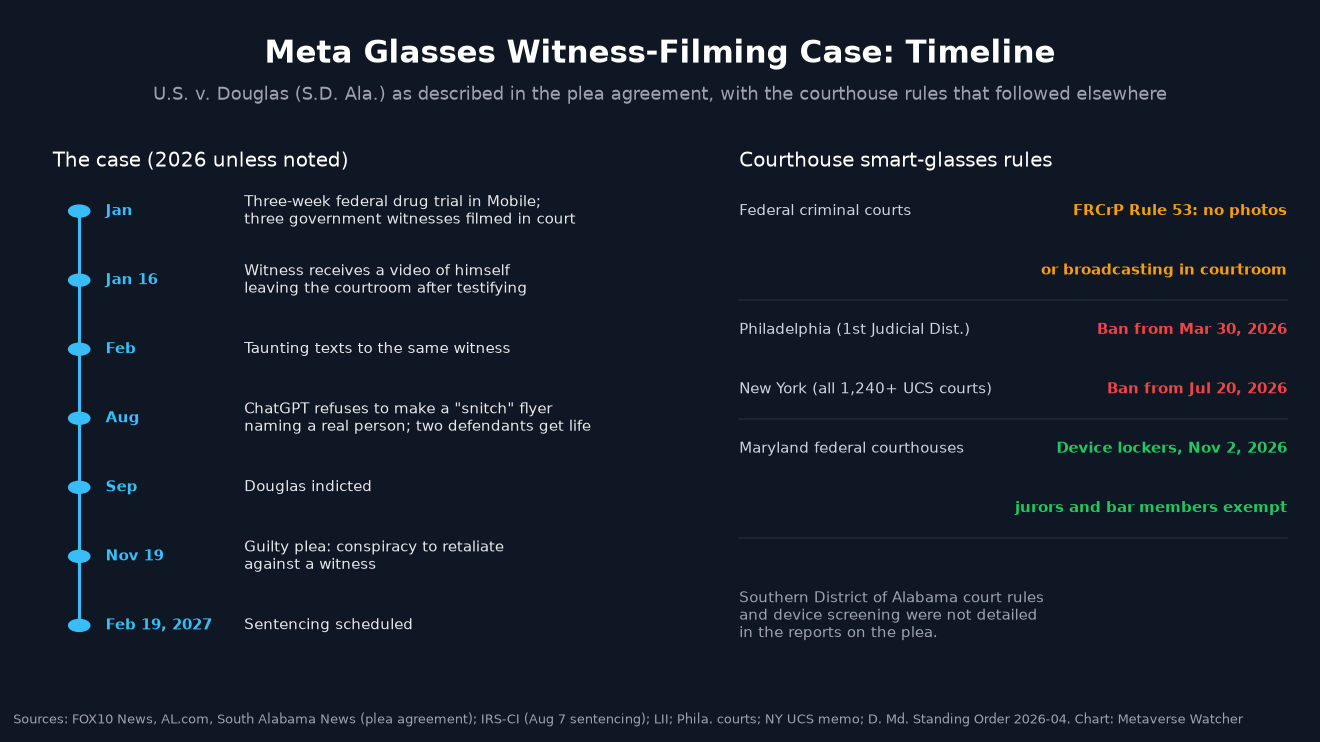
According to the plea agreement as summarized by FOX10, AL.com and South Alabama News, Douglas wore Meta glasses inside the federal courthouse in Mobile in January 2026 and recorded three witnesses who were cooperating with the government in the trial of Glennie Antonio McGee, his wife Echandza Dianca Maxie and her sister Exavieria Deagnes Maxie.
AL.com quotes the court records as saying Douglas “disseminated the videos to publicly identify and intimidate the witnesses.” The admitted conduct includes:
- Courtroom footage shared within days. On January 16, one witness received a video from a friend showing him leaving the courtroom where he had just testified.
- A “snitch” flyer. Douglas distributed a flyer with that witness’s photo labeling him an informant.
- Information about a child. She sent Discord messages identifying one of the witness’s minor children and the school the child attended.
- Taunting texts. In February she sent the same witness repeated messages mocking him for testifying, with his number saved in her phone as “The Rat.”
- A threat on video. In one recording, according to AL.com, Douglas told someone: “This guy telling, do anyone know him, he needs to be hurt.”
She also admitted working with co-conspirators to obtain personal information about the witnesses. Investigators confronted her with evidence that included the courthouse’s own internal surveillance video, and she confessed, according to the plea document. The maximum penalty for the charge is life in prison, but prosecutors have agreed to recommend leniency, FOX10 reported.
The ChatGPT Detail
The plea agreement also records an attempt to use generative AI. In August, months after the trial, Douglas asked ChatGPT to create a flyer identifying one of the witnesses as a “snitch.” The chatbot declined, responding that it could not create a flyer accusing a real person of being a confidential informant, but offered to produce an image clearly labeled as a fictional character or parody, according to FOX10. AL.com separately reported that she used ChatGPT to generate and distribute a flyer; the FOX10 and South Alabama News accounts of the plea document describe the request as refused.
The Trial Behind the Case
The underlying prosecution was substantial. According to an August 7 IRS Criminal Investigation release, a three-week jury trial in January 2026 covered a Mobile-based organization that distributed hundreds of pounds of cocaine and tens of thousands of counterfeit fentanyl pills between 2017 and 2024 and used children as couriers. U.S. District Judge Terry F. Moorer sentenced McGee and Maxie to life in prison and fined them $10 million and $1 million respectively. AL.com reports that the harassment of the witnesses continued through August, after those sentences were handed down. Douglas was indicted in September.
Why Camera Glasses Are a Courthouse Problem
Recording in federal criminal courtrooms is already prohibited. Federal Rule of Criminal Procedure 53 states that “the court must not permit the taking of photographs in the courtroom during judicial proceedings or the broadcasting of judicial proceedings.” The difficulty is enforcement. Camera glasses look like ordinary eyewear, and screening that focuses on phones and cameras can miss them. The Mobile case was uncovered after the fact, through a witness who saw the video and the courthouse’s own security footage.
That is the gap several court systems have tried to close this year. We compared the approaches in our courthouse smart glasses rules explainer; the current status is below.
| Court system | Rule | Effective | Who is covered |
|---|---|---|---|
| Federal criminal courtrooms | FRCrP Rule 53: no photography or broadcasting of proceedings | Long-standing (restyled 2002) | Courtroom proceedings; device screening varies by courthouse |
| Philadelphia, First Judicial District of Pennsylvania | Order barring smart, Meta or AI glasses with any recording capability without written authorization | March 30, 2026 | Everyone; prescription and non-prescription; violators face contempt, removal or arrest |
| New York Unified Court System | July 1 memo: smart glasses must be vouchered with court officers | July 20, 2026 | Everyone, including attorneys, witnesses and court employees; more than 1,240 courts per Bloomberg Law |
| U.S. District Court, District of Maryland | Standing Order 2026-04: portable devices, including smart glasses, stored in lobby lock boxes | November 2, 2026 | Visitors to Baltimore and Greenbelt courthouses; bar members, jurors and listed officials exempt |
None of these rules applied in Mobile, and the reports on the plea do not describe what device screening the Southern District of Alabama courthouse used in January. The case is likely to be cited by courts weighing whether a general recording ban is enough, or whether eyewear needs to be named explicitly, as Philadelphia, New York and Maryland have done.
The Recording Light Question
Meta’s glasses include a capture LED meant to signal recording to people nearby. Whether that light works as a safeguard is a live regulatory question. This week the Dutch data protection authority, the Autoriteit Persoonsgegevens, advised consumers against buying AI camera glasses after testing six models. Biometric Update reports the regulator found indicator lights on virtually all devices were hard to see or easy to cover, and most kept recording when the light was obscured. The regulator did not name the brands tested. We covered those findings in our report on the Dutch watchdog warning.
A courtroom is a setting where people are seated, facing forward and paying attention to testimony rather than to the eyewear of spectators behind them. Even a working LED offers limited protection there. The plea documents as reported do not say whether the light on Douglas’s glasses was covered or whether anyone noticed it.
What It Means for Owners
For the large majority of owners who use camera glasses for hands-free photos, calls and AI queries, the practical takeaway is simple: courthouses are among the places where these devices are now explicitly unwelcome, and in New York and Philadelphia they must be surrendered or left at home, including prescription pairs. Our smart glasses recording laws guide covers consent rules more broadly, and our Ray-Ban Meta privacy settings guide explains the controls Meta offers on the device.
For regulators and the industry, the case moves the bystander-privacy debate from hypothetical misuse to an admitted one, with a specific harm: identifying cooperating witnesses in a case involving cartel-connected drug trafficking. Meta has not commented publicly on the plea in the reports we reviewed. We will update this story after sentencing on February 19, 2027.
Sources: FOX10 News (November 19, 2026); AL.com (November 20); South Alabama News (November 20); Fox News (November 20); IRS Criminal Investigation (August 7); LII, FRCrP Rule 53; First Judicial District of Pennsylvania; NY Unified Court System memo; U.S. District Court for the District of Maryland; Autoriteit Persoonsgegevens; Biometric Update (November 21). All checked November 22, 2026.