Pimax has spent a decade selling PC VR HEADSETS. On October 6 it put its name on a COMPUTER for the FIRST time: the Spation, a COMPACT desktop built around a Ryzen 7 9800X3D and a FULL desktop graphics card, unveiled alongside the $1,399 Crystal Pro headset. The machine has NO price and NO SHIP date, and the two documents Pimax published about it the SAME day DISAGREE on what a do-it-yourself buyer actually receives.

Two Documents, Two DIY Kits
Pimax’s launch announcement says: “A DIY configuration is also available, allowing customers to supply their own storage memory and GPU.” The official Frontier 2026 FAQ, also dated October 6, answers “What is the DIY option?” with: “We supply the Spation, and you bring your own motherboard and GPU.”
Those are DIFFERENT purchases. The first reads like a NEAR-COMPLETE PC that is MISSING its DRIVE, its RAM and its graphics card. The second reads like a case and power supply WAITING for a board, which would also leave the CPU question OPEN. The same FAQ adds that on the standard machine, “Storage, memory and graphics are upgradeable with standard parts,” which NAMES the SAME three components as the press release and leaves the MOTHERBOARD out. As of Wednesday afternoon, BOTH pages still carried the October 6 date with NO correction, a discrepancy MIXED flagged earlier today. Pimax has not said which wording is RIGHT.
What the Standard Build Includes
Both documents AGREE on the configuration Pimax ASSEMBLES itself:
- CPU: AMD Ryzen 7 9800X3D, with Pimax’s own qualifier “or equivalent”
- GPU: AMD RX 9070 XT or Nvidia RTX 5070 Ti
- Memory and storage: 32GB of DDR5-6000 and a 1TB M.2 NVMe SSD
- Power: a 1000W SFX supply
- Networking: Wi-Fi 7, Bluetooth 5.4 and 2.5G Ethernet
- Outputs: two DisplayPort 2.1, one HDMI 2.1, one USB-C DisplayPort 1.4a, one USB4 and six USB 3.2 Gen 2 ports
- Software: Windows or SteamOS
The “or equivalent” on the processor MATTERS. It means the ONE component that defines the X3D GAMING pitch is not strictly LOCKED in the spec. The GPU choice is also a REAL fork: the RX 9070 XT and RTX 5070 Ti are COMPARABLE-TIER cards, but they run DIFFERENT driver stacks, and Nvidia-specific VR features such as DLSS will only apply to ONE of the two builds.
Three Ways to Describe One Box
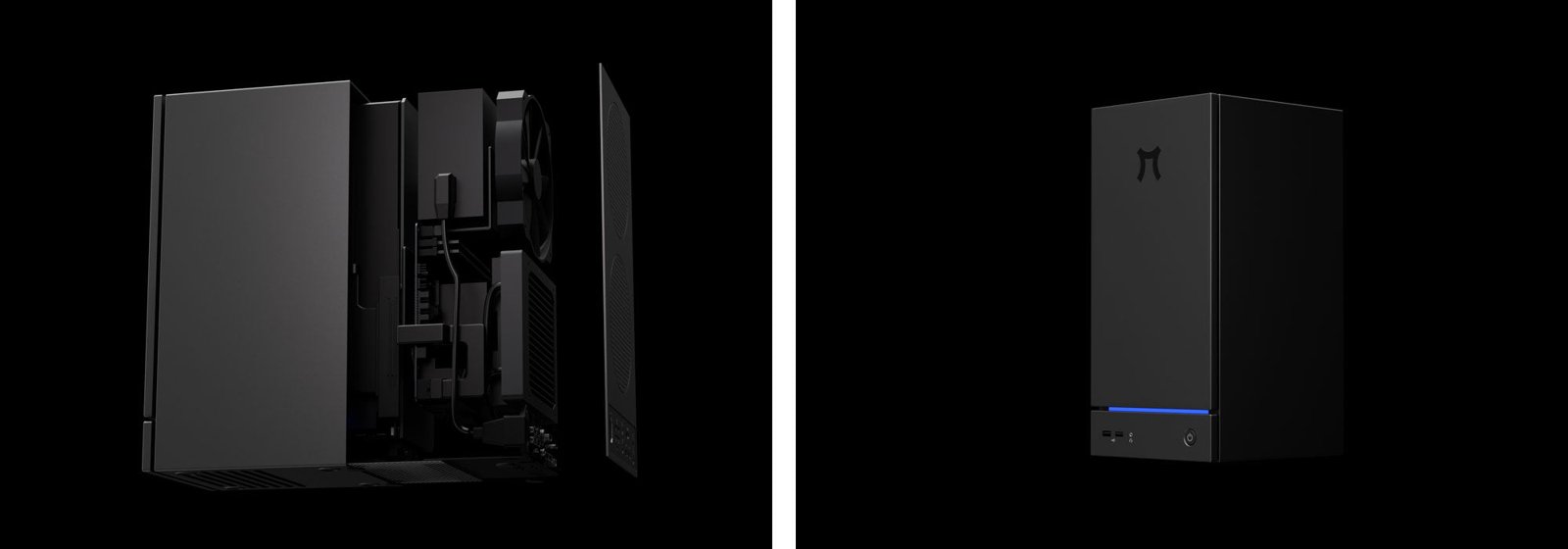
Pimax has NOT published DIMENSIONS, and its size language SHIFTS by document. The press release says the parts sit “in a chassis smaller than a typical tower PC.” The FAQ is FAR tighter: “a blade-sized chassis no thicker than a dual-slot graphics card.” The launch graphic itself uses a THIRD framing, “Workstation Power. Console Footprint.” The renders show a NARROW, upright box with FRONT USB ports and a power button, so “smaller than a tower” and “console footprint” both FIT. Whether it TRULY matches the thickness of a dual-slot card CANNOT be checked until Pimax lists MEASUREMENTS.
Built for One Benchmark, Tested on None
Pimax sets a SPECIFIC target. Asked whether the Spation will run Microsoft Flight Simulator 2024 in VR, the FAQ answers: “That is the bar it was built for: a long flight sim session at VR resolution, held smooth.” That is a SENSIBLE goal for a HEADSET maker, since SIMULATION is one of the MOST DEMANDING PC VR workloads. But Pimax has published NO FRAME-RATE figures, NO thermal data and NO noise measurements, and running a 9800X3D plus a 300W-class GPU in a COMPACT case is EXACTLY where THERMALS and fan NOISE tend to DECIDE the result. The claim is a DESIGN TARGET, not a DEMONSTRATED result.
The FAQ also makes CLEAR that the Spation does NOT have Pimax’s new third-generation 60G AirLink built in. The FAQ says the kit “is not built-in,” so WIRELESS foveated streaming to a Crystal Pro still means BUYING the $599 AirLink kit SEPARATELY.
No Price, No Date, No Reservation
“Pricing and availability will be announced later,” the FAQ says, pointing buyers to a NOTIFICATION sign-up on pimax.com. It adds that there is NO $1 reservation for the Spation, UNLIKE the Crystal Pro. Separately, Pimax said in the launch announcement that its Pimax Play software is coming to LINUX as a DEDICATED client, which matters for anyone planning to run the Spation on SteamOS with a Pimax headset. Pimax gave NO date for that client EITHER.
The Metaverse Watcher Take
A VR headset maker selling a PC tuned for VR is a LOGICAL, even OVERDUE, move: the PC is often the HARDEST part of a high-end VR setup to get right. But at this stage the Spation is a SPEC SHEET and a set of RENDERS. Before anyone can JUDGE it, Pimax needs to settle THREE things in WRITING: what the DIY kit CONTAINS, how BIG the box really is, and what it COSTS. Until then, flight-sim buyers have a PROMISE, not a PRODUCT.
Sources: Pimax launch announcement (Oct 6); Pimax Frontier 2026 FAQ (Oct 6); MIXED (Oct 7).