By the Metaverse Watcher newsroom. Prices were checked on Xreal’s US store on Sunday, November 22, 2026. Specifications come from Xreal’s product pages and Road to VR’s launch comparison. Prices can change without notice, so confirm the total in your cart before you pay. This page contains no affiliate links.
The Xreal One Pro vs 1 Pro+ decision is unusually simple, because the two glasses share almost all of their hardware. The 1 Pro+, launched on October 15, 2026, is a refresh of the One Pro rather than a new generation. It adds a brighter display, faster 2D-to-3D conversion and a redesigned nose pad. The optics, chip, resolution and field of view are carried over.
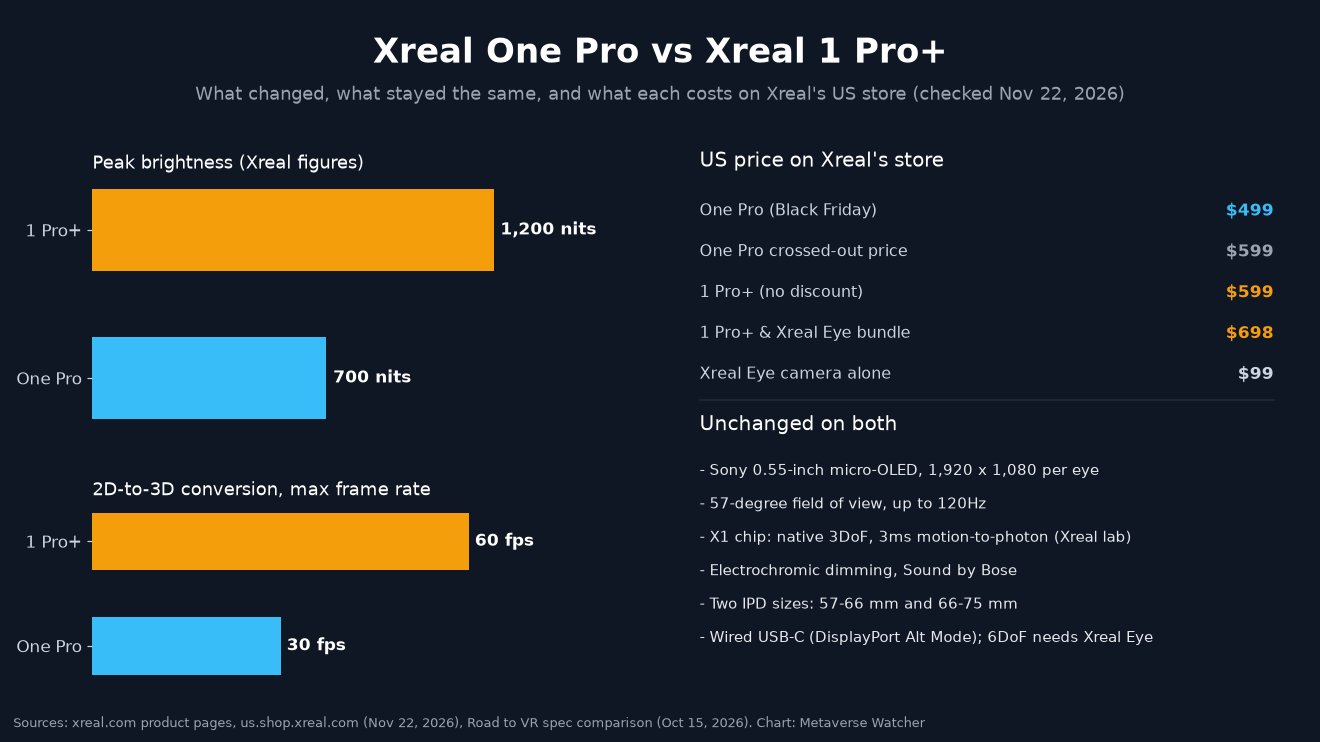
What has changed since launch is the price gap. For Black Friday, Xreal has cut the One Pro to $499 on its US store, against a $599 crossed-out price. The 1 Pro+ remains at $599 with no discount. That $100 difference is now the main thing to weigh, and this guide sets out what it buys.
The Short Answer
- Buy the One Pro at $499 if you mainly watch video or play games indoors, on flights or on trains, and do not use 2D-to-3D conversion. You get the same display panels, the same 57-degree field of view and the same X1 chip for $100 less.
- Buy the 1 Pro+ at $599 if you often use display glasses in bright rooms or near windows, if you use Xreal’s 3D conversion regularly, or if the One Pro’s nose pad has been uncomfortable for you in the past.
- Consider neither if your budget is closer to $400. The Xreal 1S is $379 on Xreal’s store for Black Friday (crossed out at $449), and our AR glasses Black Friday guide covers Viture and RayNeo alternatives.
Xreal One Pro vs 1 Pro+: Specs Compared
The table below combines Xreal’s product pages with the side-by-side chart Road to VR published at launch. Brightness and latency figures are Xreal’s own; we have not seen independent measurements of either model’s brightness.
| Feature | Xreal One Pro | Xreal 1 Pro+ |
|---|---|---|
| US price on Xreal’s store (Nov 22) | $499 (crossed out at $599) | $599 (no discount) |
| Launched | Early 2025 | October 15, 2026 |
| Display | Sony 0.55-inch micro-OLED | Sony 0.55-inch micro-OLED |
| Resolution | 1,920 x 1,080 per eye | 1,920 x 1,080 per eye |
| Peak brightness | 700 nits | 1,200 nits |
| HDR and picture modes | None at launch | AI HDR; Standard, Movie and Reading modes |
| Field of view | 57 degrees | 57 degrees |
| Refresh rate | Up to 120Hz | Up to 120Hz |
| Spatial chip | Xreal X1 (native 3DoF, 3 ms motion-to-photon per Xreal) | Xreal X1 (native 3DoF, 3 ms motion-to-photon per Xreal) |
| 6DoF and hand gestures | With Xreal Eye ($99, sold separately) | With Xreal Eye ($99, sold separately) |
| 2D-to-3D conversion | Up to 30 fps | Up to 60 fps |
| Dimming | Electrochromic | Electrochromic |
| Fit | Adjustable temples; original nose pad | Adjustable temples; redesigned nose pad |
| IPD sizes | 57-66 mm (M) and 66-75 mm (L) | 57-66 mm (M) and 66-75 mm (L) |
| Audio | Sound by Bose | Sound by Bose |
| Connection | Wired USB-C with DisplayPort output | Wired USB-C with DisplayPort output |
| Prescription lenses (Xreal store) | $59.90 | $59.90 |
Sources: Xreal One Pro page, Xreal 1 Pro+ page, One Pro store listing and 1 Pro+ store listing (checked November 22, 2026); Road to VR (October 15, 2026).
Where the 1 Pro+ Is Better
Brightness
The largest hardware change is peak brightness: 1,200 nits on the 1 Pro+ against 700 nits on the One Pro, according to Xreal and Road to VR. Xreal pairs the brighter panel with “AI HDR” processing and three picture presets. In practice, brightness matters most when there is a lot of ambient light, such as a sunlit room, a café or a window seat on a daytime flight. Electrochromic dimming on both models helps by darkening the lenses, but a brighter panel gives more headroom before the image looks washed out.
Two cautions apply. First, these are Xreal’s figures measured through its own optics, and as we noted in our launch report on the 1 Pro+, we have not seen an independent test of the 1,200-nit claim. Second, if you mostly watch in a dim room or on a night flight, the One Pro’s 700 nits is unlikely to be the limiting factor.
2D-to-3D conversion
Both models can convert ordinary 2D photos, video and games into stereoscopic 3D on the glasses themselves, with no companion app. On the One Pro, conversion runs at up to 30 fps. On the 1 Pro+, Xreal says it runs at up to 60 fps, which should make converted video and games look noticeably smoother. If you never use this feature, the difference does not apply to you.
Comfort
The 1 Pro+ has a redesigned nose pad with what Xreal describes as a broader contact area for stability, comfort and display alignment. Ben Schoon of 9to5Google, who has used the One Pro, wrote that the One Pro “often got a bit uncomfortable on my nose after a few hours” and called the new air-cushion design “a major improvement in regards to wearability.” That is one reviewer’s experience, but nose comfort is a common complaint with display glasses, so it is worth taking seriously if you plan long sessions.
What You Do Not Get for the Extra $100
The 1 Pro+ is not sharper, wider or faster at tracking. Both models use the same Sony 0.55-inch micro-OLED panels at 1,920 x 1,080 per eye, the same 57-degree field of view, the same 120Hz maximum refresh rate and the same X1 chip for native 3DoF screen anchoring. Neither model offers 6DoF tracking or hand gestures out of the box; both need the separate Xreal Eye camera, which is $99 on Xreal’s store.
Neither is a standalone device. Road to VR notes that the 1 Pro+ still connects over a USB-C cable with DisplayPort Alt Mode, even though some of Xreal’s marketing images show it without a cable. That means your phone, laptop, handheld PC or console needs a USB-C port with DisplayPort output. Xreal’s One Pro page notes that the Nintendo Switch needs the separate Xreal Hub, which is $39.99 on its store. Our guide on how to connect XR glasses to an iPhone, Switch or Steam Deck explains the connection options in more detail.
Finally, Xreal’s 1 Pro+ product page does not list a weight, so we cannot say whether the new model is lighter or heavier than the One Pro.
Price and Value
| Purchase | One Pro | 1 Pro+ |
|---|---|---|
| Glasses only | $499 | $599 |
| Glasses + Xreal Eye | $598 (bought separately) | $698 (bundle; same as buying separately) |
| Glasses + prescription lenses | $558.90 | $658.90 |
| Glasses + Xreal Hub (for Switch) | $538.99 | $638.99 |
Prices from us.shop.xreal.com, checked November 22, 2026. Totals exclude tax and shipping.
At launch, both glasses were listed at $599, so the 1 Pro+ was the obvious choice for new buyers. The Black Friday cut reverses that. 9to5Google reported that Xreal’s sale runs through November 30. TechRadar also found the One Pro at $499 on Amazon US on November 22. If the discount ends on schedule, the One Pro may return to $599, at which point the 1 Pro+ again becomes the better buy at the same price.
One more consideration: the One Pro is now the older model. Xreal still lists it on its product pages and store, but it is reasonable to expect that it will eventually be discontinued once stock clears.
XREAL 1 Pro+ | Gesture Tracking+ ✨
With XREAL Eye, interact with your spatial display using intuitive hand gestures!
Take your AR experience to the next level.
— XREAL (@XREAL_Global) November 1, 2026
Who Should Buy Which
| If you mainly… | Better choice | Why |
|---|---|---|
| Watch films on flights, trains or in bed | One Pro | Same panels and field of view for $100 less; brightness matters less in dim settings |
| Use glasses in bright rooms or near windows | 1 Pro+ | 1,200 nits versus 700 nits peak brightness (Xreal figures) |
| Use 2D-to-3D conversion often | 1 Pro+ | Up to 60 fps versus 30 fps |
| Wear glasses for several hours at a time | 1 Pro+ | Redesigned nose pad; early reviewer feedback is positive |
| Play on a handheld PC or console | One Pro | Identical 120Hz panels and X1 chip; the saving can go toward a hub or prescription lenses |
| Work on a laptop with a virtual monitor | Either | Same resolution and field of view; choose the 1 Pro+ if your workspace is brightly lit |
If You Wear Glasses
Xreal sells prescription lens inserts for each model at $59.90 on its US store during the sale, against a $159.90 crossed-out price. Inserts are model-specific, so lenses for the One Pro and the 1 Pro+ are listed separately. Our guide to smart glasses for prescription wearers covers alternatives with built-in adjustment.
The Bottom Line
At equal prices, the 1 Pro+ is the better product: it is brighter, converts 3D more smoothly and, by one reviewer’s account, is more comfortable. At $499 against $599, the One Pro is the better value for most buyers, because the hardware that matters most for everyday viewing, the panels, optics, refresh rate and chip, is identical. Pay the extra $100 only if brightness, 3D conversion or nose comfort is a specific concern for you. For a wider view of the category, see our best smart glasses of 2026 list.
Sources: Xreal 1 Pro+ product page and One Pro product page; Xreal US store listings for the One Pro, 1 Pro+, 1 Pro+ and Xreal Eye bundle, Xreal Eye, Xreal Hub, Xreal 1S and prescription lenses (all checked November 22, 2026); Road to VR (October 15, 2026); 9to5Google (October 15 and November 19, 2026); TechRadar (November 22, 2026).