OnPoint Surgical put hard numbers behind its FDA-cleared spine AR navigation stack on September 9, 2026. A peer-reviewed Journal of Spine Surgery paper reports mean pedicle-screw positional error of 1.1 mm and angular error of 1.3° across 80 cadaveric placements — figures the company and authors frame as 2–5× tighter than published navigation, robotic, and AR benchmarks.
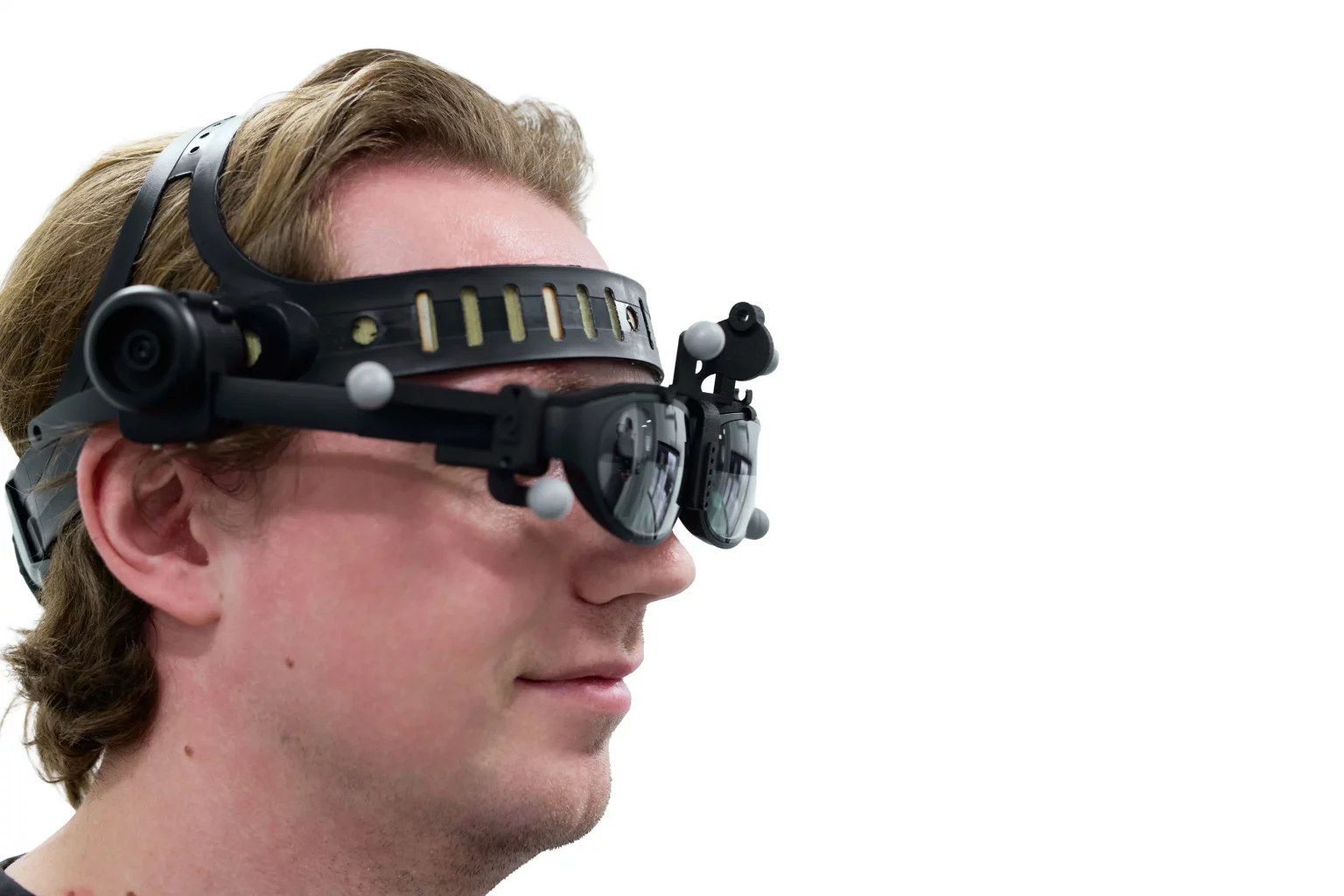
That is not a consumer headset story. It is enterprise AR with a clear clinical job: keep the surgeon’s eyes on the patient while still showing planned trajectories, not on a monitor across the room. For XR readers watching surgical spatial computing after Stryker’s Vision Pro SportSuite milestone, this is the other stack — a purpose-built 320 g AR headset with proprietary 3D stereoscopic targeting, not a general-purpose face computer adapted to the OR.
What the study actually measured
The full open-access paper — Abdulhak et al., J Spine Surg 2026;12(6):88 — describes 80 pedicle screws placed by three experienced spine surgeons across five cadaver specimens (including osteoporotic anatomy). Fifty-five screws used a minimally invasive approach; 25 were open. Thirty-four were thoracic (T5–12); 46 were lumbosacral (L1–S1). Intra-operative cone-beam CT (Medtronic O-arm) registered the plan; post-operative spiral CT scored placement.
Radiographic accuracy hit 100% under accepted Heary I/II and Gertzbein-Robbins A/B thresholds. Seventy-six screws were fully intra-pedicular (Heary I / GR A). Four were intentionally planned with an in-out-in technique for pedicles smaller than the available screw diameter. No medial or inferior breaches. No canal or foraminal violations.
Quantitative 3D analysis compared planned trajectories to implanted screws: mean positional error 1.1 ± 0.5 mm (range 0.22–2.72 mm) and mean angular error 1.3° ± 0.5° (range 0.39–3.85°). Exploratory subgroups found no significant surgeon-to-surgeon difference; MIS edged open on both PE and AE in this sample.
Why the authors say the error is this low
The paper’s discussion is unusually specific about mechanism. The OnPoint headset is listed at about 320 grams including tracking arrays — lighter than several competing surgical HMDs cited in the literature. Display resolution is 1,920×1,080 per eye on micro-OLED. Custom Zeiss lens inserts, optional loupes, and a headlight stay on the same frame, so the surgeon does not swap hardware mid-case.
The headline feature is 3D stereoscopic targeting that magnifies positional and angular deviation roughly ten times and overlays those cues directly on the entry point and instrument shaft. Concentric circles for tip and angle, plus a purple “10×” positional box, sit in the center of the surgical view while the instrument advances. Green trajectory color appears when PE stays under 1.5 mm and AE under 3.0°.
Registration uses an imaging phantom mechanically coupled to the spinal reference frame during the O-arm spin rather than optical scanner tracking. OnPoint also claims a patent-protected display-alignment step so headset seating does not throw off the overlay. Surgeons keep tactile feedback — the paper contrasts that with robotic skiving risk when the hand is out of the loop.
Benchmarks, with the caveats intact
OnPoint’s PR and the paper both compare against published navigation (Brainlab, Stealth, Stryker Nav3i, 7D), robotics (Mazor X, Excelsius), and AR (Augmedics xvision, Brainlab Magic Leap, Novarad VisAR) accuracy series. Cross-study PE/AE increments versus OnPoint ranged roughly 24–81% for position and 41–80% for angle in the authors’ framing, with Welch t-tests reported as highly significant in most pairwise checks.
The paper is careful where it needs to be. This is cadaver data, not live clinical outcomes. Cross-study comparisons are contextual benchmarks, not a head-to-head RCT — anatomy, measurement methods, and case mix differ. Some comparator papers measured error on 2D slices rather than true 3D. Funding and advisory ties to OnPoint are disclosed. Three authors sit on the company’s scientific advisory board; the company paid OR rental, specimens, and CT costs.
Where this sits on the XR beat
Surgical AR is no longer a demo reel. Augmedics, Stryker’s Vision Pro SportSuite path, and now OnPoint’s published millimeter-scale numbers are competing on workflow and accuracy, not novelty. OnPoint’s bet is a purpose-built HMD that keeps loupes, headlights, and magnified deviation cues in one line of sight — closer to an instrument than to a consumer spatial computer.
What is confirmed: FDA-cleared OnPoint AR platform; peer-reviewed cadaver accuracy of 1.1 mm / 1.3° over 80 screws; 100% Heary/Gertzbein-Robbins accurate placement in this series; open paper dated with online publication earlier in 2026 and company publicity September 9. What is not confirmed here: live-patient outcome deltas, OR time or cost savings, or how the system behaves across longer clinical series and cervical indications the study did not test.
Sources: OnPoint Surgical / PR Newswire (Sep 9, 2026); Abdulhak et al., Journal of Spine Surgery (open access); article landing page; OnPoint Surgical.