October 27, 2026. Rokid used its Rokid Jungle 2026 event in Hangzhou to announce Rokid Color, its first FULL-COLOR AI glasses, alongside a second-generation Rokid Glasses 2 and a gesture-control ring called Rokid Ring. Rokid Color puts a color Micro LED display in front of both eyes in a 55-gram frame, starts at 4,999 yuan (roughly $700) in China, and ships from April 2027. It is the clearest sign yet that display glasses are moving past the single-color green text that defines most of today’s products.
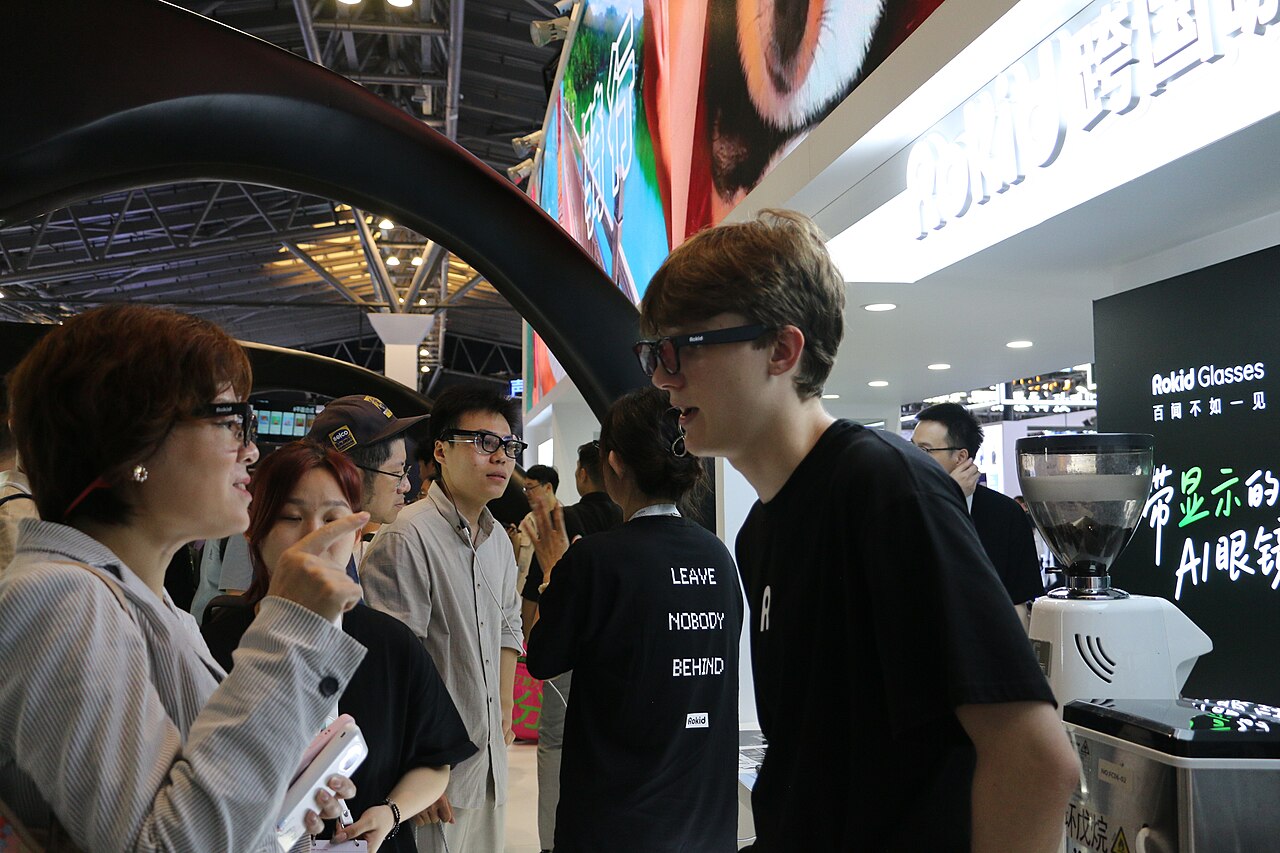
Rokid Color Specs: What the Company Announced
According to launch-day reporting from IT Home, Zhidx and TrendForce, the key numbers are:
- Display: a 0.16cc full-color Micro LED light engine custom-built with JBD, which Rokid compares to the size of a mung bean, rated for 16.77 million colors and a gamut of 167% sRGB.
- Optics: surface-relief diffractive waveguides, a 25-degree field of view and up to 1,000 nits of brightness.
- Architecture: TrendForce describes a “one-to-two” optical design, meaning a single light engine feeds both lenses. The image is binocular but not stereoscopic 3D.
- Weight: 55 grams, excluding nose pads, according to China National Radio.
- Controls: a touchpad on the temple, voice, a smartwatch or wristband, eye tracking, and the new Rokid Ring.
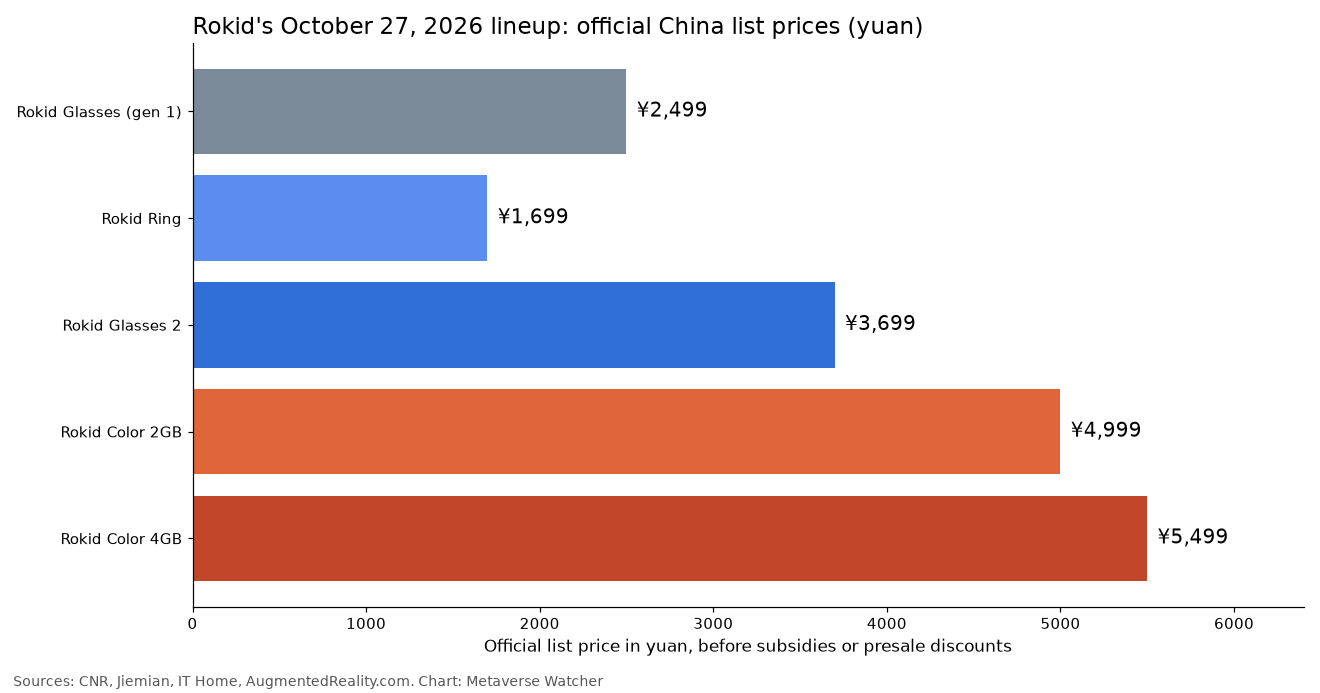
- Pricing: 4,999 yuan for the black 2GB + 64GB model and 5,499 yuan (about $770) for the tortoiseshell 4GB + 64GB model.
- Availability: deliveries roll out from April 2027. A deposit-style reservation (pay 99 yuan, get 300 yuan off) ran through midnight on October 28 in China.
Founder Misa Zhu Mingming told Zhidx the starting price was set to win users rather than to make money. After the event, he drew a line between the two glasses, per Jiemian: Rokid Glasses 2 is a tool, while Rokid Color is aimed at content and social use, such as color photo previews, short videos, video calls and casual games.
Rokid Ring: Gestures Instead of a Wristband
Input is the hard problem for any glasses with a real screen, and Rokid’s answer is a ring rather than a wrist strap. Zhidx reports that Rokid Ring reads micro-gestures: sliding a thumb along the index finger to skip a track, snapping to take a photo, and rotating a finger to scroll an app menu or change volume. It can also turn a flat surface into a touchpad and recognizes two-finger scrolling. The ring tracks heart rate, skin temperature, blood oxygen, calories and sleep.
It costs 1,699 yuan (about $240), or 998 yuan for existing Rokid glasses owners during presale. The comparison is obvious: Meta sells its monocular Ray-Ban Display glasses with the Neural Band, an EMG wristband, for $799 in the US. Rokid is betting that a ring is easier to wear all day. That is a reasonable bet, but it remains a claim until reviewers test how reliably a ring detects a finger snap on a moving train. For background on the wrist-based approach, see our look at the $499 Mudra Link EMG wristband.
Rokid Glasses 2: The Practical Upgrade, Available Sooner
For buyers who do not want to wait until 2027, Rokid Glasses 2 is the near-term product. It keeps a single-color green Micro LED display, which TrendForce notes is still the norm for this year’s Chinese display glasses, but changes almost everything around it. Jiemian lists the official details:
- Price: 3,699 yuan for classic black (3,199 yuan after China’s national subsidy) and 3,849 yuan for tortoiseshell (3,349 yuan after subsidy). A second-generation charging capsule costs 599 yuan.
- Chips: Qualcomm AR1+ Gen 1 plus a Bestechnic BES2800BP, running Android and an RTOS side by side to balance performance and battery life.
- Display: an optical engine 30% smaller than before, with rainbow artifacts cut by 60%, reflectivity cut by 70% and in-coupling efficiency up 30%.
- Battery: 263mAh, 25% more than the first generation. The new 335mAh charging capsules and a 1,500mAh case can recharge the glasses six times, and reach 90% in 30 minutes.
- Audio and voice: new speakers with Dolby-certified sound, four omnidirectional microphones and a bone-conduction microphone.
That price is a notable step up from the first-generation Rokid Glasses, which sold for 2,499 yuan, as AugmentedReality.com points out.
Why Full Color Matters, and the Caveats
Monochrome green displays are good enough for captions, translation and turn-by-turn arrows, but they cannot show a photo preview, a map with colored routes or a video. Full color changes what glasses can be used for. Rokid is not alone: TrendForce notes that RayNeo announced its fourth-generation binocular full-color iO+ glasses on the same day, and Brilliant Labs just shipped Halo with a full-color microOLED display at $399. The supply side is moving too, as we covered in our report on Samsung and LG’s AR glasses displays.
Rokid also carries weight in this market. It is one of the four brands that TrendForce says together hold more than half of AR glasses sales, a market the firm expects to reach 1.31 million units shipped in 2026. The company has been building services around its hardware, including voice ride-hailing with Tencent Mobility.
The caveats are real. Rokid Color is a launch announcement, not a reviewed product, and it does not ship for about six months. A 25-degree field of view is modest, and a single light engine split across two lenses limits depth effects. Battery life for Rokid Color was not among the figures in the reports we reviewed, and none of them gave international pricing or release dates. Until someone wears it outdoors in daylight, the 1,000-nit figure is a specification, not a verdict.
The Bottom Line
Rokid Color puts a credible price on full-color, all-day display glasses: about $700 in China, at a weight close to ordinary eyewear. Rokid Glasses 2 is the safer purchase today, and the ring is the most interesting experiment in the lineup. For a broader view of what is available now, read our guide to the best smart glasses of 2026.
Sources: China National Radio, Jiemian, IT Home, Zhidx, TrendForce, AugmentedReality.com. US dollar figures are approximate conversions.