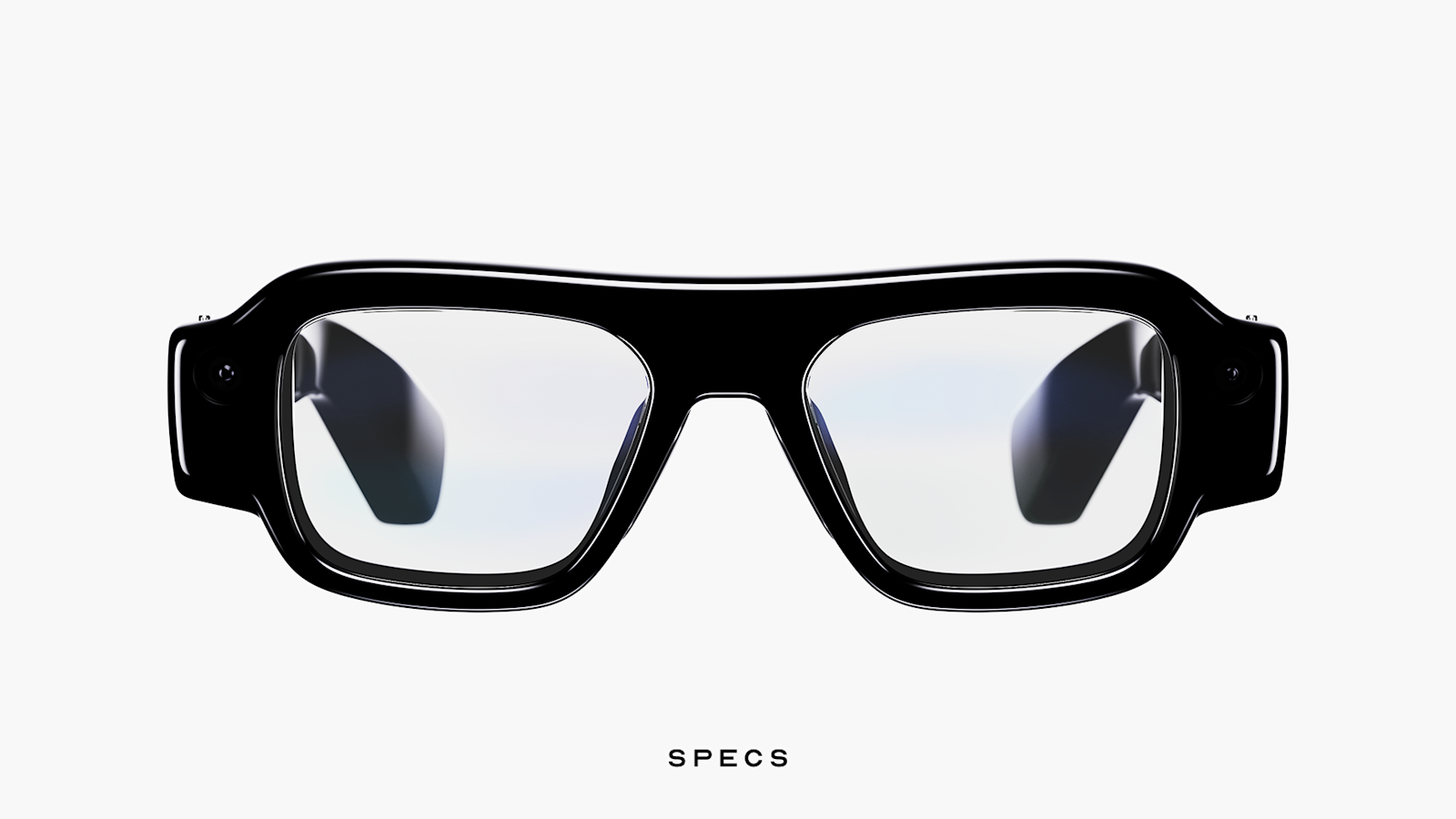
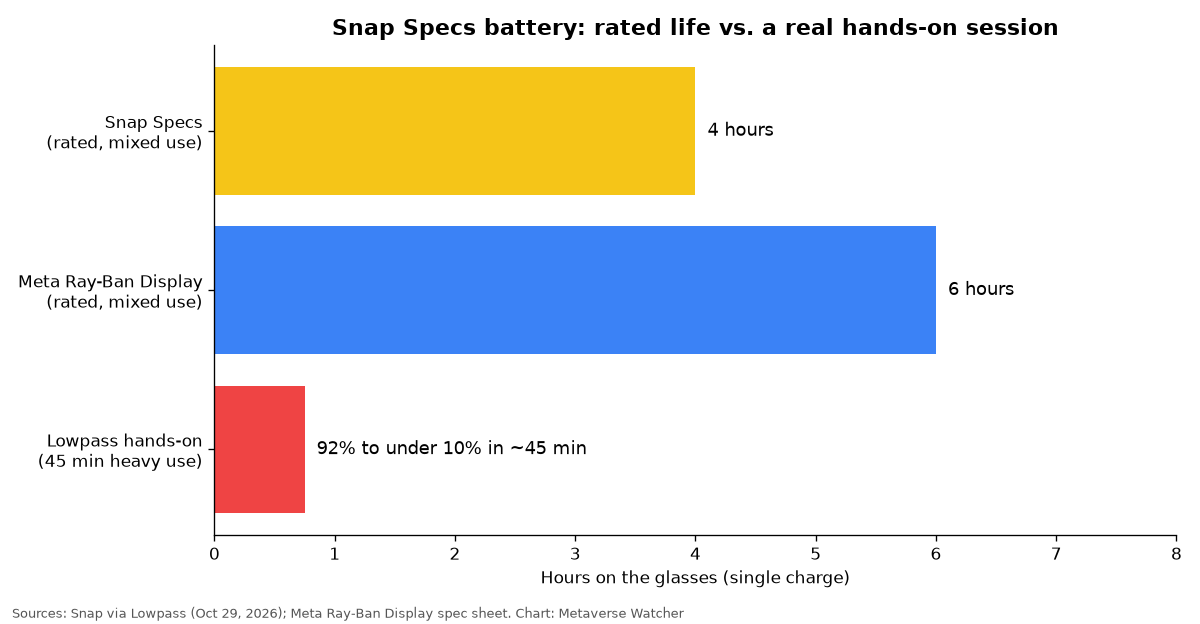
Snap Specs are close to shipping, and the first extended hands-on reports published on October 29, 2026 point to the same weak spot: battery life. Snap says its $2,195 standalone AR glasses last up to FOUR hours of mixed use, with a charging case that adds four more charges. In a 45-minute press demo, though, one reviewer watched the battery fall from 92% to under 10%.
What the Snap Specs battery test showed
Janko Roettgers of Lowpass spent roughly 45 minutes with Specs while Snap representatives demoed the device to press in San Francisco this week. He watched videos, played AR games, made a video call and tried several other Lenses, which he described as heavy use. When he put the glasses on, the indicator read 92%. By the end, it was below 10%.
Two details matter for reading that result fairly. The glasses started at about 50% brightness indoors, and Roettgers raised brightness to near maximum after stepping onto a balcony, where he struggled to read the AR menus. Bright outdoor use is a known drain on any waveguide display. Even so, his conclusion was blunt: buyers should expect “range anxiety,” and a full-length movie on one charge is unlikely.
Snap’s own figures, as relayed to Lowpass, are up to four hours of mixed use per charge. That figure covers everything from immersive Lenses to Bluetooth audio with the display off, so display-heavy sessions will land well below it. The included case supports up to four additional charges.
Why Specs drain faster than puck-based glasses
The trade-off is architectural. Specs are fully standalone: two Qualcomm Snapdragon processors, LCoS light engines, custom waveguides and the battery all live in the frame. That is why the glasses weigh around 135 grams, about twice a pair of Ray-Ban Meta AI glasses. Competing devices move the compute and battery off the face. XREAL Aura keeps its glasses under 95 grams by putting a 4,455 mAh battery, the chip and a cooling fan into a 265-gram tethered puck. Meta’s upcoming VR Glasses and Apple’s Vision Pro use the same split approach.
A standalone frame has a hard ceiling on battery volume. A puck can simply be bigger. Snap chose the cleaner, cable-free design and accepted shorter sessions plus a case-charging routine.
Snap Specs vs. rival glasses: battery, weight and price
| Device | Design | Rated battery | Weight | US price |
|---|---|---|---|---|
| Snap Specs | Standalone AR, waveguide | Up to 4 hrs mixed use; case adds 4 charges | ~135 g | $2,195 |
| Meta Ray-Ban Display | Monocular display glasses | 6 hrs mixed use; ~30 hrs with case | 69 g | $799 |
| XREAL Aura | Wired AR glasses + compute puck | Not specified in sources cited; 4,455 mAh puck battery | 95 g glasses, 265 g puck | $1,099 launch price (normally $1,279) |
These devices are not direct substitutes. Ray-Ban Display shows a small 20-degree heads-up panel, while Specs render full 3D AR objects around you. Still, the table shows why battery will shape how people actually use Specs: as a device for short sessions, not one you wear all day.
Other hands-on impressions: fit, brightness and software
A separate hands-on from WIRED’s Boone Ashworth, also published October 29 after a public demo at Westfield Century City in Los Angeles, was more positive on comfort. He found Specs lighter than they look, said they stayed put during AR push-ups, and noted that Specs come in two sizes. In direct sunlight at full brightness, the AR elements stayed visible, and the lenses dimmed automatically in what Snap calls “sunglasses mode.”
The criticism there focused on software. Ashworth reported finicky pinch controls, rainbow shimmer from the waveguides even with AR off, Bluetooth keyboard lag during a Google Docs demo, and Lenses that felt like advertising. He concluded that Specs “lack a killer feature” at their price. Snap told WIRED that “the hardware, software, available experiences and price all need to develop together.”
What this means for buyers
- Plan for the case. Specs depend on top-ups from the charging case. Treat four hours as a best case, not a typical session with the display on.
- Outdoor use costs more. Both reviewers raised brightness outside, and Lowpass ties that directly to faster drain.
- Specs suit short sessions. Specs fit navigation, quick games, calls and creative Lenses better than movies or full workdays.
- Wait for full reviews. Snap says Specs ship before the end of 2026. Independent battery testing on retail units will matter more than demo-floor impressions.
For earlier coverage, see our Snap Specs outdoor demo report from New York and Snap’s Robert Downey Jr. appointment. To compare Specs with everything else arriving, read our upcoming smart glasses tracker, the best smart glasses of 2026, and our report on the XREAL Aura launch.