Raven Resonance has opened orders for Raven Prism 1, a pair of display glasses that is not a phone accessory at all. It is a standalone computer running a Linux-based operating system, with a full-color display in the right lens, eye-gaze and voice control, and hot-swappable batteries. The San Francisco company launched it publicly on Oct. 29, 2026 alongside light-engine partner Avegant, with a starting price of $1,499 and first shipments planned for January 2027.
Most smart glasses on sale this fall, from Meta Ray-Ban Display to Even G2, lean on a paired phone for apps and connectivity. Raven is betting that developers and professionals want the opposite: glasses they can SSH into and run their own software on. Here is what the company has confirmed, what it costs, and how it compares.
What Raven Prism 1 is
Raven calls the product an “ambient computer”: a screen that sits in the corner of your vision when you need it and stays out of the way when you don’t. According to the Avegant launch announcement, a full-color image appears in the right eye through a single waveguide with a 30-degree diagonal field of view, which Raven compares to a 16-inch laptop screen at arm’s length. The light engine is a full-color LCoS design from Avegant, and Raven’s developer page rates the display at more than 1,500 nits, bright enough to stay readable outdoors.
The glasses do not need a phone. Inside is a quad-core 64-bit ARM processor with up to 4 GB of RAM and 32 GB or more of storage, plus dual-band Wi-Fi and Bluetooth 5 with Low Energy, so keyboards, mice and controllers can connect directly. Raven says the frame weighs under 70 grams and ships with more than 25 apps through its own store, covering uses such as a portable second screen, browser video, turn-by-turn directions beamed from a phone, recipes and boarding passes.
Why the Linux angle matters
The software is the real differentiator. Raven OS is a custom Linux distribution for wearables, with a Wayland compositor and OpenGL ES for 2D and 3D graphics. The developer page promises “full chroot access” and says that if a program runs on ARM64, it runs on the glasses. Developers can SSH in, use any language or toolkit, and build against an SDK that Avegant says is published on GitHub.
That is a very different model from Meta’s or Google’s. Meta Ray-Ban Display apps run through Meta’s own platform, and Android XR glasses such as XREAL Aura run Google’s stack with Gemini built in. An open Linux device gives tinkerers, researchers and enterprise IT teams root-level control, much as Valve’s approach has done for PC VR, a theme we have followed in our coverage of Steam Frame’s Linux kernel support. The trade-off is that Raven has to build an app ecosystem from scratch, and 25 launch apps is a small start.
Controls, camera and privacy
Raven Prism is driven mainly by where you look. Dedicated eye sensors feed eye-control models from Pupil Labs and Raven itself, and the company’s pre-order announcement says the eye control is “privacy-preserving” and implemented in hardware. Voice commands and Bluetooth peripherals fill in the rest.
There is a 13 MP world-facing camera with an 84-degree horizontal field of view, four beamforming microphones and two downward-facing speakers. Given the scrutiny camera glasses now face, including the senators’ questions to Meta over smart glasses privacy, Raven’s choices here are notable: the camera has a physical cover that the wearer slides open, and illuminated indicators show when sensors are active.
Specs at a glance
| Spec | Raven Prism 1 |
|---|---|
| Price | From $1,499; $49 refundable reservation |
| Display | Full-color LCoS (Avegant light engine), single diffractive waveguide, right eye |
| Field of view | 30 degrees diagonal |
| Brightness | 1,500+ nits |
| Processor and memory | Quad-core 64-bit ARM, up to 4 GB RAM, 32 GB+ storage |
| Software | Raven OS (Linux), SSH, native ARM64 apps, 25+ apps at launch |
| Input | Eye control, voice, Bluetooth peripherals |
| Camera | 13 MP, 84-degree horizontal FOV, physical cover |
| Audio | 4 beamforming mics, 2 downward-facing speakers |
| Battery | Hot-swappable “Raven Wings,” two pairs in the box |
| Weight | Under 70 g |
| Prescription | Built in; -4.5 to +4.5 diopters for the current batch |
Price, batches and when it ships
Raven Prism is priced from $1,499, and buyers hold a place with a fully refundable $49 deposit. Raven says the glasses are made in batches in the US. Its reservation page, checked Nov. 2, lists Batch 1 (January 2027) and Batch 2 (early 2027) as full and Batch 3 (spring 2027) as almost full, with those slots reserved for early supporters. New general reservations go into Batch 4, scheduled for summer 2027. In practice, someone ordering today should not expect glasses for roughly eight months.
Shipping is limited to the United States for now, with the European Union listed as “soon.” The box includes the glasses and two pairs of Raven Wings batteries, and frame color, RAM and storage are chosen later. Prescription lenses are built in from -4.5 to +4.5 diopters for this batch, and Raven says later batches will widen the range and add progressive lenses. That range is a little wider than Meta Ray-Ban Display’s -4.00 to +4.00 but far narrower than Even G2’s ±12.00.
How it compares
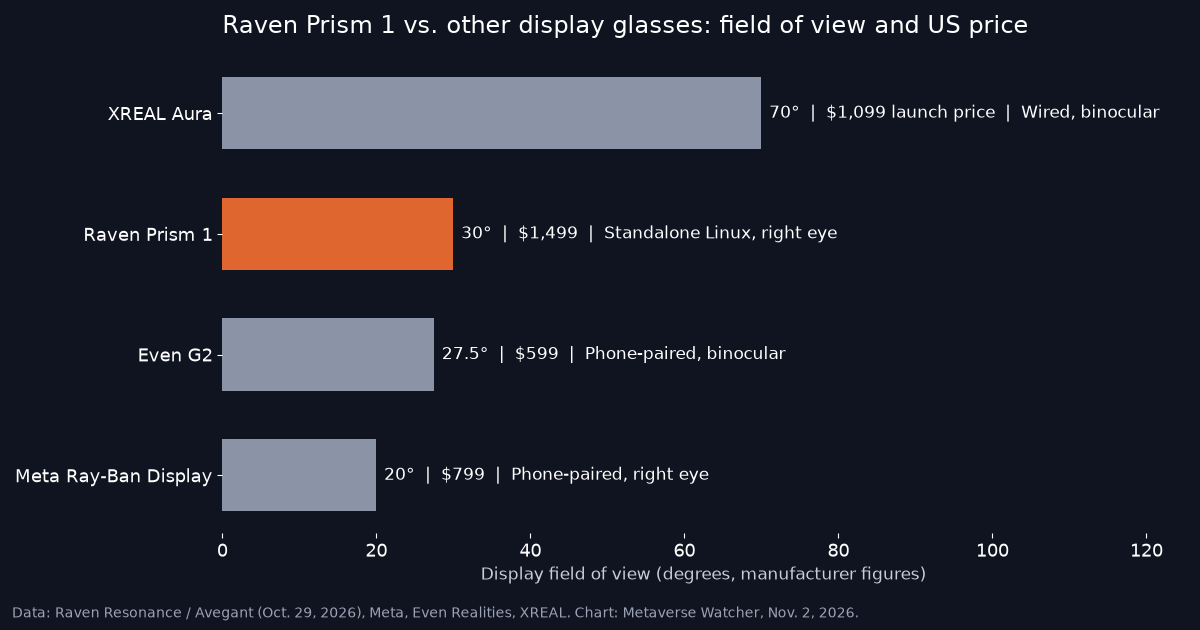
At $1,499, Raven Prism costs nearly twice as much as Meta Ray-Ban Display ($799 with the Neural Band) and well over twice the $599 Even G2. Its 30-degree view is wider than Meta’s 20 degrees and Even’s 27.5 degrees, but it is a single-eye display, so it is built for glanceable information rather than immersive video. XREAL Aura offers a 70-degree binocular view for less money at its launch price, but it is a tethered Android XR device with a different purpose. Raven’s case rests on three things none of those rivals combine: a standalone computer, an open Linux stack and gaze control. For a wider look at what is coming, see our upcoming smart glasses 2026–2027 tracker and our best smart glasses of 2026 list.
So the Raven Prism #smartglasses cost $1,499 and can be reserved with a $49 deposit
— TonyVT SkarredGhost (@SkarredGhost) October 31, 2026
The bottom line
Raven Prism 1 is the most open pair of display glasses announced this year, and its hardware choices on privacy, gaze input and swappable batteries are thoughtful. It is also expensive, monocular, unreviewed and, for new buyers, months away. Developers who want a Linux wearable they fully control have a real reason to put down $49. Everyone else should wait for hands-on reviews and battery-life figures, which Raven has not yet published.