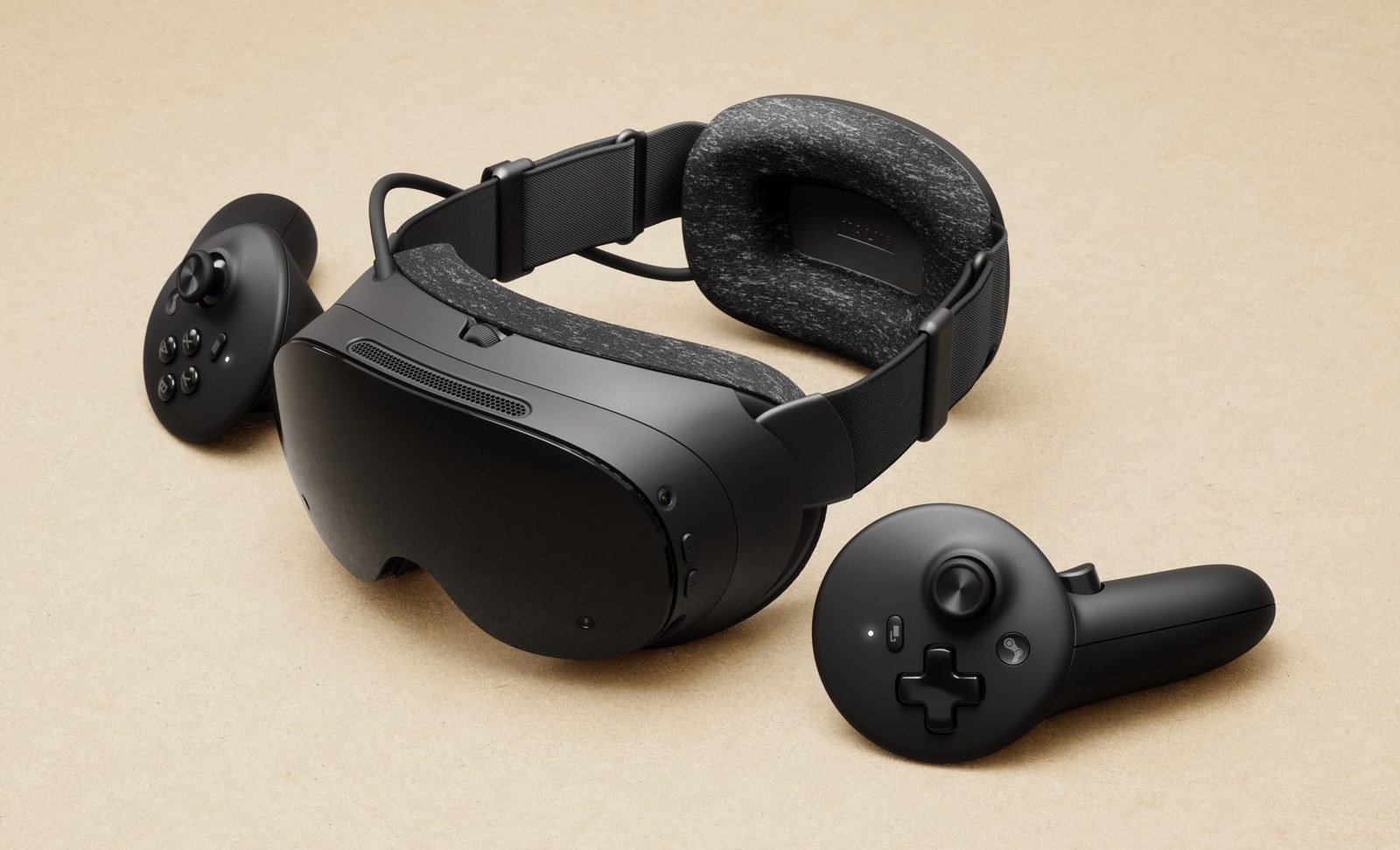
Valve’s Steam Frame now has initial support in the mainline Linux kernel. The headset’s Device Tree, filed under its “Deckard” codename, was merged on Sunday, October 25, as part of the Linux 7.4 SoC pull, Phoronix reported. The same week, a separate commit in Valve’s own Frame kernel tree added drivers for external CD-ROM drives, about nine minutes after a Valve developer told a forum user the company would “look into” it. Here is what each change actually does, what it does not do yet, and what Steam Frame owners should expect.
What landed in Linux 7.4
The upstream patches were written by Neil Armstrong of Linaro and describe the Frame’s hardware to the kernel so a standard Linux build can boot on it. According to Phoronix, the initial support covers:
- The Snapdragon 8 Gen 3 (SM8650) SoC, reserved memory regions and voltage regulators
- GPIO keys, PMIC functions and the PMIC ADC
- UFS internal storage and the SD card slot
- USB in gadget mode
- The WCN7850 Wi-Fi 7 and Bluetooth combo chip
- I2C and other basic peripherals
Phoronix also notes that the Frame’s bootloader starts Linux in EL2, the hypervisor exception level on Arm, which makes it simpler to boot a standard kernel than on devices where firmware keeps that level for itself. The list is just as notable for what is missing. Displays, tracking cameras, eye tracking and the rest of the VR stack do not appear in the initial support list. Phoronix is clear that the most complete support remains in Valve’s downstream SteamOS kernels.
Why mainline support matters
A device supported only by a vendor’s downstream kernel lives or dies by that vendor’s patch cadence. Once its Device Tree is upstream, every future kernel release carries it, kernel maintainers review changes to it, and other distributions can build for it without carrying Valve’s patches. TechPowerUp points out that this could eventually allow alternative Linux distributions on the headset. In practice that means a general-purpose Arm Linux desktop is plausible long before anything resembling a full VR experience outside SteamOS, because the display and tracking pieces are the hardest to upstream.
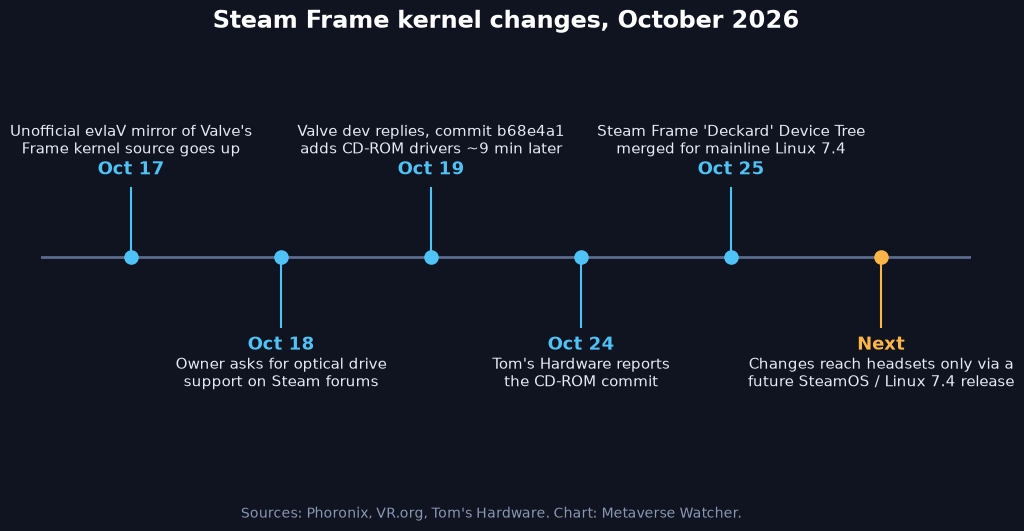
For Valve, upstreaming lowers the long-term cost of keeping the Frame current. It also fits with Valve publishing the Frame’s kernel source, which an unofficial mirror spread across 24 GitHub repositories in mid-October. Developers have already used that code to dig into the Frame’s display details.
The nine-minute CD-ROM commit
The second story started on the Steam forums. On October 18 at 9:19 a.m. PT, a user posting as Aiodensghost asked for optical drive support so they could use an external drive with the headset for older games and films. Valve developer Gabe Rowe replied on October 19 at 12:43 p.m. PT with “we will look into this thanks for alerting us.” According to VR.org’s analysis of the timestamps, commit b68e4a1 landed 8 minutes and 53 seconds later.
The change itself is small. It enables three existing kernel options as modules in the Frame’s kernel configuration, arch/arm64/configs/gabe_defconfig:
CONFIG_CDROM=m, the core CD-ROM layerCONFIG_BLK_DEV_SR=m, the SCSI CD-ROM driver used by USB optical drivesCONFIG_CHR_DEV_SG=m, the SCSI generic interface that ripping and burning tools use
The commit message reads “for parity with steamdeck/machine,” which explains the speed. Valve did not write new code. It turned on drivers that already ship in Steam Deck’s kernel. Tom’s Hardware first reported the commit on October 24 and noted it sits in Valve’s deckard-linux-no-oopsies repository, so technically minded owners could build the kernel themselves. PC Gamer followed two days later.
Steam Frame kernel updated with external CD-ROM drive compatibility just one day after a user asked Valve for it
— Rock Paper Shotgun (@rockpapershot) October 27, 2026
What Steam Frame owners can actually do today
Neither change is on retail headsets yet. The CD-ROM drivers have not shipped in a SteamOS update, and Valve has given no date. The Linux 7.4 work only reaches users once that kernel is released and Valve or another distribution builds on it. If you want to try optical media when the update arrives, keep these limits in mind, based on VR.org’s reporting:
- You will need a powered USB optical drive or a powered USB hub.
- Kernel drivers only let the system read the disc. They do not add DVD or Blu-ray playback software or decryption.
- Older PC games with disc copy protection, such as the SafeDisc-protected Need for Speed: Carbon that prompted the request, may still fail under Proton and the FEX x86 emulator.
For everyday use, the bigger factors are still battery life and streaming setup. Our Steam Frame Wired review covers battery and pairing. Recent SteamOS 3.9.3 beta changes show where Valve’s own software work is focused. If you are still waiting on hardware, see how to check your Steam Frame order wait.
The bottom line
Mainline Linux 7.4 support is the more important change for the long run. It moves the Steam Frame toward being an open Arm computer that any distribution can target, even though VR features stay in SteamOS for now. The CD-ROM commit is minor in technical terms, but it shows how quickly Valve can act when a request only needs a kernel configuration change. If you are still deciding whether to buy one, our Steam Frame vs Quest 3 buying guide and roundup of the best VR headsets of 2026 compare the options.