By Metaverse Watcher staff. Published October 28, 2026.
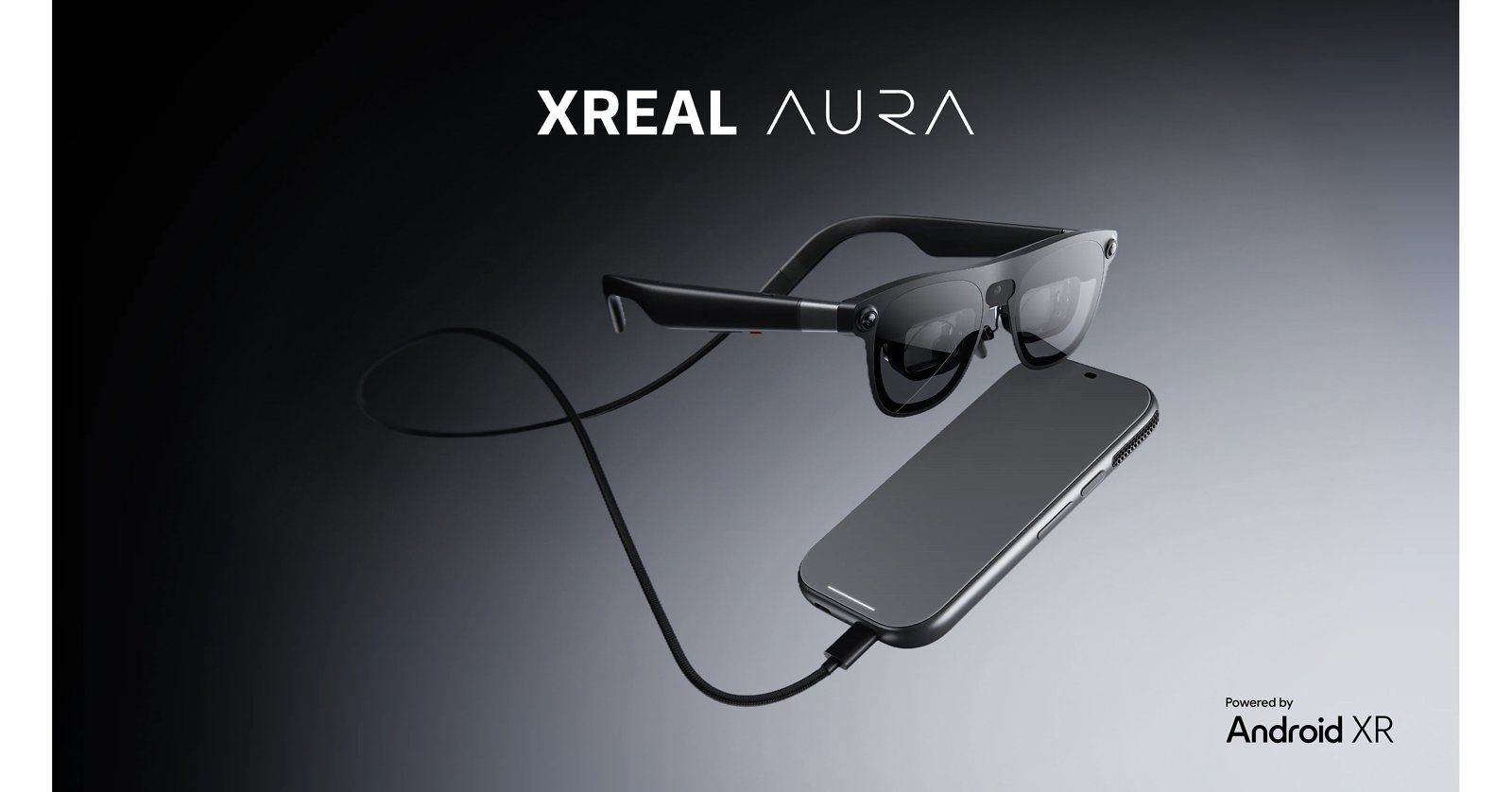
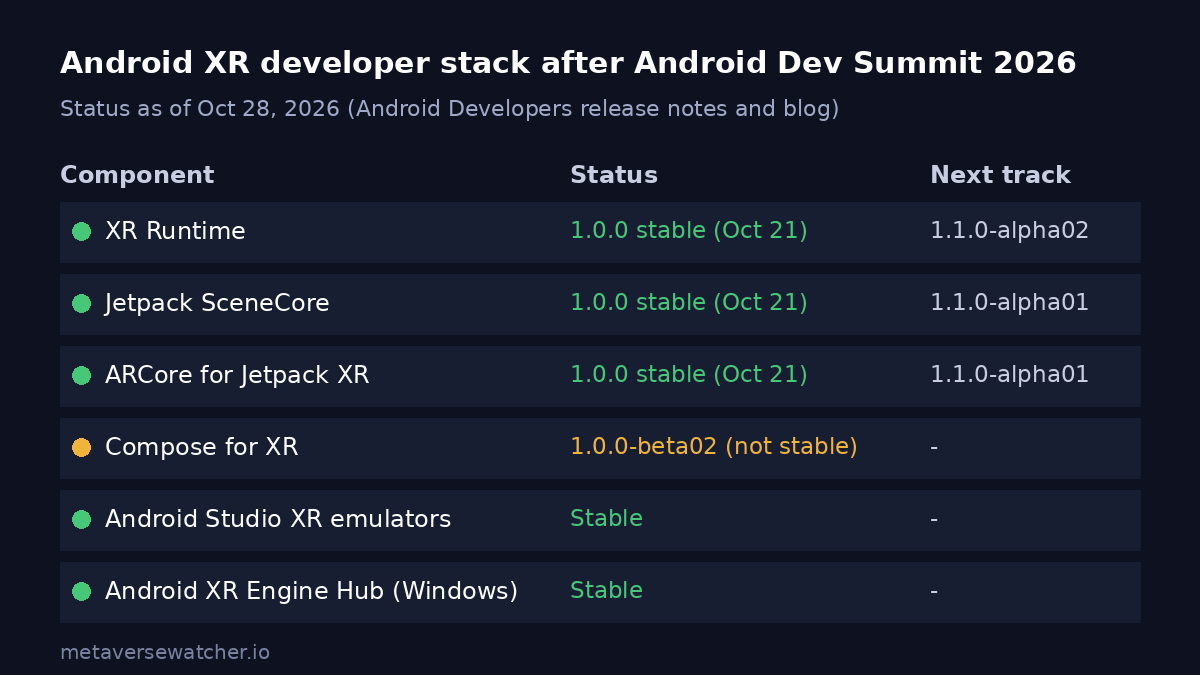
Google used its Android Dev Summit on Wednesday to move the core of the Jetpack XR SDK out of preview. XR Runtime, Jetpack SceneCore and ARCore for Jetpack XR are now STABLE at version 1.0.0, the Android Studio XR emulators and the Android XR Engine Hub have also graduated, and Geospatial APIs are now part of the production toolset. The timing is not accidental: the same keynote opened orders for the XREAL Aura at $1,099, the first wired glasses running Android XR.
What Google declared stable
In its Dev Summit recap, Android’s developer product team listed four XR items that are now generally available:
- Core Jetpack XR libraries. Google says SceneCore, ARCore for Jetpack XR and XR Runtime now come with production-ready APIs, long-term API stability and backward compatibility.
- Android Studio XR emulators. Developers can build and visually check apps for wired XR glasses, audio glasses and display glasses without owning the hardware.
- Android XR Engine Hub. The Windows desktop tool for Unity, Godot and Unreal now ships as stable, with a dedicated workflow for starting and analyzing performance traces.
- Geospatial APIs. Available in ARCore for Jetpack XR and in Unity, they let apps anchor content to real-world locations on wired XR glasses and on Google’s “intelligent eyewear.”
The library release notes show the binaries actually landed a week before the keynote. XR Runtime, SceneCore and ARCore for Jetpack XR all published 1.0.0 on October 21, 2026, and each has already opened a 1.1 alpha track. That ends a run that went through release candidates in September and October, which we tracked in our coverage of the first Jetpack XR release candidate and SceneCore RC02’s memory-leak fixes.
What each stable library does
According to Google’s release notes, XR Runtime holds the common classes, interfaces and utilities that the other Jetpack XR libraries share. SceneCore is the scene graph: it places 2D panels and 3D models, sets spatial environments and spatial audio sources, and anchors virtual content to the room. ARCore for Jetpack XR supplies perception, including motion tracking, persistent anchors, hit testing, plane detection with semantic labels such as floor, wall and tabletop, and Geospatial poses from Google’s Visual Positioning System (VPS).
The Geospatial piece matters most for glasses. When Google first previewed it in Developer Preview 4 in May, it said VPS anchoring covered more than 87 countries and pitched it alongside the Gemini Live API for location-aware experiences such as guided walking tours. The new 1.1.0-alpha01 build of ARCore already adds horizontal, vertical and yaw accuracy readouts to the Geospatial state, plus a new SpatialAnnotation API for tracking bounded 3D shapes in the physical world.
The caveat: Compose for XR is still in beta
“Stable” does not yet cover the whole stack. Jetpack Compose for XR, the declarative UI layer most Android developers will use to put spatial panels and orbiters around existing apps, was at 1.0.0-beta02 on October 21. That beta also carries a known issue: it depends on SceneCore 1.0.0-rc01, which has a memory leak, so Google tells developers to override the dependency to SceneCore 1.0.0 in their build configuration. Beta02 also requires Kotlin 2.2 and removes several deprecated APIs, so teams that built against earlier alphas should expect some migration work.
In practice, studios can now ship engine-based or SceneCore-based apps on APIs Google has committed to keep, while Compose-heavy app teams are building on a beta UI layer for a little longer.
Why the emulator and Engine Hub matter
The hardware base for Android XR is still small. Samsung’s Galaxy XR headset is on sale, the XREAL Aura ships in mid-November in the U.S., Canada and South Korea (with Japan orders opening November 2), and other glasses are still on the way. Stable emulators let developers target the glasses form factors without buying each device, a point Digital Trends also highlighted, noting that buying hardware just to test an app is not practical for every developer.
For game developers, the Engine Hub brings Direct Preview, which streams live device data into the Unity, Godot or Unreal editor so developers can skip the build-and-deploy loop. It can also capture Perfetto performance traces, reduce them locally to CPU, GPU and frame-timing summaries, and optionally send those summaries to Gemini with the developer’s own Google AI Studio key for optimization suggestions. It also handles APK sideloading and perception-permission toggles. It remains Windows-only. We covered Direct Preview’s limits when it was in preview in our Engine Hub explainer.
How it compares
Meta’s Horizon OS and Apple’s visionOS already give developers stable, versioned SDKs tied to shipping headsets. Google’s pitch is different: one Android toolchain that spans a headset, wired glasses, display glasses and audio-only glasses, with existing Google Play apps running as 2D panels from day one. With today’s release, the lower layers of that toolchain carry the same compatibility promise as the rest of Jetpack. The remaining gap is the Compose for XR UI layer, and the size of the installed base that apps can reach.
What to watch next
- A stable Compose for XR 1.0 release, which would complete the core developer stack.
- The 1.1 alpha features, including SpatialAnnotation and the richer Geospatial accuracy data, moving toward beta.
- Whether app counts on the XREAL Aura grow beyond the 150-plus “made-for-XR” experiences Google and XREAL listed at launch.
- More glasses hardware. Our report on Android XR glasses phone pairing in Play Services shows the plumbing for phone-tethered eyewear is already rolling out.
New to the platform? Start with our guide, What Is Android XR? Devices, Glasses and Apps.
Sources: Android Developers Blog (Oct 28, 2026); Jetpack release notes for XR Runtime, SceneCore, ARCore for Jetpack XR and Compose for XR; Android XR Engine Hub; Google Keyword; Digital Trends.