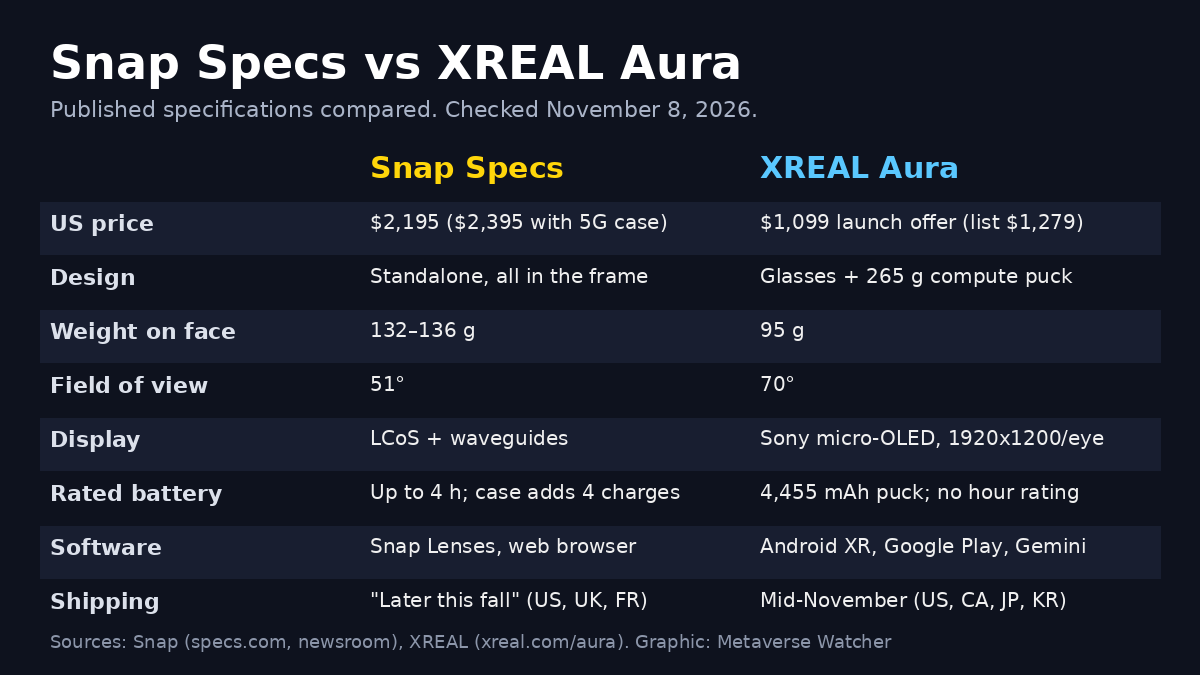
Snap Specs vs XREAL Aura is the comparison most people shopping for see-through AR glasses will make this holiday season. Both let you look at the real room with your own eyes rather than through cameras, both run their own app platforms, and both arrive in the same few weeks. But they are built on opposite ideas. Specs put the entire computer inside the frame. Aura moves the computer and battery into a cabled puck so the glasses themselves can stay light. That single design choice drives almost every difference in price, comfort, battery and software below.
This comparison uses the companies’ own published specifications and store listings, checked on November 8, 2026, plus the hands-on reporting we have tracked since launch. Metaverse Watcher has not tested either device, and we say so where it matters.
The Short Answer
Choose XREAL Aura if you mainly want a large private screen for movies, laptop work and handheld gaming, you will mostly use it seated, and you want Android apps and Gemini. It costs about HALF as much while the launch offer lasts, it ships first, and it doubles as a wired display for other devices.
Choose Snap Specs if you want AR you can walk around in, with no cable and nothing in your pocket, and you value Snap’s Lenses, navigation, translation and shared experiences over watching video from your laptop. You will pay $2,195 for that, and you will be working around a rated battery life of up to four hours.
Specs Side by Side
| Specification | Snap Specs | XREAL Aura |
|---|---|---|
| Form factor | Standalone AR glasses; compute and battery in the frame | Optical see-through glasses plus a cabled compute puck |
| Weight | 132 g (Narrow, 47 mm) / 136 g (Wide, 52 mm) | 95 g glasses; 265 g puck |
| Display | LCoS light engines with custom waveguides | Sony micro-OLED, 1920 x 1200 per eye, up to 120 Hz, 1,050 nits peak |
| Field of view | 51° | 70° |
| Processor | Two Qualcomm Snapdragon processors in the frame | Snapdragon Reality Elite (48 TOPS) in the puck; XREAL X1S coprocessor in the glasses |
| Input | Hands and voice | Hands, voice, puck touchpad, Bluetooth keyboards, mice and controllers |
| Battery | Up to 4 hours mixed use; case adds four charges (about 20 hours total) | 4,455 mAh (34.84 Wh) in the puck; no runtime rating on the product page |
| Software | Snap Lenses, Specs Intelligence, web browser, partner apps | Android XR with Google Play apps and Gemini |
| Video input from other devices | Not supported | DisplayPort Alt Mode over USB-C |
| Fit | Narrow and Wide frames | M (60–66 mm) and L (66–72 mm) IPD sizes |
| US price | $2,195; $2,395 with the 5G charging case | $1,099 (12GB/256GB) or $1,299 (16GB/512GB) through the end of the year; list $1,279 / $1,499 |
| Availability | Pre-order in the US, UK and France; shipping “later this fall” | Orders open in the US, Canada, Japan and South Korea; shipping from mid-November |
Sources: Snap’s SPECS store page, Snap’s newsroom and XREAL’s Aura product page, checked November 8, 2026.
Price and Availability
Price is the widest gap. Snap’s store lists Specs at $2,195 with a $200 refundable deposit, and Snap says the deposit is not an order confirmation: buyers pay the balance when Snap contacts them closer to the shipping window. A Wi-Fi plus cellular version with a 5G charging case costs $2,395 and needs its own data plan, which in the US comes from Verizon.
XREAL’s product page shows a limited-time launch offer through the end of the year: $1,099 for the 12GB/256GB model and $1,299 for 16GB/512GB, which XREAL says is $180 and $200 below the original prices. XREAL also states that people who already bought at the original price will be refunded the difference. After the offer ends, the list prices return to $1,279 and $1,499, as we detailed in our XREAL Aura launch coverage.
Timing favors Aura too. XREAL expects shipments from mid-November. Snap has still not named a date. On its November 4 earnings call, CEO Evan Spiegel said the company was “really looking forward to beginning to ship Specs later this fall,” as we reported in our Snap Q3 2026 earnings analysis. With fall ending December 21, anyone counting on a pair as a holiday gift has no guarantee.
Design and Comfort
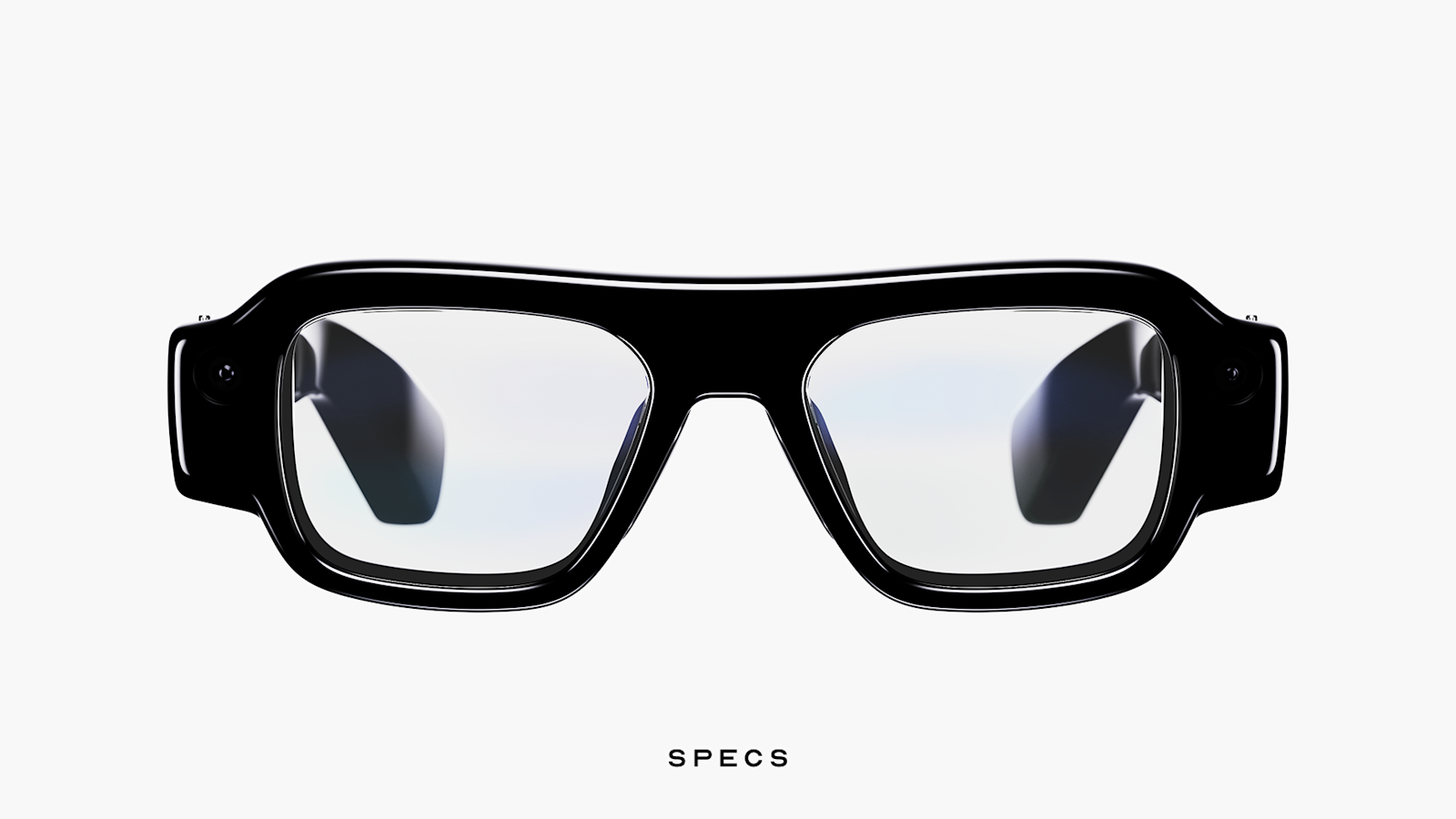
Snap’s approach is the cleaner one to wear: no cable, no puck, nothing to carry beyond the glasses and their case. The cost is weight on the face. At 132 to 136 grams, Specs weigh roughly 40 grams more than Aura’s glasses and about twice a pair of Ray-Ban Meta camera glasses. Early hands-on impressions on comfort have been mixed but generally better than the number suggests; WIRED found them lighter than they look during a public demo, as noted in our Specs battery life report.
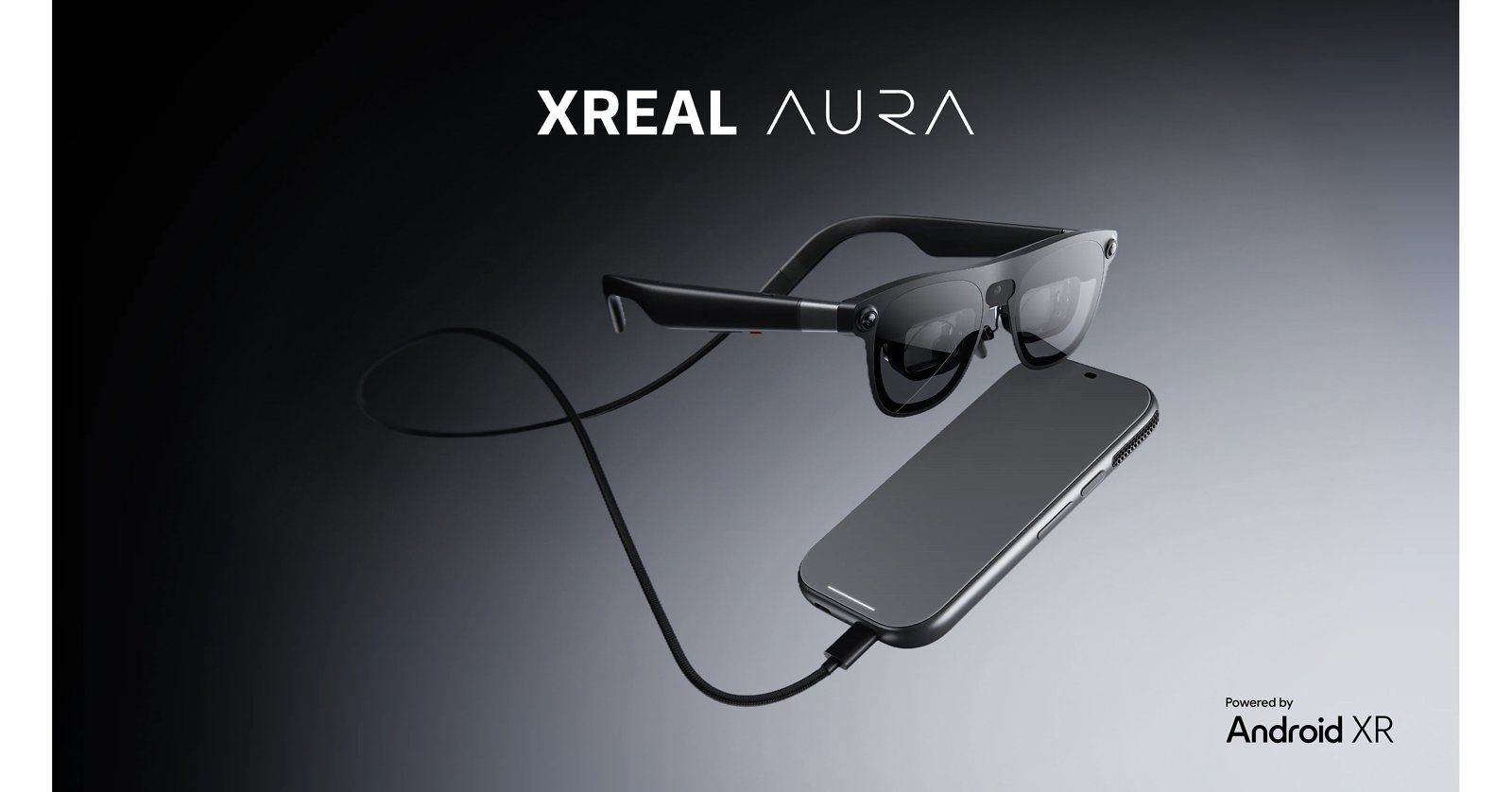
Aura puts only 95 grams on your head, but you carry a 265-gram puck with an active cooling fan and a cable running to it. For a plane seat, a couch or a desk, that is a small price. For walking around a city, it is the main reason Aura is better treated as a seated device.
Display and Field of View
On paper, Aura has the bigger and better-documented picture. Its 70-degree field of view is among the widest in see-through glasses, and XREAL publishes the full display data: 1920 x 1200 pixels per eye, up to 120 Hz, 1,050 nits peak brightness and five levels of electrochromic dimming.
Snap rates Specs at 51 degrees and compares the view to a 115-inch screen about 10 feet away, but it has not published resolution, refresh rate or brightness. The narrower window matters more for AR than for video: objects pinned in the room are cut off at the edges of the view until you turn your head, a limit UploadVR and Engadget both described in their hands-on reports. Bright daylight is also a challenge for waveguide displays; in the press session we covered, the reviewer turned brightness close to maximum outdoors.
Battery Life
Specs are rated at up to FOUR hours of mixed use, with the included case adding four more charges for about 20 hours in total. That figure includes lighter tasks such as audio with the display off. In one 45-minute press demo of heavy use, Lowpass saw the battery fall from 92% to under 10%. Snap’s design choice explains it: a frame has a hard ceiling on battery volume.
Aura’s battery lives in the puck: 4,455 mAh, or 34.84 Wh. XREAL’s product page does not give an hour rating, so buyers should treat runtime as unconfirmed until independent reviews arrive. The puck charges at up to 57 W over USB-C and can be topped up from a power bank or laptop during use, which is harder to do with glasses alone.
Software and Apps
This is where the two products differ most in daily use. Aura runs Android XR, Google’s platform for headsets and glasses, so it opens with access to Google Play’s mobile and tablet apps, a growing set of spatial apps, Google TV, YouTube, Google Photos with 3D conversion, Maps Immersive View and Gemini, which can answer questions about what you are looking at. Launch titles such as Fallout: Factions on XREAL Aura show how developers are using the optical see-through design for tabletop games.
Specs run Snap’s own platform. Apps are called Lenses, built in Snap’s Lens Studio, alongside a web browser that reaches services such as YouTube and HBO Max, Spotify, Specs Intelligence (Snap’s anticipatory AI service), live captions in dozens of languages and Connected Lenses for shared experiences with other wearers. Snap has also demonstrated outdoor navigation and calling, which we covered in our Specs New York outdoor demo report. The catalog is smaller than Google Play, but much of it is designed for walking-around AR rather than floating windows.
Using Them as a Screen for Other Devices
If you want glasses that act as a monitor, the choice is easy. Aura’s second USB-C port supports DisplayPort Alt Mode, so a laptop, phone, Steam Deck or other handheld appears as a window beside your Android XR apps. Our guide on connecting XR glasses to an iPhone, Switch or Steam Deck covers the setup. Specs do NOT accept video input from other devices at all.
Prescriptions and Fit
Aura comes in two IPD sizes, M for 60–66 mm and L for 66–72 mm, and XREAL warns that the wrong size can cause blurry edges and eye strain, so measure before ordering. Specs come in Narrow and Wide frames. Prescription inserts for Specs come from a partner at extra cost; Snap had not posted a price when we checked. Our prescription lens inserts guide explains what to look for with any headset or glasses.
Privacy
Both devices carry cameras with recording indicators. Aura has an RGB camera with a privacy LED for Gemini and capture. Snap says Specs do not use facial recognition or continuously record audio, video or images, and an external LED lights when recording is active. These are company statements rather than independent audits. If you plan to wear either at work, check your employer’s rules first; our report on smart glasses policies at work covers the bans and rules already in place.
XREAL announced the Aura launch on X:
Who Should Buy Which
| If you mainly want to… | Better pick | Why |
|---|---|---|
| Watch movies and streams on a big private screen | XREAL Aura | 70° view, published 1,050-nit micro-OLED panels, dimming lenses |
| Use a laptop or handheld console in glasses | XREAL Aura | DisplayPort input; Specs take no video input |
| Walk around with AR directions, captions and translation | Snap Specs | No cable or puck; built for use on the move |
| Play shared AR games with friends in the same room | Snap Specs | Connected Lenses designed for multi-user AR |
| Spend as little as possible | XREAL Aura | $1,099 launch offer through the end of the year |
| Have a pair before the holidays | XREAL Aura | Mid-November shipping; Specs still have no date |
The Bottom Line
For most buyers this fall, XREAL Aura is the safer purchase: it costs less, ships sooner, has a bigger published field of view and works with the devices you already own. Snap Specs are the more ambitious product, the closest thing on sale to true all-day AR glasses without a tether, but the high price, short rated battery life and still-unannounced ship date make them a better fit for developers and early adopters than for casual buyers.
Neither is a direct substitute for lighter camera or display glasses such as Ray-Ban Meta or Even G2. For that category, see our Meta Ray-Ban Display vs Even G2 comparison, our ranked list of the best smart glasses of 2026, and our upcoming smart glasses release tracker. If you are weighing Aura against a full headset instead, read XREAL Aura vs Galaxy XR.
Prices and availability were checked on Snap’s and XREAL’s official store pages on November 8, 2026, and can change. Metaverse Watcher has not tested either device and has no affiliate relationship with Snap or XREAL.