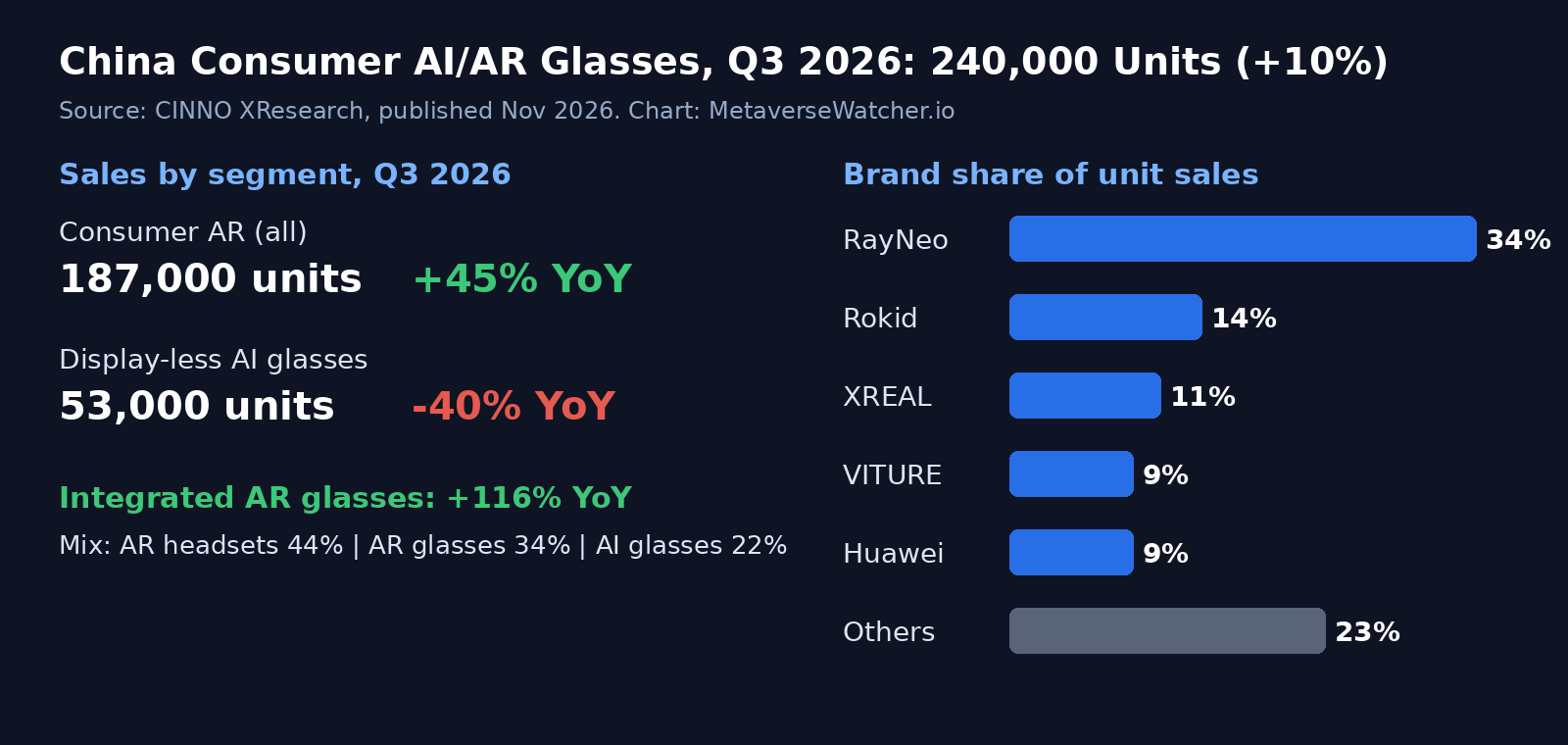
China’s smart glasses market is moving in the opposite direction from the West. New data from Shanghai-based CINNO XResearch shows consumer AI and AR device sales in mainland China reached 240,000 units in the third quarter of 2026, up 10% year over year and 4% from the second quarter. Underneath that modest headline, the mix shifted sharply: glasses with displays surged, while camera-first, display-less AI glasses, the category Meta dominates globally, fell 40%.
The Numbers
According to CINNO’s quarterly analysis, republished by EE Times China on November 11 and first reported by Zhitong Finance:
| Segment (China, consumer) | Q3 2026 units | Year over year | Quarter over quarter | Share of sales |
|---|---|---|---|---|
| Total AI/AR devices | 240,000 | +10% | +4% | 100% |
| Consumer AR (all display devices) | 187,000 | +45% | +10% | 78% |
| – Tethered AR “headsets” (display glasses) | n/a | n/a | n/a | 44% |
| – Standalone AR glasses with displays | n/a | +116% | Up | 34% |
| Display-less AI glasses | 53,000 | −40% | −12% | 22% |
A note on terms: CINNO’s “AR headset” category (分体式 AR头显) refers to tethered display glasses that plug into a phone, PC or console, the XREAL One and VITURE style of product, not VR headsets. “Integrated AR glasses” are standalone glasses with built-in waveguide displays and AI assistants, such as RayNeo’s iO line.
The overall growth rate is a sharp slowdown. CINNO notes that the market grew 108% year over year in Q1 2026, and attributes the deceleration to a cooling of display-less AI glasses after a wave of launches and promotions in the second quarter, with no breakout new product in Q3.
RayNeo Leads With a Third of the Market
By brand, CINNO puts TCL-backed RayNeo at 34% of unit sales, well clear of Rokid (14%), XREAL (11%), VITURE (9%) and Huawei (9%). All other brands, including Xiaomi, Alibaba’s Qwen-branded glasses, INMO and iFlytek, make up the remaining 23%.
- RayNeo: CINNO credits the iO AI glasses, launched in August at 34 grams and from 1,996 yuan, as the quarter’s key product, with more than 12,000 units sold in August and the top spot among standalone AR devices in both August and September. RayNeo previewed a full-color Micro LED successor, iO+, on October 27. We covered the iO in depth in our RayNeo iO review roundup.
- Rokid: 14% share on the strength of its waveguide Glasses line. On October 27 it announced Glasses 2 (from 3,699 yuan, on sale November 11), the full-color Rokid Color (4,999 yuan) and a Rokid Ring controller (1,699 yuan).
- XREAL: 11%, built on tethered display glasses like the One Pro. CINNO says XREAL’s 1 Pro+ launched October 27 at 3,499 yuan, alongside the overseas launch of the Android XR-based Aura.
- VITURE: 9% in China, but CINNO says the company held 17% of the global AR device market in Q2 2026, second only to RayNeo, and sells more overseas than at home.
- Huawei: 9%. Its camera-equipped AI glasses, launched in April, ranked first among display-less AI glasses in China in June, according to CINNO.
Why This Diverges From the Global Picture
Globally, the story is the reverse. Counterpoint Research’s H1 2026 tracker found display-less AI glasses made up 96% of worldwide AI glasses shipments, with Meta holding 94% of that segment. North America alone accounted for half of display-less shipments, while China was just 3%, per Counterpoint’s regional split reported by 9to5Mac. In the display segment, Counterpoint found China was the largest market at 45% of shipments. (See our earlier coverage: Counterpoint’s 263% growth report and Rokid’s 41% share of AR + AI glasses.)
Three factors explain the split. First, Meta does not officially sell its glasses in mainland China, which removes the product that defines the camera-glasses category elsewhere. Second, Chinese brands have a mature local supply chain for waveguides and micro-displays, letting them ship display glasses at prices Western buyers would associate with camera-only models; RayNeo’s iO starts at 1,996 yuan. Third, Chinese glasses ship with domestic AI models built in (CINNO notes RayNeo’s iO launched with DeepSeek V4 Pro and Qwen 3.7 Max), giving the displays something useful to show: translation, navigation and assistant responses.
What CINNO Expects Next
CINNO expects Q4 2026 to set a new record for China’s consumer AI/AR market, driven by the Singles’ Day (Double 11) and Double 12 shopping festivals, government trade-in subsidies, and a wave of new full-color Micro LED waveguide glasses. Excluding ultra-low-cost white-label products, the firm forecasts global AI/AR glasses shipments will top 15 million units in 2026, up 152% year over year. It also cites Ray-Ban Meta sales of more than 3.7 million pairs in H1 2026 and a Meta production capacity target of over 13 million pairs a year. Those Meta figures come from CINNO’s report; Meta has not confirmed them.
CINNO’s outlook also lists international entrants, including Google’s Gemini glasses and Apple. On timing, CINNO describes an Apple launch around the end of 2026, but the most recent Bloomberg reporting, summarized by Android Authority today, points to a WWDC unveiling in June 2027 and availability later that year. Our Apple smart glasses tracker follows that timeline. The Android XR glasses from Samsung, Google, Warby Parker and Gentle Monster go on sale December 10 in the U.S. and South Korea, not China.
What It Means for Buyers
For Western buyers, China’s numbers are a preview. The brands winning in China, including RayNeo, Rokid, XREAL and VITURE, are the same ones bringing display glasses to North America and Europe, and the shift to full-color Micro LED waveguides suggests the next generation of imports will be brighter and more capable. If the price gap between camera-only glasses and display glasses keeps shrinking, the camera-first model Meta built may face its strongest test from display glasses rather than from rival camera glasses. For current options, see our best smart glasses of 2026 and upcoming smart glasses tracker.
Data note: CINNO reports consumer unit sales in mainland China; Counterpoint reports global shipments. The two use different methods and are not directly comparable, so we cite each on its own terms.