AR, VR, MR, XR, spatial computing: the industry’s vocabulary has grown faster than most buyers can track. Marketing departments use the terms loosely, and some devices now do more than one thing. A Meta Quest 3 is a virtual reality headset one minute and a mixed reality device the next; Apple avoids all of the acronyms and calls Vision Pro a “spatial computer.” This guide explains what each term actually means, where today’s headsets and glasses fit, and which category suits which buyer.
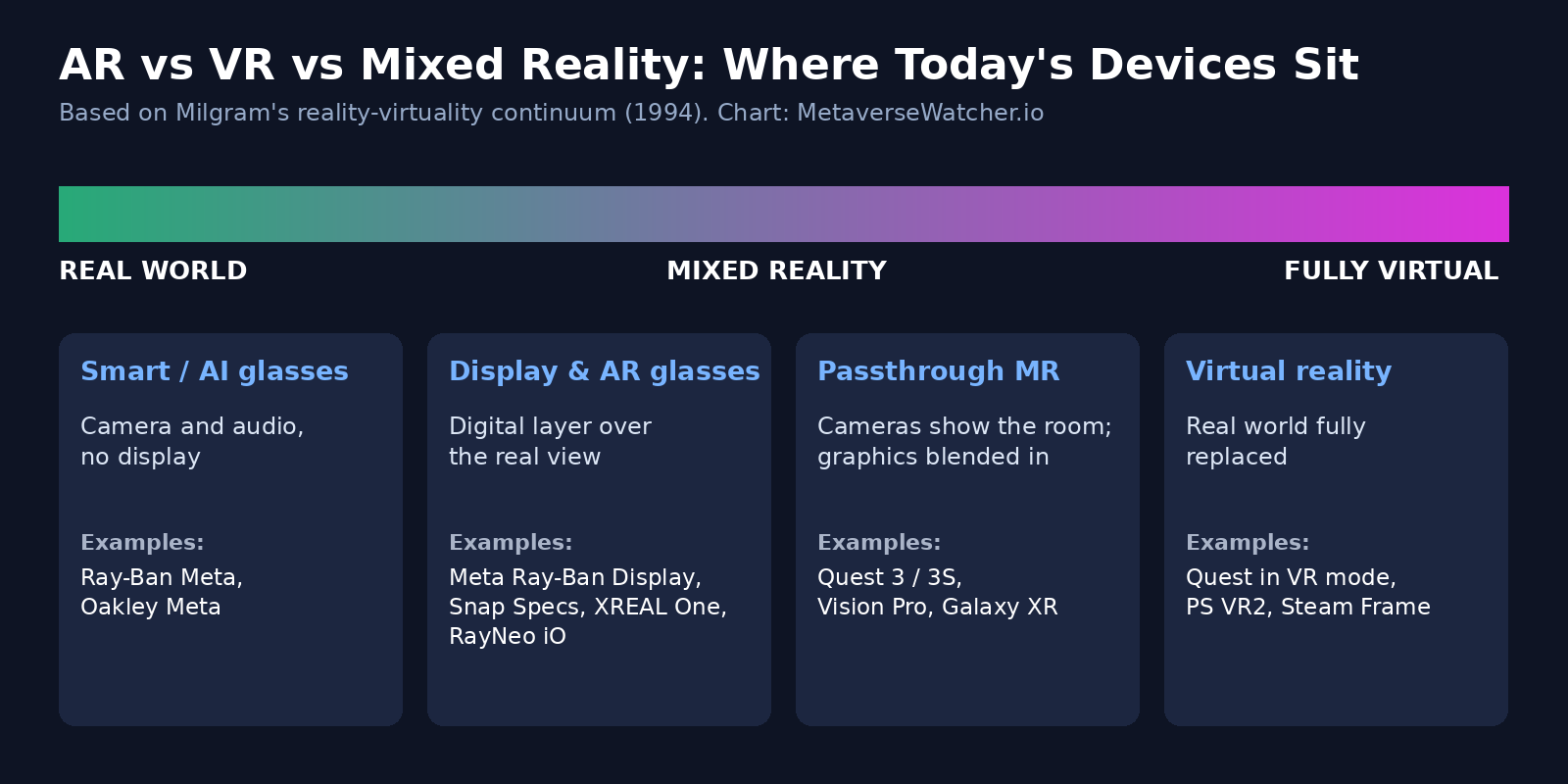
The Short Answer
- Virtual reality (VR) replaces your view of the real world with a fully computer-generated one.
- Augmented reality (AR) keeps the real world as your main view and adds digital information on top of it.
- Mixed reality (MR) blends the two, so virtual objects appear anchored in, and can interact with, your real surroundings.
- Extended reality (XR) is the umbrella term covering all of the above.
Where the Terms Come From
The cleanest framework is three decades old. In 1994, researchers Paul Milgram, Haruo Takemura, Akira Utsumi and Fumio Kishino described a “reality-virtuality continuum”: a line with the real environment at one end and a fully virtual environment at the other. Everything in between is mixed reality. Close to the real end is augmented reality, where virtual content augments the real world; close to the virtual end is “augmented virtuality,” where real-world elements appear inside a virtual space.
By that original definition, AR is a type of mixed reality, not a separate category. In everyday product marketing, though, “mixed reality” has come to mean something narrower: a headset that uses cameras to show you the room and blends graphics into it. That is the sense we use below.
Virtual Reality (VR) Explained
VR headsets block out your surroundings and fill your field of view with a rendered world, tracking your head and hands so the scene responds as you move. This is the most immersive category and the home of most gaming: shooters, rhythm games, flight simulators and fitness apps. Our best VR headsets of 2026 guide ranks current options.
- Examples: Meta Quest 3 and 3S in VR mode, PlayStation VR2, Valve’s Steam Frame.
- Strengths: deepest immersion, the largest game libraries, wide field of view (Meta lists 110° horizontal for Quest 3).
- Weaknesses: you cannot see your surroundings without switching modes; some people get motion sick (see our motion sickness guide); bulk and battery life limit sessions.
Mixed Reality (MR) Explained
Modern mixed reality headsets use outward-facing color cameras to capture your room and display it inside the headset in real time, a technique called video passthrough. The headset maps walls, furniture and surfaces, so a virtual board game can sit on your real table or a game character can hide behind your real couch.
Passthrough quality is the key spec. According to Meta’s developer device comparison, Quest 3 offers color stereoscopic 4 MP passthrough at 18 pixels per degree with a depth sensor; Quest 3S matches the 18 PPD but lacks the depth sensor; and Meta’s upcoming VR Glasses raise passthrough to 26 PPD with autofocus. Higher numbers mean text and objects in your real room look sharper.
- Examples: Meta Quest 3 and 3S, Apple Vision Pro, Samsung Galaxy XR.
- Strengths: you stay aware of your surroundings; virtual screens for work and video; the same device can switch to full VR.
- Weaknesses: you are still wearing a headset, and the real world is a camera feed rather than your natural view, with some loss of clarity.
If you already own a Quest 3, our list of the best mixed reality games for Quest 3 is the quickest way to see what MR adds. For high-end headsets, see Galaxy XR vs Apple Vision Pro.
Augmented Reality (AR) Explained
True AR devices let you look through clear lenses at the real world, with digital images projected into your view. This is called optical see-through, and it usually relies on waveguides: thin pieces of glass or plastic that route light from a tiny projector into your eye. Because you see the world directly, AR glasses can be worn while walking around, talking to people and working.
AR glasses today come in a few distinct flavors:
- Full AR glasses with spatial tracking that anchor 3D content in the room, such as Snap Specs, which began shipping in September (our launch coverage).
- Heads-up display glasses that show notifications, captions, navigation and AI answers in a small floating panel, such as Meta Ray-Ban Display and Even Realities G2 (compared here) and RayNeo’s iO.
- Tethered display glasses such as XREAL One and VITURE models, which plug into a phone, laptop, console or handheld and show a large virtual screen. They are often marketed as AR, but they work more like a wearable monitor.
Where Do Smart Glasses Fit?
The best-selling face computers today are not AR at all. Ray-Ban Meta and Oakley Meta glasses have cameras, microphones, speakers and an AI assistant, but no display. They sit at the “real world” end of the spectrum: they add AI and capture features to your day without adding anything to what you see. Counterpoint Research found that display-less AI glasses made up 96% of global AI glasses shipments in the first half of 2026, with Meta holding 94% of that segment. China is the exception, where display glasses are now growing faster, as we reported in our China Q3 smart glasses analysis.
AR vs VR vs MR Compared
| Virtual reality | Mixed reality (passthrough) | Augmented reality | AI smart glasses | |
|---|---|---|---|---|
| What you see | Fully virtual world | Camera view of room plus graphics | Real world through lenses plus overlays | Real world only |
| Display | Opaque screens | Opaque screens plus color cameras | Transparent waveguide or birdbath optics | None |
| Immersion | Highest | High, switchable | Low to moderate | None |
| Wear in public? | No | Rarely | Yes (glasses form) | Yes |
| Best for | Games, fitness, simulation | Games, virtual screens, video, work | Navigation, captions, glanceable info, media | Photos, calls, music, AI assistant |
| Examples | PS VR2, Steam Frame, Quest (VR mode) | Quest 3/3S, Vision Pro, Galaxy XR | Snap Specs, Meta Ray-Ban Display, XREAL One | Ray-Ban Meta, Oakley Meta |
What Is XR, and What Is Spatial Computing?
Extended reality (XR) is the catch-all term for VR, AR and MR together. Google’s Android XR platform uses it deliberately because the same operating system runs on headsets like Galaxy XR and on glasses; our Android XR guide explains that lineup. Spatial computing is Apple’s preferred phrase for apps and interfaces placed in the 3D space around you rather than on a flat screen. It describes the experience, not a different technology; in practice, Vision Pro is a passthrough mixed reality headset.
And the metaverse? That refers to persistent, shared virtual spaces, which you can visit through XR devices or a regular screen. We cover that separately in What Is the Metaverse?
Which Should You Buy?
- You mainly want games and fitness: a VR headset that also does mixed reality, such as Quest 3 or 3S, gives you both categories in one device.
- You want a big private screen for movies or work: tethered display glasses are the lightest, cheapest route; a premium MR headset offers more apps and multitasking.
- You want something to wear all day: AI smart glasses for capture and assistance, or heads-up display glasses if you want captions, navigation and notifications in view. Start with our best smart glasses of 2026.
- You want to build for the future: full AR glasses remain early and expensive, but they show where the category is headed.
Frequently Asked Questions
Is Meta Quest 3 AR or VR?
Both. It is a VR headset with color passthrough cameras, so it runs fully virtual games and mixed reality apps that blend graphics into your room. It is not optical AR, because you see the room through cameras rather than clear lenses.
Is Apple Vision Pro AR or VR?
Technically, it is a passthrough mixed reality headset that can also run fully immersive experiences. Apple markets it as a spatial computer.
Are Ray-Ban Meta glasses AR?
No. The standard Ray-Ban Meta glasses have no display. Meta Ray-Ban Display, a separate model, adds a small heads-up display in one lens.
Is mixed reality the same as augmented reality?
In the original academic framework, AR is one form of mixed reality. In current product marketing, “MR” usually means camera passthrough on a headset, while “AR” usually means see-through glasses.