By the Metaverse Watcher newsroom. Published Monday, November 23, 2026. Specifications come from DPVR’s launch announcement and its September preview; competitor figures were checked against HTC and Valve listings on November 23, 2026.
DPVR has launched the P1 Max Eye, a standalone VR headset with built-in binocular eye tracking, at a standard price of $999. The price includes the eye-tracking feature license. The Shanghai company is selling the headset to businesses, research institutions and developers rather than consumers, and it says gaze data runs at 120 to 220 Hz on the current firmware, according to DPVR’s launch announcement dated November 23.
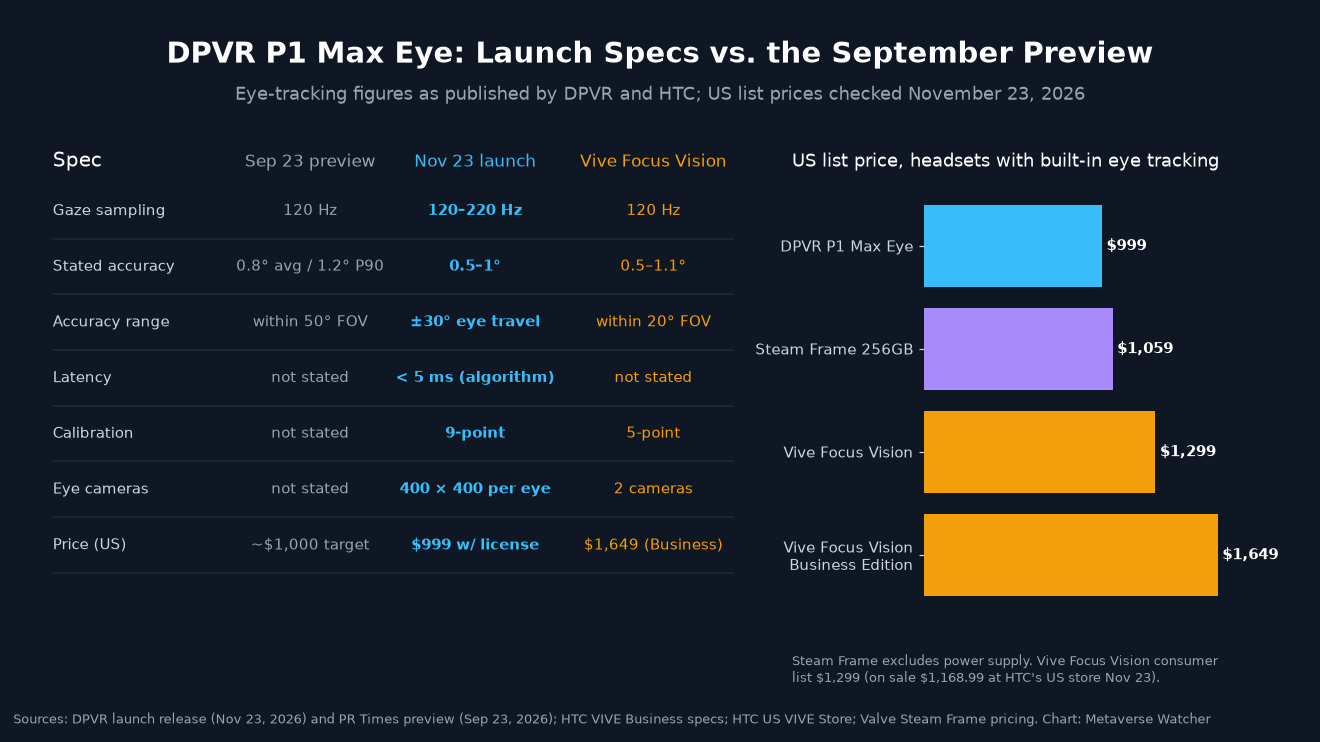
The headline number is the sampling rate. When the company previewed the model two months ago, it planned a 120 Hz module. The launch version claims up to 220 Hz, a tighter accuracy range and a stated latency figure, at roughly the price it targeted in September. That puts it below the eye-tracking headsets most labs and training teams already compare against.
What DPVR Announced
The P1 Max Eye uses two eye cameras, one per eye, each with a resolution of 400 × 400 pixels. The company lists the following eye-tracking figures:
- Sampling rate: 120–220 Hz with the current firmware.
- Accuracy: 0.5–1°.
- Latency: under 5 ms for the tracking algorithm.
- Calibration: nine-point.
- Tracking range: eye movement up to 30° up, down, left and right of the optical axis.
- Data access: Unity and Unreal SDKs that expose raw data from each eye plus a combined gaze point, delivered without downsampling at the rate the firmware supports.
The rest of the headset is the existing P1 Max: a Qualcomm Snapdragon XR2 chip, 8GB of RAM, 128GB of storage and a combined display resolution of 3,664 × 1,920. The company says prescription glasses can be worn with the eye-tracking module installed. For deployments, it adds a kiosk mode that launches a single app and disables the system menu, along with a configuration tool. Depending on order volume, OEM options can cover the power supply, housing, logos, boot screens, user interface, firmware, default settings and preinstalled apps.
The target uses are visual-function assessment tools, visual training, research on perception and behavior, and usability testing, where teams want to know which steps of a task hold a user’s attention. The company announced the launch on X:
Meet DPVR P1 Max Eye. 👀
Your next discovery starts with a glance.
Our enterprise VR headset brings up to 220Hz binocular eye tracking to research, visual training, and XR development.
Learn more 👇
— DPVR (@DPVR_Global) November 23, 2026
What Changed Since the September Preview
The eye-tracking model was first described on September 23 in a PR Times release carried by ZDNet Japan. At that stage it planned a multi-light-source module running at 120 Hz. The module’s stated error was 0.8° on average and 1.2° at the 90th percentile, measured within a 50° field of view. The release noted that those were figures for the module alone and that performance in the finished headset would be confirmed through prototype testing. The planned price was about $1,000 including the eye-tracking license.
A day earlier, heise online reported German pricing for the wider P1 Max line: 549 euros for the battery version, 649 to 749 euros for the wired version depending on the cable, and a target of under 1,000 euros for eye tracking. Notebookcheck also notes that an August report had cited $799 for an eye-tracking version.
| Spec | September 23 preview | November 23 launch |
|---|---|---|
| Gaze sampling | 120 Hz | 120–220 Hz (current firmware) |
| Stated accuracy | 0.8° average, 1.2° P90 (module, within 50° FOV) | 0.5–1° |
| Latency | Not stated | Under 5 ms (algorithm) |
| Calibration | Not stated | Nine-point |
| Price | About $1,000 with license (planned) | $999 with license |
The final release does not restate the preview’s 90th-percentile figure or say over what field of view the 0.5–1° range applies, so the two accuracy claims are not a like-for-like comparison.
How It Compares on Price
The most direct rival in enterprise eye tracking is HTC’s Vive Focus Vision. The Business Edition lists at $1,649 on HTC’s US store, including two years of Vive Business Warranty and Services, and was shown as sold out on November 23. HTC’s specifications list 120 Hz binocular gaze output, 0.5° to 1.1° accuracy within a 20° field of view and five-point calibration. The consumer Vive Focus Vision lists at $1,299 and was on sale for $1,168.99 the same day, but HTC says commercial use requires the Business Warranty and Services program.
Valve’s Steam Frame also has eye tracking, at $1,059 for the 256GB kit, but Valve uses it mainly for foveated streaming to a PC rather than as a research tool. Our Steam Frame eye tracking explainer covers how that works, and the Steam Frame specs and price guide has regional pricing. Meta’s Quest Pro, which also has eye tracking, is no longer a forward-looking option; we covered its end-of-support timeline earlier this month.
On paper, the P1 Max Eye offers the highest sampling rate of the group at the lowest price. The trade-off is the chip. The P1 Max uses the original Snapdragon XR2, which heise describes as Qualcomm’s first XR chip generation from 2020, while current consumer headsets use newer silicon. For stimulus-and-measurement apps in a lab, sampling rate and raw data access may matter more than graphics performance. For heavier training simulations, the chip is a real constraint.
Availability and Open Questions
There is no published ship date. Delivery schedules, evaluation units and OEM terms are available on request, according to the launch release. In August, the company named the Netherlands-based reseller VR Expert as the exclusive distributor of the P1 Max in Europe and North America. VR Expert also runs the XREAL Aura enterprise evaluation program we reported on in September. The launch release does not say whether that agreement covers the Eye model.
Several details buyers will want are not yet public:
- Which firmware settings or conditions deliver 220 Hz rather than 120 Hz.
- The field of view over which the 0.5–1° accuracy figure was measured.
- How gaze data is stored and handled on the device. Gaze data can reveal attention, fatigue and other personal traits, a concern we outlined in our eye-tracking privacy analysis. That matters for any research or medical-adjacent use.
- Independent accuracy testing. All figures above are the manufacturer’s own.
What It Means
The P1 Max Eye is not a consumer headset, and it is not marketed as one. Its significance is price. Research-grade eye tracking in a standalone headset has typically meant a business-edition premium or a dedicated lab system. At $999 with the license included, the P1 Max Eye undercuts HTC’s business offering by $650 at list price while claiming a higher sampling rate. Whether the accuracy holds up in independent testing will decide whether labs and training teams take it seriously.
Readers shopping for a consumer headset should start with our best VR headsets of 2026 guide. For background on the categories, see AR vs. VR vs. mixed reality.
Sources: DPVR launch release (November 23); DPVR preview via PR Times / ZDNet Japan (September 23); heise online (September 22); Notebookcheck (November 23); DPVR and VR Expert distribution announcement (August 12); HTC Vive Store, Focus Vision Business Edition; Vive Business specifications; HTC Vive Store, Focus Vision; DPVR on X. All checked November 23, 2026.