Amazon has put a PRICE on always-on conversational memory, and it is FAR below anything the smart-glasses industry charges for the same idea. Amazon’s October 15 announcement introduces Bee Frontier, a wrist-or-clip wearable that is on sale NOW for $74.99 at Amazon.com, and Bee Eclipse, a credit-card-sized phone attachment that Amazon says will be available “soon,” STARTING at $99.99. Both LISTEN to the wearer’s conversations and turn them into SUMMARIES, insights and to-dos.
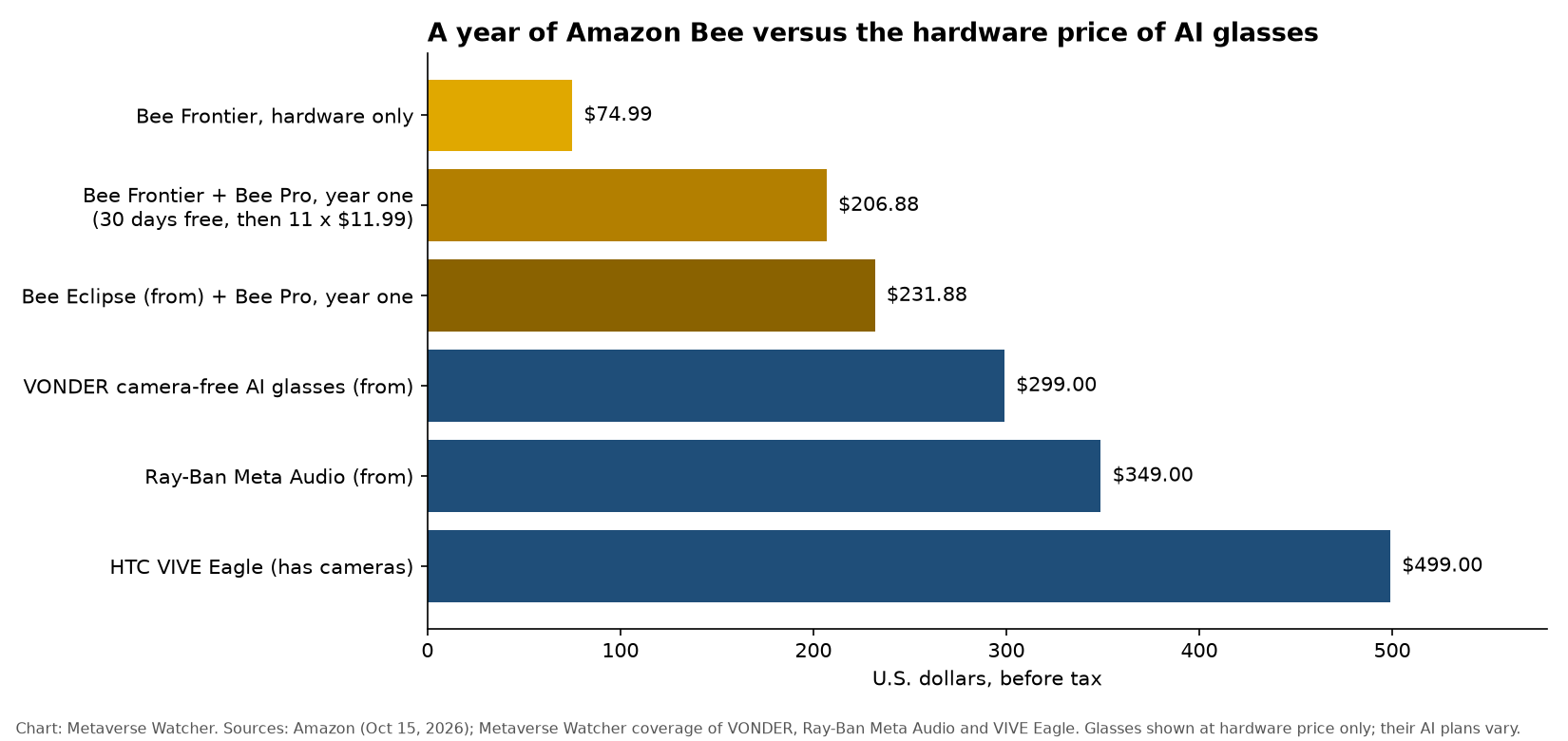
NEITHER device has a DISPLAY, a CAMERA or a lens. That is exactly why it MATTERS to this beat. The most CROWDED corner of AI eyewear right now is the CAMERA-FREE pair that sells LISTENING and MEMORY: Meta’s Ray-Ban Meta Audio from $349, VONDER’s glasses from $299, and XGIMI’s MemoMind One, whose meeting memory can switch on by ITSELF. Amazon is now selling the MEMORY part of that pitch without the FRAMES, for roughly a QUARTER of VONDER’s starting price.
What Amazon is actually shipping
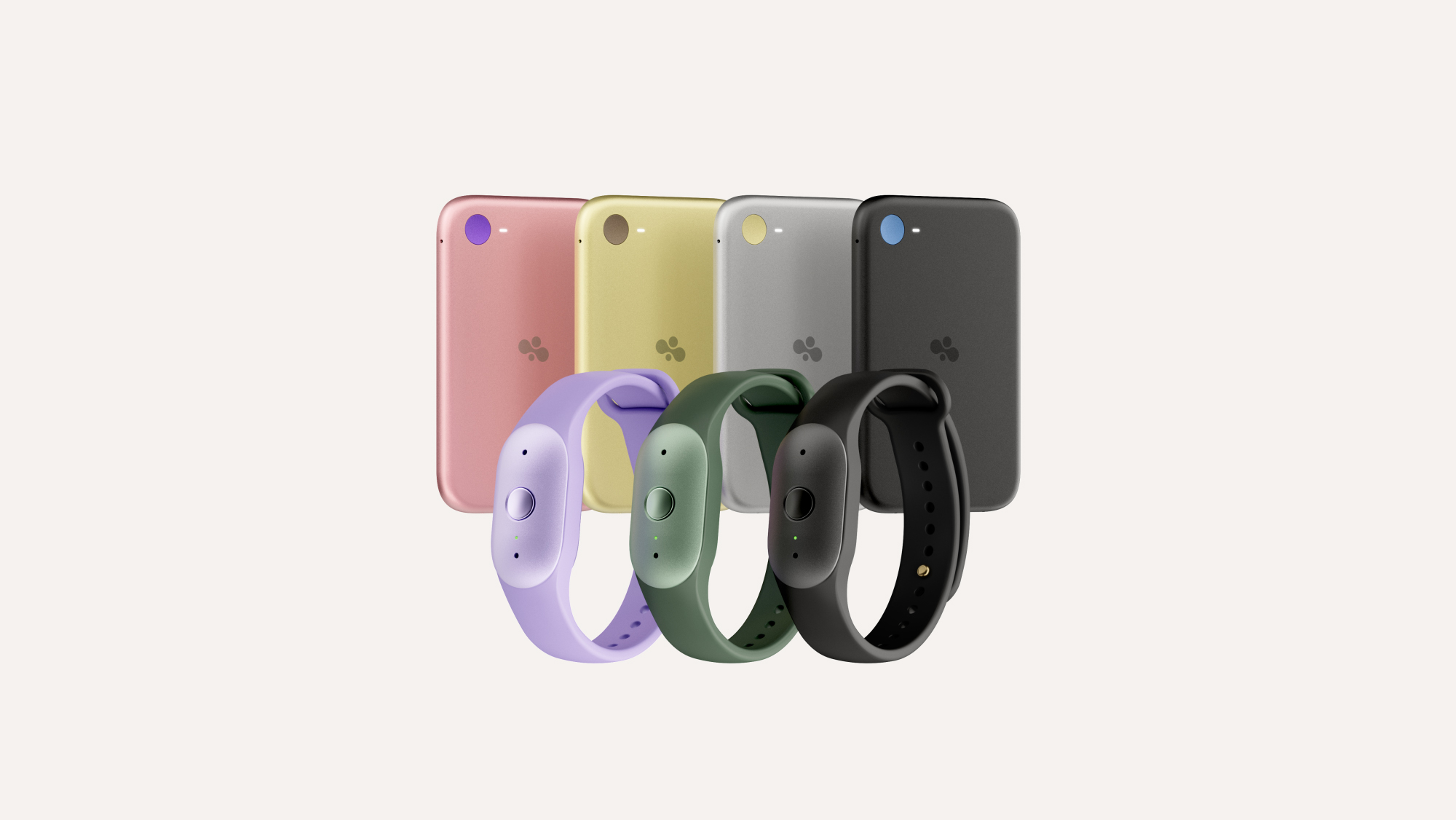
By Amazon’s own description, the two devices DIFFER mainly in WHERE they sit:
- Bee Frontier is WORN on a silicone wristband or CLIPPED to clothing. Amazon claims up to SEVEN days of battery life, an IP67 water-resistance rating, USB-C charging and DUAL microphones with noise filtering. It comes in Onyx, Lavender and Sage.
- Bee Eclipse attaches MAGNETICALLY to the back of a phone and is pitched at CALLS as well as in-person talk. Amazon claims “more than 21 days” of battery life. It will come in Silver, Midnight, Honey and Blush, with NO release date.
- Both use a SINGLE press to turn on and off, with an LED that shows when the device is ACTIVE. Amazon says Frontier can also be set to switch itself OFF after no sound is detected for a period, giving five or 15 minutes as EXAMPLES.
The battery figures are MANUFACTURER claims. Amazon published NO test conditions, and Metaverse Watcher has NOT tested either device. The Verge’s Victoria Song reports that Frontier is a SLIGHT redesign of the original Bee, with a more PROMINENT recording button, and that the original sold for $50 before Amazon BOUGHT the startup last year.
The hardware is cheap; the useful part is a plan
Amazon says every buyer gets conversation summaries, recaps and 14-day memory at NO extra cost. EVERYTHING that makes Bee feel like an ASSISTANT sits in Bee Pro, at $11.99 a month: unlimited recent summaries, suggested to-dos, daily memories, a chat assistant, conversation templates, third-party integrations, the desktop app, and the NEW Alexa+ and Amazon.com connections. New customers get the FIRST 30 days of Bee Pro free.
Do the ARITHMETIC and the price GAP with glasses NARROWS. A Frontier plus ELEVEN paid months of Bee Pro comes to $206.88 in YEAR ONE, before tax. Eclipse at its STARTING price COMES to $231.88. That is still BELOW the hardware price of every camera-free pair above, but it is no longer a ROUNDING error. For context, HTC’s VIVE Eagle bundles its AI Plus tier free for TWO years, then bills $2.50 a month on annual billing.
Listening that feeds a store
The SHOPPING hook is the part glasses makers should READ closely. Amazon says connecting Bee to Amazon.com lets the device “surface items you mention” as product RECOMMENDATIONS on the Amazon HOMEPAGE and inside the Bee mobile and desktop apps. The Verge describes the integration as OPT-IN and gives the example of a spouse asking you to buy cat litter. Connecting to Alexa+ lets an Echo speaker use voice ID to READ your Bee summaries and to-dos back to you.
Meta is ALSO pushing its assistant toward commerce: CNBC has reported that shopping is a top use of Meta’s Muse, with RETAIL connectors such as Walmart, Gap and Sephora. The DIFFERENCE is ownership. Meta connects to OTHER people’s stores, and HTC sells PRIVACY as the product. Amazon owns the STORE, so the line from “heard it” to “recommended it” runs through ONE company.
The privacy claims are Amazon’s own
Both devices run on what Amazon calls Bee Private Compute, which it describes as an ISOLATED processing environment where “no one, including Amazon, can access your data.” The company SAYS audio “is never stored,” is processed into insights in REAL TIME and DELETED, and that transcripts are encrypted with keys that only the DEVICE creates and controls. Users can DELETE transcripts and summaries at ANY time. For Eclipse, Amazon says users are PROMPTED to get permission from call participants EACH time a recording starts.
None of this has been INDEPENDENTLY audited in ANYTHING Amazon published. The Verge adds one MATERIAL detail from Amazon’s briefing: Bee’s AI is trained on the OWNER’s voice at setup, and other speakers are NOT automatically identified unless they agree to let Bee learn their voices too. That limits WHO can be named in a transcript. It does not change the fact that their WORDS are PROCESSED.
That is the SAME BYSTANDER question European REGULATORS are now putting to eyewear. The EDPB’s statement on smart glasses calls today’s recording indicators INSUFFICIENT, and three Dutch groups take Meta’s camera glasses to COURT in Amsterdam on November 26. A small LED on a wristband faces the SAME critique, with less surface to make it VISIBLE.
What is still missing
- A date for Eclipse. Amazon says “soon,” and “starting at $99.99” is a FLOOR, not a FULL price list.
- Markets. The announcement names ONLY Amazon.com and gives NO international pricing.
- Independent testing of BATTERY life, MICROPHONE range and the Private Compute claims.
- Any eyewear plan. Amazon has said NOTHING about putting Bee into glasses, and Metaverse Watcher is not suggesting it has.
The takeaway for the glasses market is BLUNT. Camera-free AI glasses have been SOLD partly on MEMORY and RECALL. Amazon now offers that FEATURE on a $74.99 wristband, with the real VALUE gated behind a MONTHLY plan and a SHOPPING link. Glasses makers will need a better ANSWER than “it remembers your MEETINGS,” because a cheaper device on your WRIST now says the SAME thing.