
Valve has FINALLY REBUILT the Linux Steam client as a 64-BIT application, at least on the BETA channel. Its October 15 Steam Client Beta notes say the client “is now a 64bit application” and “now runs inside a Steam Runtime container,” the SAME sandboxing technology Steam GAMES already use. What the notes do NOT say is that the change FREES Linux PCs from 32-bit SOFTWARE. Within HOURS, Valve PUBLISHED a requirements file that says the OPPOSITE: 64-bit-only x86_64 systems are “not supported.”
For VR users that fine print MATTERS. SteamVR on a Linux desktop is INSTALLED and LAUNCHED through the Steam CLIENT, so every Linux PC that drives a Valve Index or streams to a Steam Frame inherits whatever the client DEMANDS. That is a GROWING group, and Valve has spent the past MONTH TIGHTENING its Linux VR stack, as our coverage of 32-bit OpenXR in Proton and of Valve’s ALVR support stance has shown.

What Changed on October 15
Phoronix reported the beta at 6:08 PM ET on October 15, calling the 32-bit CLIENT one of the LAST holdouts keeping Linux gamers on i686 libraries. Valve’s stated reason is CONSISTENCY: running the client inside the Steam Runtime container “will help the Steam client provide a more consistent experience across multiple distributions.” The same beta also ADDS Steam Achievement Sets, a Remote Play “Display Style” setting for stretching or zooming a stream, and FIXES for memory leaks in game streaming and controller code.
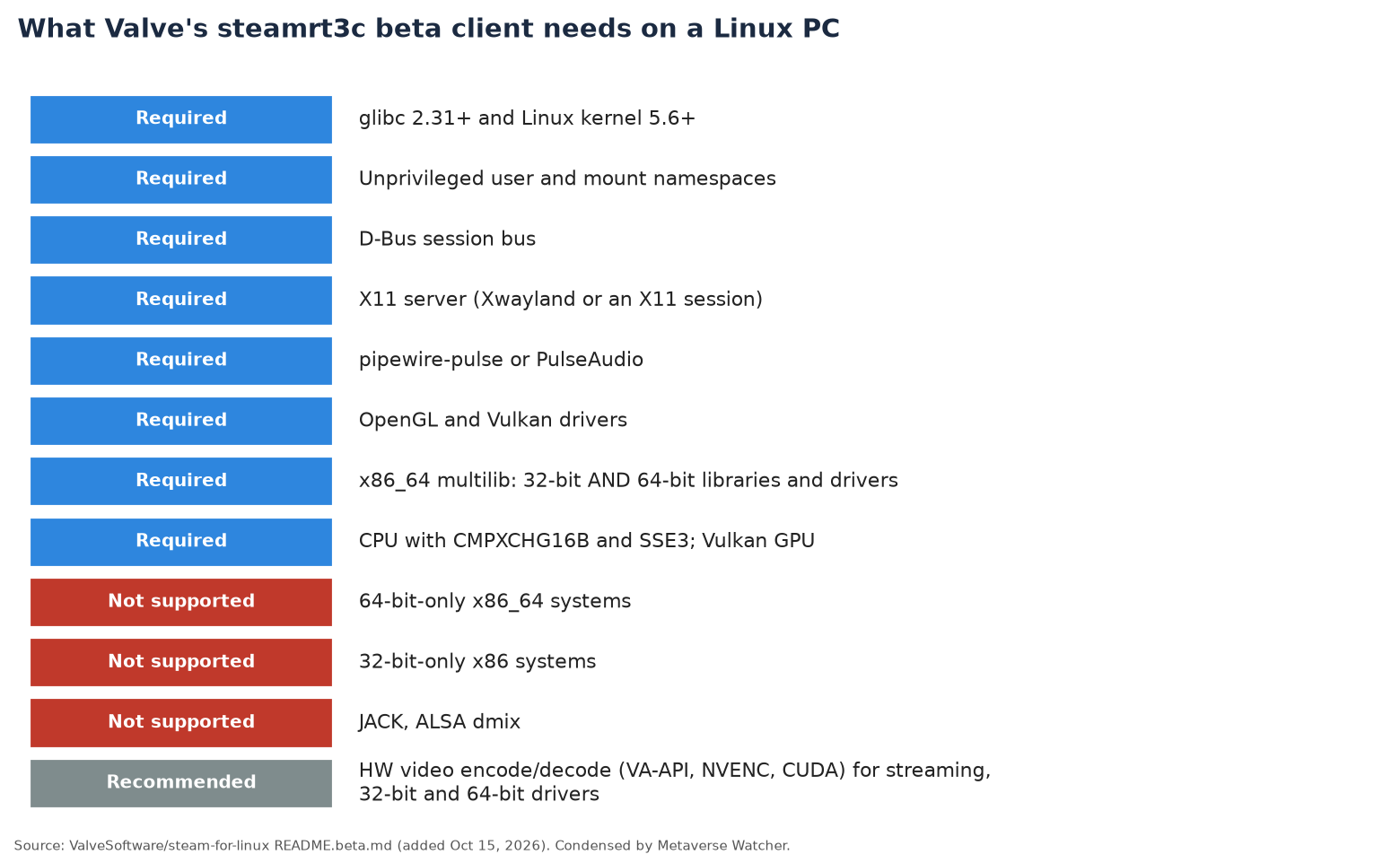
Then the FINE PRINT arrived. At 7:26 PM ET, Valve engineer Andres Rodriguez committed a new README.beta.md to the steam-for-linux repository titled “Add steamrt3c client requirements.” It states that x86_64 systems “must support multilib and have both 32-bit … and 64-bit … versions of required libraries and graphics drivers installed.” It EXPLICITLY lists 64-bit-only x86_64 systems and 32-bit-only x86 systems as UNSUPPORTED.
Why 32-Bit Drivers Stay
Rodriguez EXPLAINED the reasoning just 26 MINUTES later on issue #13015. “Note that i386 multilib is still required,” he wrote. “This is because 32bit games will require a 32bit graphics driver stack to run correctly. Even with Proton WOW64, there is a large library of linux native 32bit games that would stop working if the host system was 64bit only.” Eliminating 32-bit host libraries “was not a goal of this change,” he added, though it “should help reduce the set” a system needs.
The issue itself is OLDER than the beta. It was opened on March 20, 2026, after a tester FOUND that the “reaper” helper shipped in the steamrt64 folder is a 32-bit ELF binary, which on its OWN keeps 32-bit GL libraries on the HOST. As of October 18 the issue is still OPEN, with 85 COMMENTS. In the same reply, Rodriguez asked packagers to STOP shipping unofficial builds such as a steam-beta package on the Arch User Repository, saying unsupported setups GENERATE support TICKETS for game developers and Valve.
The Requirements That Could Bite a VR Rig
Beyond multilib, the README sets a CONCRETE floor: glibc 2.31 or newer, Linux kernel 5.6 or newer, a D-Bus session bus, OpenGL and Vulkan drivers, and an x86_64 CPU with CMPXCHG16B and SSE3. THREE items deserve ATTENTION from anyone running PC VR on Linux.
- Namespaces. The container needs UNPRIVILEGED user and mount namespaces. The README SPELLS OUT the sysctl settings and an AppArmor caveat, so HARDENED kernels may need changes before the client STARTS.
- Audio. Only pipewire-pulse or PulseAudio is supported. JACK and ALSA dmix are listed as “not supported,” which MATTERS on audio-production machines that double as VR PCs.
- Display and encoding. An X11 server is REQUIRED, either Xwayland or an X11 session, so a PURE Wayland desktop without Xwayland is OUT. Hardware video encode and decode through VA-API, NVENC or CUDA is RECOMMENDED “for streaming and game recording,” with both 32-bit and 64-bit drivers.
The README describes DESKTOP PCs only. It covers x86 and x86_64 and says NOTHING about ARM, and Steam Frame ships its OWN Steam client inside SteamOS. The beta therefore lands on the PCs that DRIVE headsets, not on the HEADSET itself.
Reaction on X CENTERED on the HEADLINE rather than the CAVEAT. Phoronix’s post announcing the beta drew more than 1,100 LIKES:
Today's Steam Beta Makes The Linux Client A 64-bit App
— Phoronix (@phoronix) October 15, 2026
Linux gamers rejoice! 🥳
https://t.co/FYcJIHrZLC
The Metaverse Watcher Take
A 64-bit, containerized client is a REAL cleanup, and moving it onto the SAME runtime as games should mean FEWER distro-specific BREAKAGES for anyone launching SteamVR from a Linux desktop. But “64-bit” is NOT “32-bit-free.” Linux VR users should keep multilib and BOTH driver stacks INSTALLED, CONFIRM their audio and namespace settings BEFORE opting in, and treat this as BETA software that Valve itself asks people NOT to repackage. Valve has given NO date for the STABLE client, and the 32-bit reaper question from March is still OPEN. Until BOTH are SETTLED, the HOST requirements for Linux PC VR have not gotten any SHORTER.
Sources
- Valve: Steam Beta Client Update, October 15th (October 15, 2026)
- ValveSoftware/steam-for-linux: README.beta.md, steamrt3c client requirements (committed October 15, 2026)
- ValveSoftware/steam-for-linux issue #13015: 32-bit libraries are still required for 64-bit games (opened March 20, 2026)
- Phoronix: Today’s Steam Beta Makes the Linux Client a 64-bit App (October 15, 2026)
- Hardware Busters: Steam Linux client goes 64-bit in beta, but 32-bit libraries stay (October 2026)
- Post by @phoronix on X (October 15, 2026)