Mid-September just delivered two speech brain-computer interface milestones in the same news cycle — one COMMERCIAL demonstration, one peer-reviewed AVATAR study — and both matter for anyone watching Meta’s hologram calling demos at Connect next week.
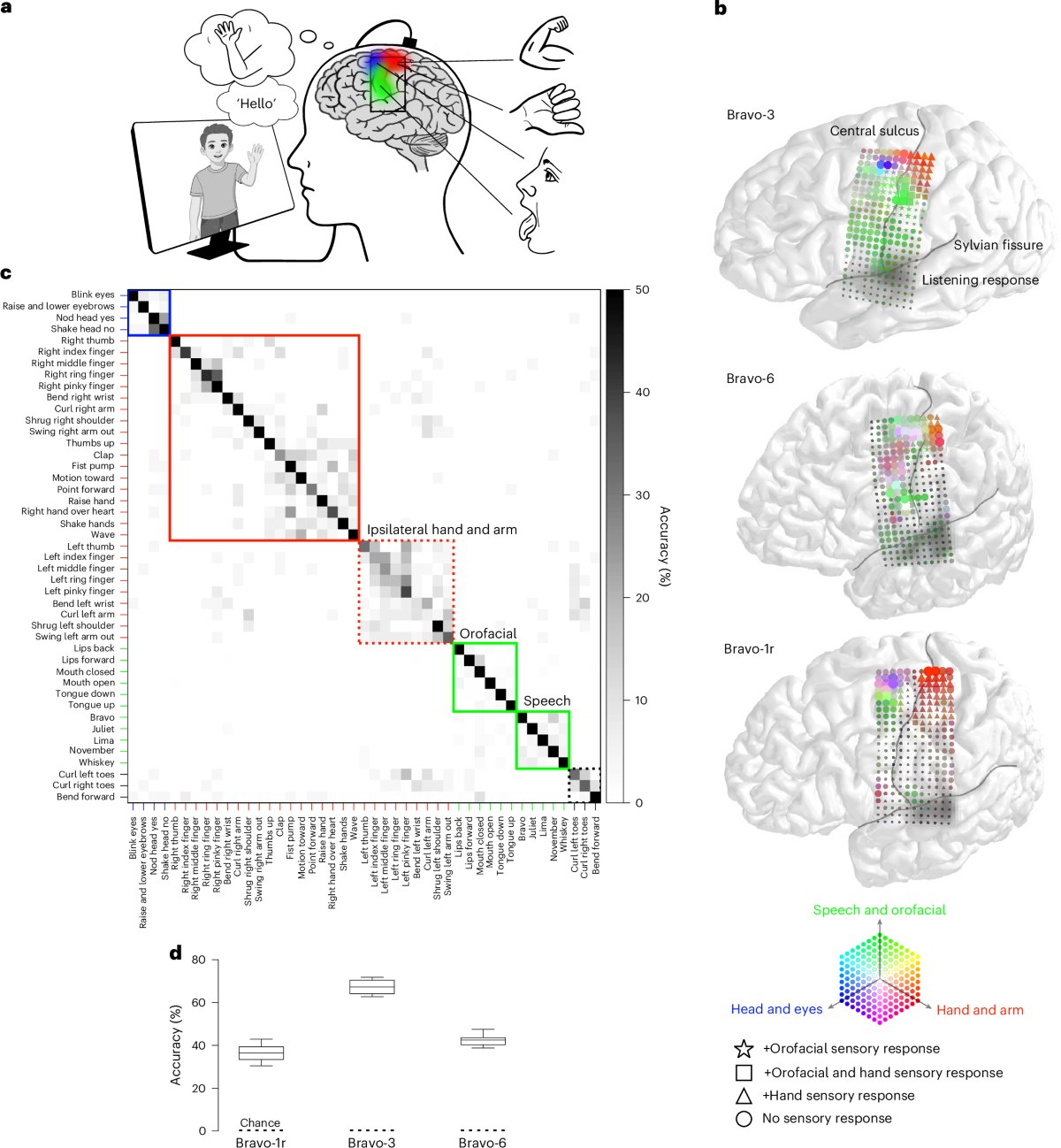
On September 14, Edward Chang’s team at UCSF published Simultaneous speech and gesture decoding for multimodal communication in paralysis in Nature Neuroscience. The open-access paper reports a single electrocorticography IMPLANT over sensorimotor cortex that can decode attempted SPEECH and upper-body GESTURES at the same time, then push both streams into a personalized full-body virtual AVATAR.
Natural conversation mixes words with nods, shrugs, and fist pumps. Prior BCI work mostly split those CHANNELS. Chang’s group recorded three participants with vocal-tract and limb paralysis, showed one implant can carry signals for several movement types, and then ran parallel DECODERS in two participants so speech became TEXT while gestures moved an avatar BODY.
In conversational blocks, one participant hit median accuracies of 100% for BOTH speech and gesture decoding across three blocks, according to the Nature Portfolio summary. Training on speech and gestures TOGETHER improved PERFORMANCE and cut mistakes versus training the channels in isolation. The authors are clear that larger vocabularies, more participants, and broader gesture sets are still required before clinical USE.
The same September 14 window brought a separate commercial SIGNAL. Austin-based Paradromics announced that the first participant in its Connect-One Early Feasibility Study used the fully implanted CONNEXUS BCI for real-time SPEECH and text. The Michigan woman, living with progressive motor neuron disease and severe dysarthria, chose her own WORDS — starting with “Okay, I have a lot to say” — answered open-ended questions, and spoke with her grandchildren on a live PHONE call. Output was text plus synthesized SPEECH, not an avatar.
Connexus uses 421 microelectrodes in an intracortical ARRAY, with wireless transmission through intact skin. Paradromics says the system also distinguished attempted speech from imagined SPEECH patterns. CEO Matt Angle framed the platform as “effectively the world’s most sophisticated conduit between human INTENTION and AI.” The company did not publish words-per-minute, word-error rate, vocabulary size, or LATENCY — so this is a DEMONSTRATION, not a benchmark paper.
Inside BCI correctly separates the two September 14 results: UCSF is academic, avatar-mediated, and peer REVIEWED; Paradromics is company-reported free speech with text and TTS. Different modalities, different VERIFICATION. What they share is TIMING — and a reminder that speech restoration and multimodal AVATARS are advancing on parallel tracks while Meta teases Codec Avatar hologram CALLS on Phoenix at Connect on September 23–24.
For XR readers, the practical TAKEAWAY is narrower than the headlines. These systems restore COMMUNICATION for people with paralysis; they are not consumer headset FEATURES. But the research stack behind avatar TELEPRESENCE — decoding INTENT, rendering a body, syncing speech with GESTURE — is the same stack consumer platforms keep promising. When Connect shows a photorealistic CALL, remember that clinical labs just spent the same week proving a single implant can drive speech and gesture TOGETHER onto an avatar, and that a commercial intracortical device just let a participant SPEAK her own words in real time.
Sources: Brosler et al., Nature Neuroscience; Nature Portfolio summary; Paradromics / Business Wire via BioSpace; Inside BCI; Paradromics Connexus.