By the Metaverse Watcher newsroom. Covers November 7–13, 2026. Published Friday, November 13, 2026.
This was the week Android XR glasses got a price tag. Google, Samsung, Warby Parker and Gentle Monster opened pre-orders for the first Intelligent Eyewear frames at $395 and up, while Meta disclosed that in-app purchases now earn more on the Quest Store than paid apps do. IMAX signed on to Meta VR Glasses for 2027, and Snap Specs hands-on reports kept coming. Meta’s camera glasses also had a rough week on safety and security. Here is everything that mattered in XR this week, with links to our full coverage.
The Week at a Glance
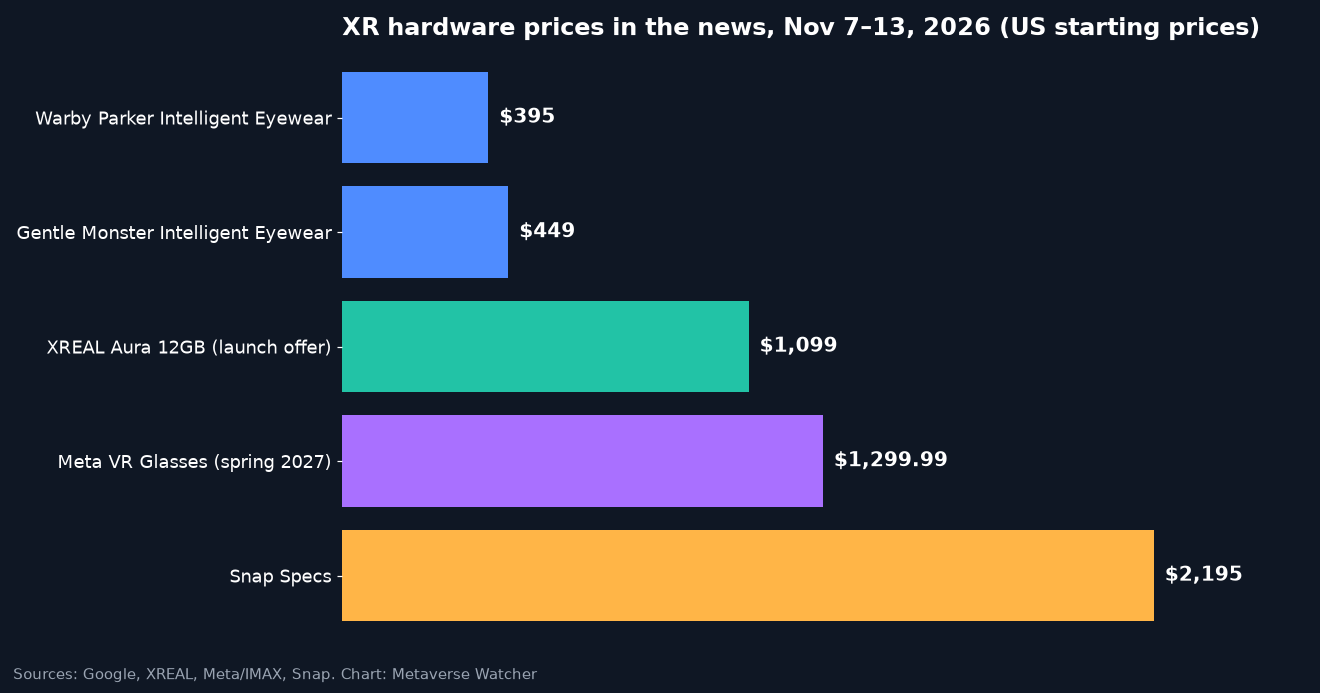
| Story | Key number | Why it matters |
|---|---|---|
| Google Intelligent Eyewear pre-orders | From $395 (Warby Parker), $449 (Gentle Monster); stores Dec 10 | First Android XR glasses on sale; a direct Ray-Ban Meta rival |
| Meta Quest Store revenue mix | Top 50 apps each made over $1M (Jan–Sep) | In-app purchases passed paid app sales for the first time |
| IMAX Enhanced on Meta VR Glasses | $1,299.99; spring 2027 | First VR device in the IMAX Enhanced program |
| Snap Specs hands-on reports | $2,195; 132 g; 51° field of view | Comfort largely fixed; display and battery still questioned |
| Meta Glasses update 130 + Ray-Ban Meta hack | 5 Meta Glasses styles affected; 1-byte bypass | Camera glasses now get phone-style safety and security scrutiny |
| Pico Space Pro | Reported Dec 2 launch | Unconfirmed by Pico, which pulled a date once already |
| Even G2 SDK + XREAL Aura for work | Alpha SDK; Aura from $1,099 | Display glasses are being sold to businesses |
1. Google’s Android XR Glasses Go on Pre-Order From $395
The biggest story of the week landed on November 12. In a post on Google’s blog, Shahram Izadi, Google’s VP and GM of XR, opened pre-orders for the first Intelligent Eyewear collections, made with Samsung, Warby Parker and Gentle Monster. Warby Parker frames start at $395 in three styles (Alden, Reid and Wren). Gentle Monster starts at $449 with six designs. Both go on sale in stores on December 10 in the United States and South Korea.
The hardware is the same across both brands. WIRED reports a weight of about 41 grams, nine hours of battery life, a case that recharges the glasses up to seven times, and a 12MP camera with a recording LED. There is no display in the lens. These are Gemini audio-and-camera glasses, so the real rival is Ray-Ban Meta, not Meta Ray-Ban Display. Phone support is narrow at launch: Pixel 7 or newer, recent Galaxy phones on One UI 9, and iPhone 13 Pro or newer. 9to5Google’s hands-on notes that much of the image processing is offloaded to the phone.
Earlier in the week, a Galaxy Wearable app update added pairing support and model numbers for both lines. We covered that in Samsung smart glasses pairing lands in Galaxy Wearable. The full price, spec and phone list is in Google Intelligent Eyewear: price, specs and phones. If you are choosing between camera glasses, our Ray-Ban Meta vs Oakley Meta vs Meta Glasses comparison covers Meta’s side of the market.
2. In-App Purchases Now Lead Meta Quest Store Revenue
Meta gave its clearest look yet at Quest spending in a Horizon OS developer blog post by Chris Pruett, its Director of Games. For January through September 2026, Store revenue was “steady” against the same period last year, even without a new headset. For the first time, in-app purchases passed premium app sales as the largest source of revenue. Each of the top 50 apps made more than $1M after store fees. Among developers in the Horizon+ program, 80% now earn more from Horizon+ than from Store sales.
For buyers, this points to more free-to-play games and more subscription value, and fewer big one-time purchases. Our analysis and the top-50 cohort table are in Meta Quest Store: in-app purchases now top paid app sales. For the paid games still worth buying, see the best Quest 3 games of 2026.
3. IMAX Makes Meta VR Glasses Its First VR Device
On November 10, IMAX and Meta turned a line from Meta’s September launch post into a licensing deal. Meta VR Glasses, due in spring 2027 at $1,299.99 in the US, will be the first VR device certified under IMAX Enhanced. IMAX will ship an updated IMAX app with a virtual theater, and select titles will play in IMAX’s Expanded Aspect Ratio. Together with the new Theater mode in Horizon OS 2.10, it shows Meta pitching its next device as a personal cinema first. Details: IMAX Enhanced Meta VR Glasses: IMAX app coming in 2027.
4. Snap Specs Hands-On Reports Settle on a Verdict
Snap Specs still have no full scored reviews, but five hands-on reports from outlets including TechRadar, TechCrunch and UploadVR now point the same way. The $2,195 standalone AR glasses are a real engineering first. At 132 g, the comfort problems of earlier prototypes are largely solved. Open questions remain about the 51° display, the roughly four-hour rated battery and what the glasses are actually for. Snap still says shipping will begin before the end of 2026. Our roundup quotes each outlet: Snap Specs reviews: what 5 hands-on tests found. If you are weighing Specs against tethered glasses, see Snap Specs vs XREAL Aura.
5. Meta’s Camera Glasses Face Safety and Security Questions
Two separate stories this week showed that smart glasses now get the scrutiny phones do. First, Meta emailed owners of its house-brand Meta Glasses, in an email marked “Action required,” to install version 130. The update fixes a rare issue where frames can get “too warm” when moisture or sweat gets inside. It covers five styles: Adventurer, Fury, Starfire, Nova and Capri. Meta says Ray-Ban Meta and Oakley Meta are NOT affected. See Meta Glasses update 130 fixes moisture overheating.
Second, a security researcher published a detailed write-up showing Ray-Ban Meta glasses could be made to run code Meta never signed. After Meta’s fix in firmware 127, she got around it by changing a single byte in a configuration file the glasses accept from the paired phone. The attack needs control of that phone, so this is not a remote takeover of strangers’ glasses, but it is the most detailed public look yet at how the glasses decide which code to trust. Full breakdown: Ray-Ban Meta hack: one byte bypassed app signing. For workplace rules on camera glasses, see our analysis of smart glasses at work.
6. Pico Space Pro Gets a Reported December 2 Date
Chinese XR outlet VRAR World reported on November 9 that Pico Space Pro will launch on December 2. Pico has not confirmed the date, and its developer FAQ still says only that the headset will launch globally in 2026. The caution is earned: Pico announced a September 2 launch event in August and cancelled it five days later. Space Pro is ByteDance’s answer to Apple Vision Pro and Samsung Galaxy XR, and the first device to run PICO OS 6. Our timeline: Pico Space Pro launch reported for December 2.
7. Display Glasses Move Into the Workplace
Even Realities launched the Even G2 Enterprise SDK on November 10. The SDK runs inside a company’s own mobile app and talks to the glasses over Bluetooth, and Even says its servers are not part of the runtime connection. It is in alpha, by application, and needs Enterprise firmware that is not yet public. See Even G2 Enterprise SDK opens glasses to company apps.
Google and XREAL are pitching XREAL Aura for work as well, IT Brief reported, with a 70-degree optical see-through display, a weight under 95 grams, Google Play apps and DisplayPort input from a laptop. XREAL’s US store lists the 12GB model at $1,099 (regular price $1,279), with batch shipping expected to begin in mid-November. One of Aura’s most distinctive early games is Fallout: Factions, which puts a tabletop skirmish on your real table.
8. Quest Software: Theater Mode and Wired PC Streaming
Horizon OS 2.10 on the Public Test Channel adds a dedicated Theater environment for video. Some testers also get a pared-down Navigator with only three tabs: Search, Library and Notifications. See Horizon OS 2.10: Quest Theater mode and simplified Navigator, and our guide on how to update Meta Quest 3 and 3S. Separately, Microsoft’s Mixed Reality Link can now stream a Windows 11 desktop to Quest 3 and 3S over a USB cable, which helps on hotel and office networks. Setup steps: Mixed Reality Link adds USB streaming.
9. Enterprise and Health: XRHealth and Varjo
XRHealth bought virtual addiction treatment provider PursueCare on November 9, a week after it acquired the VR cognitive rehabilitation startup living brain. PursueCare brings two FDA-authorized prescription digital therapeutics, RESET and RESET-O. The deals turn a VR therapy company into a broader digital care business where the headset is only one device (our report). In defense, the Finnish Defence Forces are piloting Varjo XR-4 headsets to train soldiers against small FPV drones. Varjo says the headset is clear enough to train against a five-inch drone at realistic distances (full story).
10. Games: Steam Frame Cross-Saves and New Releases
Psytec Games turned on shared Steam Cloud saves for Crystal Rift, so a dungeon run started on PC can continue on Steam Frame and back again. This is the kind of cross-device support that makes Valve’s headset more useful (details). For everything else that launched, see New VR Games This Week: November 9–15, 2026.
What to Watch Next Week
- XREAL Aura deliveries: the first batch shipments are due to start in mid-November in the US, Canada, Japan and South Korea. Watch for the first owner reports and full reviews.
- Intelligent Eyewear demos: Warby Parker store demos are expanding before the December 10 retail date. Watch for longer-term impressions of battery life and camera quality.
- Pico confirmation: whether Pico confirms or moves the reported December 2 Space Pro date.
- Horizon OS 2.10 stable release: whether Theater mode leaves the test channel.
- Black Friday (November 27): early VR and smart glasses deals are already live. Our early Black Friday VR deals post lists verified prices.
Missed last week? Read the XR Week in Review for November 6, 2026.