By the Metaverse Watcher newsroom. Published Tuesday, November 17, 2026. Prices and stock checked on November 17, 2026 against Valve’s Steam listings as tracked by Steam Hardware Stock. We will update this comparison if Valve changes a price or restocks Index parts.
For seven years the Valve Index was the default answer for anyone serious about PC VR. Now it has a successor and an end date. Valve’s Steam page says plainly that “Valve Index is no longer being produced,” and the remaining stock is selling at 20% off while supplies last. Meanwhile the Steam Frame costs $1,059 and is still sold through a reservation queue.
That leaves two groups of people with a real decision: Index owners wondering whether to upgrade, and new PC VR buyers wondering whether a discounted Index is a bargain or a trap. This guide compares the two headsets spec by spec, prices out what each actually costs today, and gives a clear recommendation for each type of buyer.
The short answer: the Steam Frame is the better headset for almost everyone, with roughly double the pixels per eye, wireless PC streaming, eye tracking and no base stations. The Index still wins on audio and Lighthouse tracking precision. And in the US right now, a new Index setup is hard to complete from Valve, because only the headset and tether were in stock at the latest check.
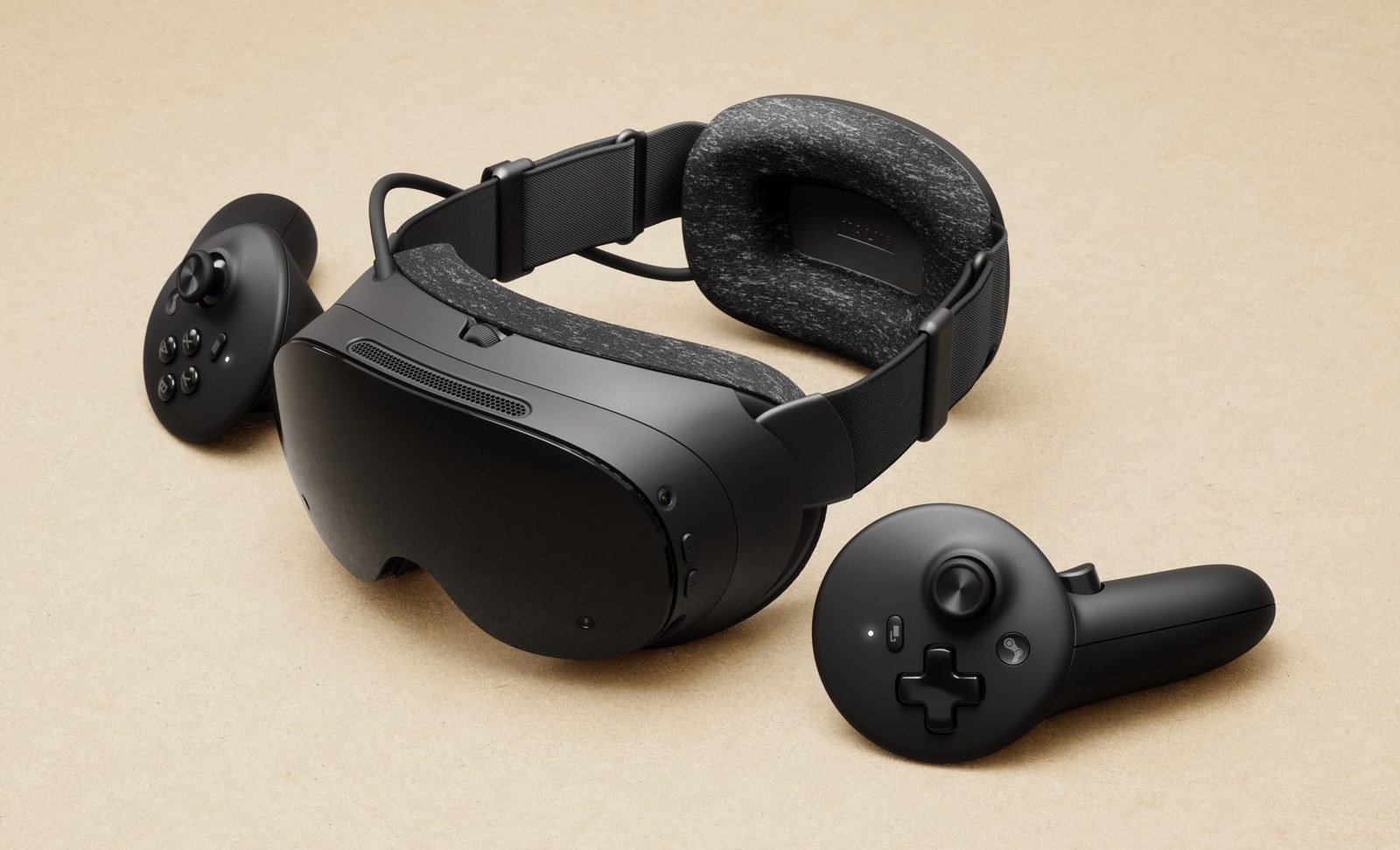
Steam Frame vs Valve Index: Specs Side by Side
| Spec | Steam Frame | Valve Index |
|---|---|---|
| Released | 2026 (reservations opened September 14, 2026) | June 28, 2019 |
| Status | Current, reservation and waitlist only | Discontinued, remaining stock only |
| Type | Standalone plus wireless PC streaming | Tethered PC VR only |
| Processor | Snapdragon 8 Gen 3, 16GB RAM, SteamOS 3 | None (runs on your PC) |
| Display per eye | 2160 x 2160 LCD | 1440 x 1600 LCD |
| Refresh rate | 72–144 Hz (144 Hz experimental) | 80, 90, 120 or 144 Hz |
| Lenses | Pancake | Conventional (non-pancake) |
| Field of view | Up to 110 degrees (Valve) | Valve gives no single figure; Wikipedia lists an estimate of 108 degrees |
| IPD range | 60–70 mm | 58–70 mm |
| Tracking | Inside-out, 4 cameras, no base stations | SteamVR Lighthouse, base stations required |
| Eye tracking | Yes, used for foveated streaming | No |
| PC connection | Wireless via included Wi-Fi 6E adapter | DisplayPort 1.2 and USB 3.0 cable |
| Audio | Dual drivers per ear in the strap | Off-ear BMR speakers |
| Controllers | Full gamepad layout, TMR sticks, capacitive finger sensing | Index Controllers with finger tracking |
| Weight | 440 g with strap | Heavier; owners often cite weight as a main complaint |
Display and Lenses: The Frame’s Biggest Visual Upgrade
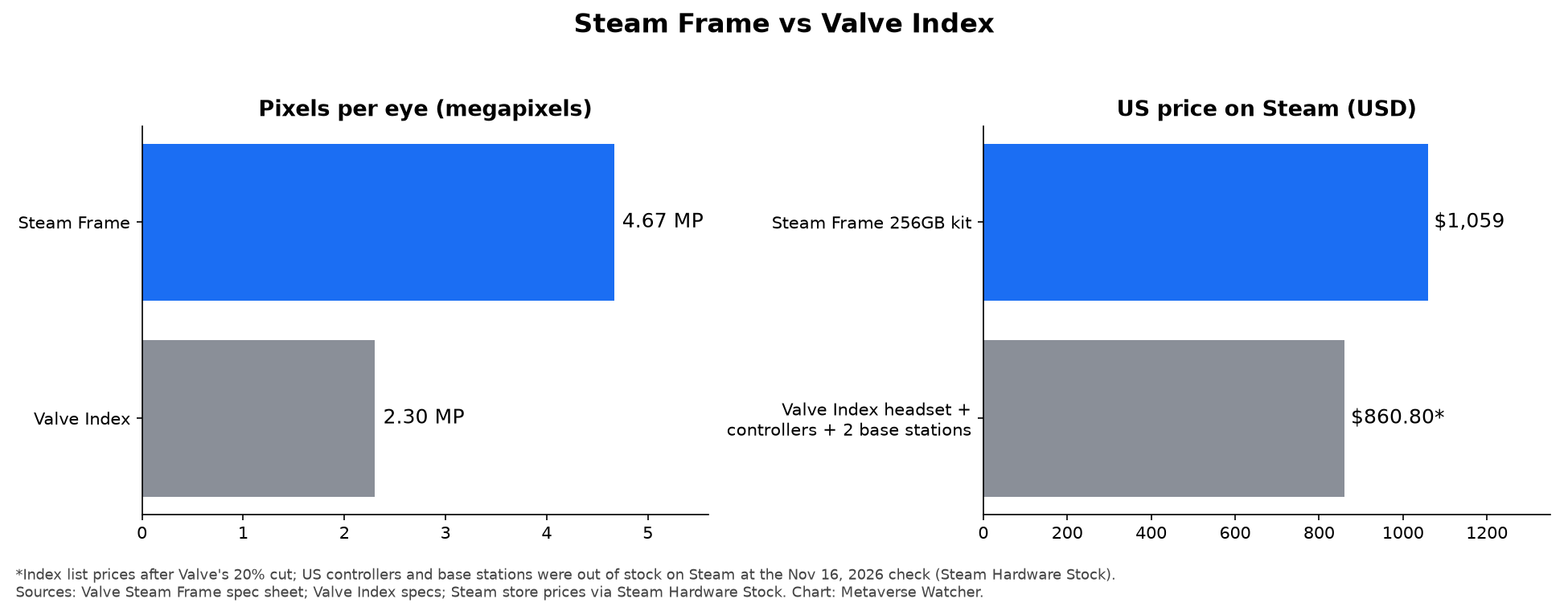
The raw numbers are lopsided. The Frame’s 2160 x 2160 panels carry about 4.67 million pixels per eye, against 2.30 million on the Index. That is roughly double, and it shows. PC Gamer wrote that the Frame’s resolution is “greatly increased” over the Index and that its pancake lenses “greatly increase the clarity of the overall picture.”
Pancake optics also give a wider sweet spot, so text stays sharp without constant headset adjustment. The trade-off is that both headsets use LCD panels, so neither delivers deep OLED blacks. Reviewers have been mixed on the Frame’s displays: our Steam Frame reviews roundup found an average score of 75/100, with several outlets calling the panels good rather than exceptional.
One spec cuts the other way. The Index’s IPD range of 58–70 mm is slightly wider than the Frame’s 60–70 mm. If your IPD is below 60 mm, measure before you commit to a Frame.
Tracking: Convenience vs Precision
This is the most important practical difference. The Index uses SteamVR Lighthouse tracking, which means mounting base stations around your room. It is still regarded as the precision benchmark for fast motion and controllers held behind your back or out of view. That precision is why many sim racers, flight simmers and competitive rhythm players held on to their Index.
The Frame tracks itself with four onboard cameras. There is nothing to mount, nothing to power at the wall and no line-of-sight planning. As PC Gamer put it, Valve’s goal was reducing “the friction of getting into and playing a game in virtual reality.” The cost is the usual inside-out limitation: controllers can lose tracking when they leave the cameras’ view.
If you already own base stations, note that the Frame does not need them, so they will not add value to an upgrade.
Wireless and Standalone: Where the Frame Changes the Category
The Index is an accessory for a gaming PC. It does nothing without a DisplayPort cable running to a capable GPU. The Frame is a full SteamOS computer that can play games on its own, and it streams PC VR wirelessly through a dedicated 6 GHz link from the included adapter, with eye-tracked foveated streaming to save bandwidth.
Wireless PC VR is the feature reviewers praise most consistently. The trade-off is battery life. Valve publishes no runtime figure, and our Steam Frame battery life guide collects published tests showing about an hour of demanding standalone play and roughly 1.5 to 2 hours when streaming. The Index, tethered to wall power, never runs out.
Audio and Controllers: The Index’s Remaining Strengths
The Index’s off-ear BMR speakers are still among the best audio solutions on any VR headset. PC Gamer called them “arguably its best feature” and noted the Frame lacks them. Longtime Index owners on the Steam Frame subreddit report the same thing: speakers and microphones are a step down on the Frame.
Controllers are closer than many expected. The Index Controllers pioneered strap-on finger tracking, while the Frame Controllers add a full gamepad layout, magnetic TMR thumbsticks designed to resist drift, and five-finger capacitive sensing. If you play many flat Steam games in the headset, the gamepad layout is a genuine advantage.
What Each Headset Costs Today
The Steam Frame 256GB kit costs $1,059 in the US and the 1TB kit costs $1,299. Both include two controllers, the wireless adapter and Half-Life: Alyx. The power supply is NOT included; Valve sells a 45 W unit for $29, or you can use any 45 W USB-C charger. You also cannot simply buy one: Valve works through reservations and regional waitlists, and our guide to the Steam Frame order wait explains how to check your place.
The Index is discontinued. Valve cut every Index price by 20% on October 13, 2026. Here is the US price list on Steam and the stock status at the latest tracker check (November 16, 2026, 6:10 PM ET):
| Valve Index part (US) | Steam price | US stock |
|---|---|---|
| Headset | $399.20 | In stock |
| Replacement tether | $103.20 | In stock |
| Base Station | $119.20 | Out of stock |
| Controllers (pair) | $223.20 | Out of stock |
| Replacement left or right controller | $119.20 each | Out of stock |
| Headset + Controllers | $599.20 | Out of stock |
| Full VR Kit | $799.20 | Out of stock |
| Face Gasket 2 Pack | $31.99 | Out of stock |
On paper, a headset, a pair of controllers and two base stations would total $860.80 at Valve’s reduced prices, about $200 less than a Frame. In practice, US buyers can ONLY get the headset and tether from Valve right now. Completing a setup means sourcing controllers and base stations elsewhere. VR.org reported in October that HTC sells the SteamVR Base Station 2.0 at $229 each, and most rooms need two, which erases the savings quickly.
Stock differs by country. The same tracker showed four of nine Index parts in stock in the UK and most EU countries, and none in Australia, France or Spain.
Should Index Owners Upgrade to the Steam Frame?
- Upgrade if the tether and weight are your main complaints, you want sharper visuals, or you want to play flat Steam games in a headset. Index owners who upgraded consistently cite the wireless link and comfort as the biggest gains.
- Wait if you mainly play seated sims where Lighthouse precision and wired reliability matter more than freedom of movement, or if the Index’s speakers are central to your experience.
- Buy spares now if you plan to keep your Index. A $399.20 replacement headset or a $103.20 tether is the cheapest insurance you will get from Valve, and Valve has not said it will restock parts that sell out.
Should New Buyers Pick a Discounted Index?
For most new buyers, no. A 2019 headset that needs base stations you cannot currently buy from Valve in the US is not a bargain, even at $399.20. Valve says the Index remains supported on Steam and SteamVR, but spare parts will only get scarcer.
If the Frame’s price or wait is the problem, there are better alternatives. The Meta Quest 3 streams PC VR well and adds color mixed reality; see our Steam Frame vs Quest 3 comparison. A PS VR2 with Sony’s PC adapter offers OLED visuals for less; our PS VR2 on PC guide covers the setup. Our best VR headsets of 2026 list ranks every current option.
Steam Frame vs Valve Index: Quick Answers
Is the Valve Index discontinued? Yes. Valve’s Steam page says the Index “is no longer being produced,” and remaining stock is sold at reduced prices while supplies last.
Is the Steam Frame the Index 2? No. Valve told PC Gamer the Frame is “not the Index 2” and that it is “trying to do something new.” It is a streaming-first standalone headset, not a wired enthusiast headset.
Does the Steam Frame need base stations? No. It uses four onboard tracking cameras.
Will the Index keep working? Valve says the Index is still supported on Steam and SteamVR.
Which has better resolution? The Steam Frame, at 2160 x 2160 per eye against 1440 x 1600 on the Index.
Once you have a headset, our best Steam Frame games list is the place to start.
Sources
- Valve: Valve Index on Steam
- Steam Hardware Stock: Valve Index stock in the United States (check of November 16, 2026, 23:10 GMT)
- PC Gamer: Valve wants you to know that the Steam Frame is not the Index 2
- VR.org: This Week in VR, October 16, 2026
- Wikipedia: Valve Index
- r/SteamFrame: Index owner upgrade impressions