Is VR bad for your eyes? It is one of the most common questions from new Meta Quest, Apple Vision Pro and Steam Frame owners, and from parents buying a headset for a child. The short answer from eye doctors is reassuring: there is NO EVIDENCE that current VR headsets cause permanent damage to healthy eyes. Headsets can, however, cause temporary EYE STRAIN, dry eyes, blurred vision and headaches, especially during long sessions or when the headset is poorly fitted.
This guide sets out what the American Academy of Ophthalmology (AAO), the American Optometric Association (AOA), the American Academy of Pediatrics (AAP), peer-reviewed research and the headset makers themselves actually say. Every source was checked on November 25, 2026. It is general information, not medical advice. If you have an eye condition or symptoms that do not go away, see an optometrist or ophthalmologist.
Quick Answer
- No known lasting harm. The AAO says ophthalmologists agree there is no reason to be concerned that VR headsets will damage eye development, health or function, while noting that no long-term studies have been done.
- Short-term discomfort is common. People blink less when looking at screens, which dries the surface of the eye and causes fatigue. Symptoms usually fade after you stop.
- Fit matters. A headset that is not adjusted to your eyes (lens spacing, or IPD, and strap position) raises the risk of blurred vision, eye strain and headaches.
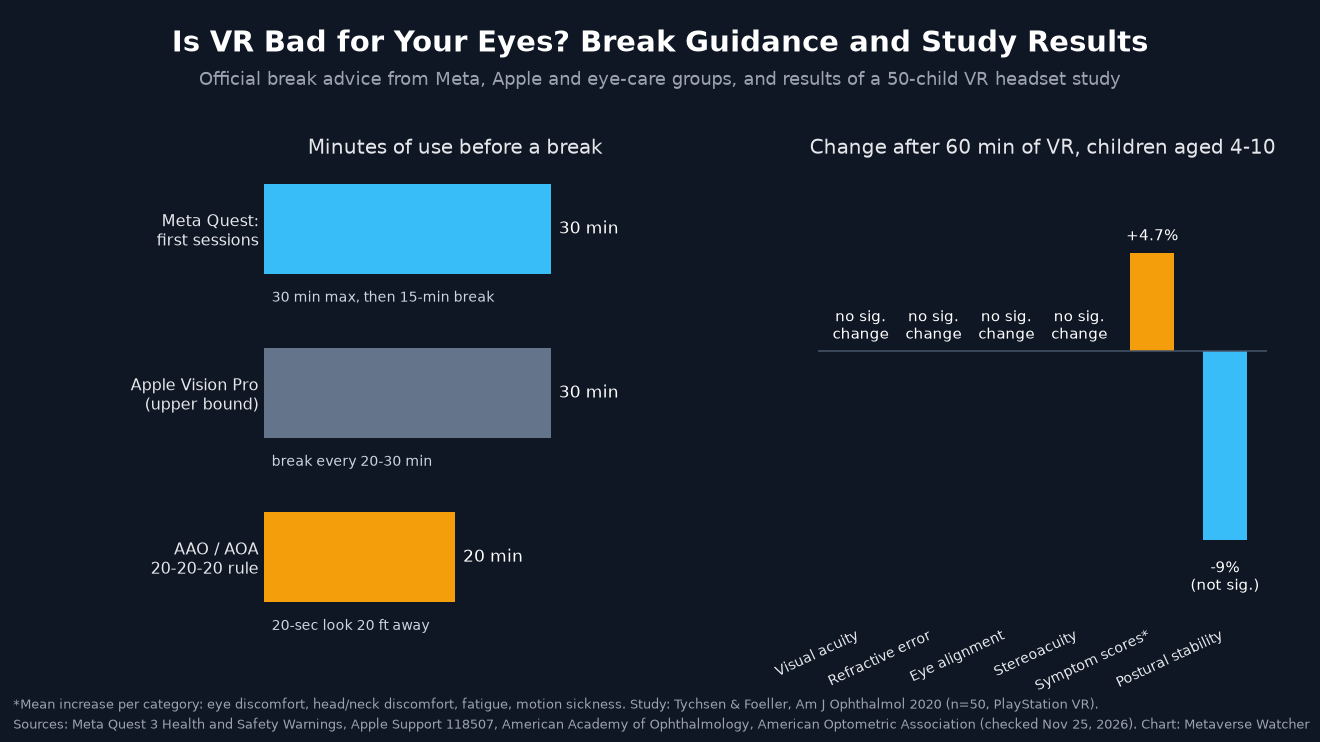
- Take breaks. Meta suggests starting with no more than 30 minutes followed by a 15-minute break. Apple suggests a break every 20 to 30 minutes while you get used to Vision Pro.
- Blue light is not the issue. The AAO says there is no scientific evidence that blue light from digital devices damages the eye.
What Eye Doctors Say About VR Headsets
The clearest statement comes from the American Academy of Ophthalmology. Its patient guide, reviewed by pediatric ophthalmologist Stephen Lipsky, MD, says that although there are no long-term studies, “ophthalmologists agree there is no reason to be concerned that VR headsets will damage eye development, health, or function.” Dr. Lipsky adds: “Age limitations for VR technology might make sense for content, but as far as we know, this technology poses no threat to the eyes.”
The same guide is direct about the limits of that reassurance. Looking at any digital screen for a long time “may cause eye strain or fatigue,” because you tend to blink less often than normal. In a separate guide on digital devices and your eyes, the AAO notes that people normally blink around 15 times per minute and that this rate “can be cut in half” when staring at screens or doing other close work. The result is the familiar set of DIGITAL EYE STRAIN symptoms: dry eyes, blurry vision, watery eyes and headache. The AAO says these effects are temporary and that devices “will not damage your eyes permanently.”
Why VR Can Feel Tiring for Your Eyes
Beyond reduced blinking, VR has one feature that ordinary screens do not. A headset shows each eye a slightly different image so you perceive depth, but the displays and lenses keep the image at a fixed optical focus. Your eyes therefore turn inward or outward (vergence) to match where a virtual object appears to be, while the focusing system (accommodation) stays set to the fixed distance of the display. Researchers call this the VERGENCE-ACCOMMODATION CONFLICT.
A widely cited study by Hoffman, Girshick, Akeley and Banks in the Journal of Vision (2008) found that this uncoupling “frequently reduces one’s ability to fuse the binocular stimulus and causes discomfort and fatigue.” When the researchers used a display that presented correct or nearly correct focus cues, viewer fatigue and discomfort were reduced. This is a comfort issue, not evidence of damage, and it helps explain why some people find close-up virtual objects more tiring than distant scenery.
Other factors that add to strain include an incorrect lens distance setting, smudged lenses, a headset sitting too high or too low on the face, and very long sessions. Fit and lens care are covered in our guides to adjusting IPD on Meta Quest 3 and 3S and cleaning Meta Quest 3 lenses.
Common Concerns, Checked Against the Evidence
| Concern | What the evidence says | Source |
|---|---|---|
| VR permanently damages eyesight | No evidence of lasting damage to healthy eyes; no long-term studies yet | AAO |
| Eye strain and dry eyes | Common and temporary; linked to reduced blinking and long sessions | AAO, AOA |
| Blue light from the displays | No scientific evidence that blue light from devices damages the eye; it can affect sleep in the evening | AAO |
| VR harms children’s vision | A 50-child study found no significant change in acuity, refraction, alignment or depth perception after 60 minutes | Tychsen and Foeller, 2020 |
| Headaches or double vision | Possible, especially with poor fit or existing binocular vision problems; stop and rest | AAO, Meta, Apple |
| Seizures from flashing content | About 1 in 4,000 people may react to light flashes or patterns, including on TV and games | Meta safety warnings |
Blue Light: A Sleep Issue, Not an Eye Damage Issue
Headsets use bright, close displays, so blue light is a frequent worry. The AAO’s guide Should You Be Worried About Blue Light? states that “there is no scientific evidence that blue light from digital devices causes damage to your eye,” and that the Academy does not recommend special blue light-blocking eyewear for computer use. It also notes that the largest source of blue light is the sun.
Where blue light does matter is sleep. The AAO says too much exposure late in the evening can disrupt the body’s sleep cycle, and suggests avoiding screens for one to two hours before bed. If you play VR at night and then struggle to fall asleep, an earlier finish is a sensible first step.
Is VR Bad for Children’s Eyes?
Age rules vary by device. Meta’s Meta Quest 3 Health and Safety Warnings set a minimum account age of 10 (requirements may vary by country) and say children’s use should always be supervised by an adult. Apple says Vision Pro is designed for people 13 and older. The AAO notes that most manufacturers set limits around 12 or 13, and that these limits may make more sense for content than for eye health.
The best-known study on young children is Tychsen and Foeller (American Journal of Ophthalmology, 2020). Researchers at St. Louis Children’s Hospital had 50 children aged 4 to 10 play a 3D flying game on a Sony PlayStation VR headset for two 30-minute sessions. Forty-six of the 50 (94%) completed both sessions with NO SIGNIFICANT CHANGE from baseline in visual acuity, refractive error, eye alignment or stereoacuity. Symptom scores for eye discomfort, head and neck discomfort, fatigue and motion sickness rose a mean 4.7%, and three children stopped early, two with mild motion sickness. The study was small and short, so it does not settle questions about years of heavy use.
The American Academy of Pediatrics takes a similar view: brief exposure has not been shown to cause harm, especially with supervision, but long-term data is limited. It points out that children may not describe eye discomfort or remove a headset on their own, and recommends substantial breaks of about 15 minutes between sessions. Meta adds a specific fit concern: a child’s IPD may be smaller than the headset’s lens spacing, which raises the risk of eye strain, blurry vision, headaches or nausea if the lenses cannot be adjusted to fit. For age rules and controls, see our Meta Quest age requirements guide and parental controls setup guide.
VR With Glasses or an Existing Eye Condition
The AAO says people with amblyopia, strabismus or other conditions that affect focusing or depth perception may not see the full 3D effect and may be more likely to get headaches or eye fatigue in VR. It stresses that this does not mean headsets cause these disorders. It also advises keeping prescription glasses on if you need them. Meta permits glasses in Quest 3 but warns that wearing them may increase the risk of facial injury if you fall or hit your face. Apple Vision Pro does not accept glasses at all; you need contact lenses or ZEISS Optical Inserts.
Our guides to wearing glasses with Meta Quest 3 and 3S and VR prescription lens inserts cover the practical options. Apple advises consulting a medical provider before using Vision Pro if you are at risk for seizures, and warns that conditions such as migraines or an eye condition may be aggravated. Meta advises consulting a doctor before use if you have previously had a seizure.
How to Reduce Eye Strain in VR
- Set the lens distance correctly. Meta says that when properly adjusted, you should see “a single, clear image.” On Vision Pro, Apple says that after the IPD adjustment (visionOS may ask you to press and hold the Digital Crown) you should see a single, clear image.
- Position the headset for the sharpest image. Move it up or down on your face and tighten the straps until text in the center of view is clear.
- Start short. Begin with no more than 30 minutes and a 15-minute break (Meta), or a break every 20 to 30 minutes (Apple), then extend gradually.
- Blink deliberately and rest your focus. The AOA’s 20-20-20 rule for screens is to look at something 20 feet away for 20 seconds every 20 minutes. In VR, that means lifting the headset or switching to passthrough and looking across the room.
- Use artificial tears if your eyes feel dry, as the AAO suggests for screen use.
- Keep lenses clean and out of the sun. Smudges reduce clarity, and Meta warns that direct sunlight on the lenses may damage the optics and display.
- Stop if symptoms appear. Meta and Apple both list eye strain, eye pain, and blurred or double vision as reasons to stop. Do not resume until symptoms are fully gone, and see a doctor if they persist.
| Source | Session guidance | Break guidance |
|---|---|---|
| Meta (Quest 3) | Start with a maximum of 30 minutes; increase gradually | 15 minutes after early sessions; younger children need more frequent, longer breaks |
| Apple (Vision Pro) | Adjust session length to your comfort | Every 20 to 30 minutes while getting used to the device |
| AAP (children) | Reasonable time limits with adult guidance | About 15 minutes between sessions |
| AAO and AOA (all screens) | Not specified | Look 20 feet away for 20 seconds every 20 minutes |
Motion sickness is a separate issue from eye strain, though the two often appear together. Our guide to preventing VR motion sickness covers comfort settings and how to build tolerance.
When to See an Eye Doctor
Temporary tiredness after a long session is expected. See an optometrist or ophthalmologist if blurred or double vision, eye pain or headaches continue after you stop, if you notice a change in your vision, or if a child repeatedly complains of discomfort or rubs their eyes during play. The AOA also notes that uncorrected or under-corrected vision problems are a major contributor to screen-related eye strain, so an up-to-date prescription can make VR more comfortable.
Bottom Line
Based on current evidence, VR is not bad for your eyes in the sense of causing lasting harm. The AAO, the AAP and the available research point to the same conclusion: short-term EYE STRAIN and fatigue are real but temporary, and they are best managed with a correct fit, clean lenses, regular breaks and deliberate blinking. Long-term research is still limited, which is why headset makers set age limits and recommend supervision for children. Use the break guidance above, stop when your eyes tell you to, and speak to an eye doctor if symptoms persist.
Sources: American Academy of Ophthalmology (VR headsets, digital devices, and blue light guides); American Optometric Association (computer vision syndrome); American Academy of Pediatrics (VR use and children); Tychsen and Foeller, American Journal of Ophthalmology, 2020; Hoffman et al., Journal of Vision, 2008; Meta Quest 3 Health and Safety Warnings; Apple Support article 118507. All checked November 25, 2026.