By the Metaverse Watcher newsroom. This article is based on the University of Pittsburgh news release distributed through EurekAlert on November 26, 2026, and on the Nature Perspective it describes. Quoted statements come from the release.
Photonic chips for AR glasses are the subject of a new roadmap in Nature. A team led by physicist Zhujun Shi of the University of Pittsburgh, with collaborators at MIT, the University of Washington, IMEC, Meta, TDK and Goertek, argues that integrated photonics could shrink the display optics inside augmented reality glasses the way integrated circuits shrank computers. The paper is a Perspective, which means it sets out a plan and a list of open problems. It does not report a finished product.
The Perspective is titled “Augmenting reality with integrated photonics” (DOI 10.1038/s41586-026-11146-7). Nature lists it as published online on November 25, 2026, and in its November 26 issue. The university’s release is dated November 26.
Key Facts
- Paper: “Augmenting reality with integrated photonics,” a Perspective in Nature, DOI 10.1038/s41586-026-11146-7.
- Lead institution: University of Pittsburgh. Zhujun Shi is an assistant professor in the Department of Physics and Astronomy.
- Co-authors’ institutions: MIT, Meta Platforms, University of Washington, IMEC (Leuven, Belgium), TDK (Tokyo) and Goertek Optical Technology (Shanghai).
- Type of paper: an invited roadmap. According to the release, Nature invited the team to write it.
- Main claim: photonic chips could guide and control light in a tiny, efficient package, which conventional display optics struggle to do.
- What it is not: neither the release nor the abstract announces a product, a launch date or measured specifications for a new device.
Why AR Glasses Need a New Kind of Display
AR glasses place digital content over the physical world, so that computing is no longer limited to a screen. The release says AR is already used in medical training and industrial maintenance and could become an everyday tool for work, communication and leisure, but only if the glasses are comfortable enough to wear all day.
That is a hard engineering target. Shi describes the requirements this way:
The requirements are rather stringent. It needs to be very small, very lightweight, and extremely efficient.
She adds that efficiency matters for more than battery life. “Whatever energy does not get used becomes a heat source,” she said, and heat is a problem for a device worn on the face. According to the release, conventional displays rely on bulky optics that cannot meet these demands, and integrated photonics offers a different way to generate and control light.
The same size and weight pressure shows up across the industry. Our report on a 1.5 mm AR glasses waveguide from Samsung and POSTECH covers one approach to thinner lenses, and our analysis of Samsung and LG’s push into AR glasses displays looks at the supply chain behind them.
What Integrated Photonics Means
Electronic chips use nanoscale structures to control electricity. Photonic chips use nanoscale structures to guide and control light instead, which puts an entire optical setup onto a single chip. The release notes that photonic chips already carry data through fiber-optic networks and data centers, because the field grew up around communication.
The release uses a historical comparison. An early University of Pittsburgh computer, a tape-driven IBM 7090 mainframe, took up nearly an entire room. Its components were later integrated onto a single chip, and those chips eventually ended up in pockets. Optics has not made that leap yet, Shi said:
The vision of integrated photonics is to miniaturize optics similar to the way we miniaturized electronics.
The Hardware Challenges
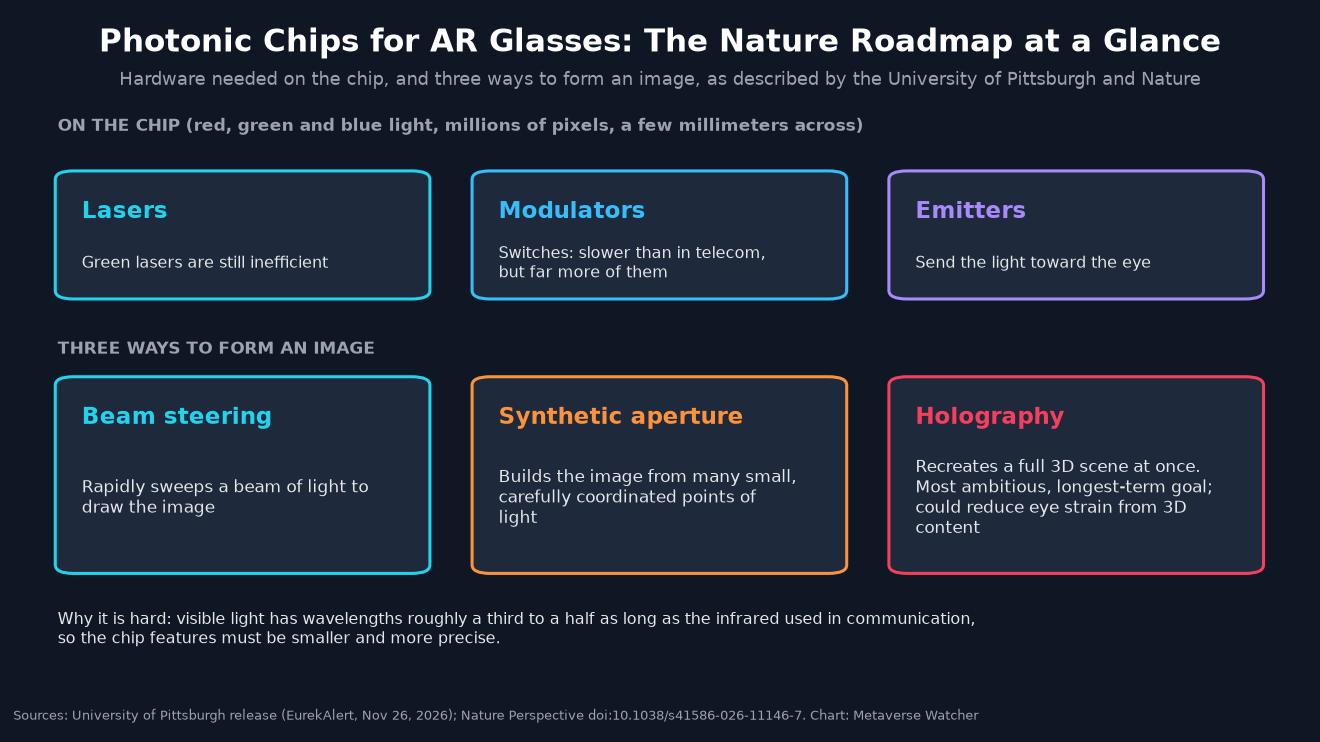
A photonic display chip must combine lasers, switches that control the light and emitters that send it toward the eye. It must handle red, green and blue light across millions of pixels in an area only a few millimeters across.
Displays push communication photonics in a new direction. They use visible light, whose wavelengths are roughly a third to a half as long as the infrared light used in communication. The chip’s features therefore have to be smaller and more precise. “How do we extend a technology that’s already mature for longer wavelengths into these shorter wavelengths?” Shi asked.
- Modulators: in communication, these switches are built for speed. A display needs less speed but far more modulators, each one small and power-efficient. Instead of using thousands of lasers, a display chip can split the light from one laser, “so one beam splits into two and two split into four and so on,” with a modulator at each split.
- Lasers: the release says the lasers themselves also need work, especially green lasers, which are still inefficient.
- Visible-light platforms: the authors argue that visible-light photonics may be nearing a turning point similar to the one communication photonics reached once many users settled on a shared manufacturing platform.
Three Ways a Chip Can Form an Image
A conventional screen is a grid of pixels. According to the release, photonic chips open up new ways to form an image, potentially placing the display directly in the lens in front of the eye. The paper describes three:
- Beam steering rapidly sweeps a beam of light to draw an image.
- Synthetic aperture builds an image from many small, carefully coordinated points of light.
- Holography recreates a full 3D scene at once. The release calls it the most ambitious, longest-term goal, and says it could also reduce the eye strain that 3D content in AR can cause.
Each approach needs different components. “The source laser needed for beam steering and holography will be different,” Shi said. Researchers must also understand how the eye perceives the result, from the grainy speckle that laser light can create to keeping the wearer’s view of the real world clear.
Background: The 2025 Flat-Panel Laser Display
The Perspective builds on earlier work. According to the release, Shi’s team developed the first flat-panel display built on photonic chips last year, fitting an entire laser projection system onto a small chip with millions of tiny light emitters. The abstract of that paper, “Flat-panel laser displays through large-scale photonic integrated circuits” in Nature, reports a 2-millimeter-thick flat-panel laser display that combines the photonic chip with a liquid-crystal-on-silicon panel. It reports 211% of the color gamut and more than 80% volume reduction compared with traditional liquid-crystal-on-silicon displays, and it demonstrates a see-through AR system.
The Shi group’s own page states that the work was conducted at Meta before Shi joined the University of Pittsburgh. Her university profile says she was previously a research scientist at Meta Reality Labs, where she developed nanophotonic platforms for AR and VR displays. Two of the Perspective’s authors, Youmin Wang and Yun Wang, list Meta Platforms as their affiliation.
Beyond AR: A Shared Challenge
The release points out that AR is not the only field that needs photonic chips working with visible light. Quantum computers built on trapped atoms or ions use visible lasers to control them, and biological imaging relies on visible light, too. All of these fields need to shrink bulky optics onto chips and face many of the same challenges. Nature’s own summary of the paper highlights the same overlap with quantum computing, bioimaging and optical sensing. Shi’s conclusion is a call for coordination:
As a community, we need to understand the different requirements, plan a roadmap and identify the shared ingredients and shared challenges, and then we can bring the revolution of miniaturization to AR displays.
What It Means for Smart Glasses and XR
For readers choosing hardware today, nothing in this paper changes what is on sale. The display technology in current products, such as the glasses covered in our best smart glasses of 2026 guide, is not described in the release as photonic-chip based. Our explainer on what smart glasses are covers the categories those products fall into.
The paper matters for the longer term. Display optics are a main limit on how small, light and cool AR glasses can become, and the roadmap identifies lasers, modulators and shared manufacturing as the work still to be done. Readers following where the market is heading can compare it with our tracker of upcoming smart glasses for 2026 and 2027.
Caveats
- A Perspective is a review and roadmap. The release provides no new measurements, and it gives no timeline for products.
- Meta, TDK and Goertek are among the co-author institutions. That shows industry interest in the research, but neither the release nor the abstract announces a commercial product from any of them.
- This article draws on the release and the paper’s abstract and author list. We did not have access to the full text of the Perspective’s figures and sections.
Sources
- University of Pittsburgh news release, “Nature paper: Are photon-powered AR glasses on the horizon?”, EurekAlert, November 26, 2026.
- Shi, Z., Notaros, J., Wang, Y., Parsons, M. F., Prakasam, V., Pham, N. P., Helin, P., Honda, T., Fukuzawa, H., Garcia Coleto, A., Wang, Y. and Calafiore, G. “Augmenting reality with integrated photonics.” Nature, doi:10.1038/s41586-026-11146-7.
- Shi, Z. et al. “Flat-panel laser displays through large-scale photonic integrated circuits.” Nature 644, 652–659 (2025), doi:10.1038/s41586-025-09107-7.
- Zhujun Shi, University of Pittsburgh Department of Physics and Astronomy.