Valve has told developers it still believes in virtual reality, while admitting that the platform is stuck in a familiar loop: studios wait for a larger audience before committing to VR, and players wait for more games before buying a headset. The comments came during a developer Q&A at Steam Indie Connect in Seoul on October 27, and they arrive as Valve’s new Steam Frame headset starts to show up in Steam’s own hardware data.
What Valve said in Seoul
Steam Indie Connect was co-hosted by Valve, the Busan Indie Connect Festival organizing committee and the Korea Creative Content Agency (KOCCA). According to Minimap, more than 380 teams applied and 60 were selected for the event. Valve was represented by Tom Giardino and Marc Wilkinson of the Steam Business team, along with a member of its localization team.
As reported by Inven Global, the CEO of a VR studio asked about Valve’s curation policies for VR after the Steam Frame launch and raised a concern among fans that Valve may be stepping back from the medium. Giardino’s answer was direct: “We still believe in virtual reality.”
He then described the problem in plain terms. Developers are waiting for the VR market to grow, while players are waiting for more VR games. At the same time, conventional flat-screen games keep getting better, and a steady stream of new releases competes for the same players every week. Giardino identified that competition as the biggest hurdle facing VR developers today.
He also noted that many Steam Frame owners use the headset as a display for their standard Steam library rather than only for native VR titles, and framed the Frame as one part of a broader ecosystem that also includes Steam Link for Quest and support for the OpenXR standard.
Price was part of the problem
Giardino linked the slow momentum partly to pricing. Rising RAM and memory costs pushed hardware prices up, and he said Valve had wanted the Steam Frame to be cheaper. “Moments when we could have welcomed many new customers became reasons to wait or hesitate on VR,” he said, adding, “I feel sorry to VR developers.”
Two caveats apply to those quotes. The session ran with live Korean interpretation and, as VR.org notes, there is no public recording. Inven Global first printed the apology as “We feel sorry” before changing it to “I feel sorry.” The underlying point is consistent with Valve’s earlier public comments, however: VR.org also cites Valve’s Kyle Selan telling the BBC that the company “set out to come out with a device that would have been much more affordable” and that the global RAM market affected it.
For reference, the Steam Frame is priced at $1,059 for the 256GB model and $1,299 for the 1TB model. Our Steam Frame vs Quest 3 comparison covers what that premium buys, and our Steam Frame order wait guide explains how to check delivery estimates.
What the Steam Hardware Survey shows
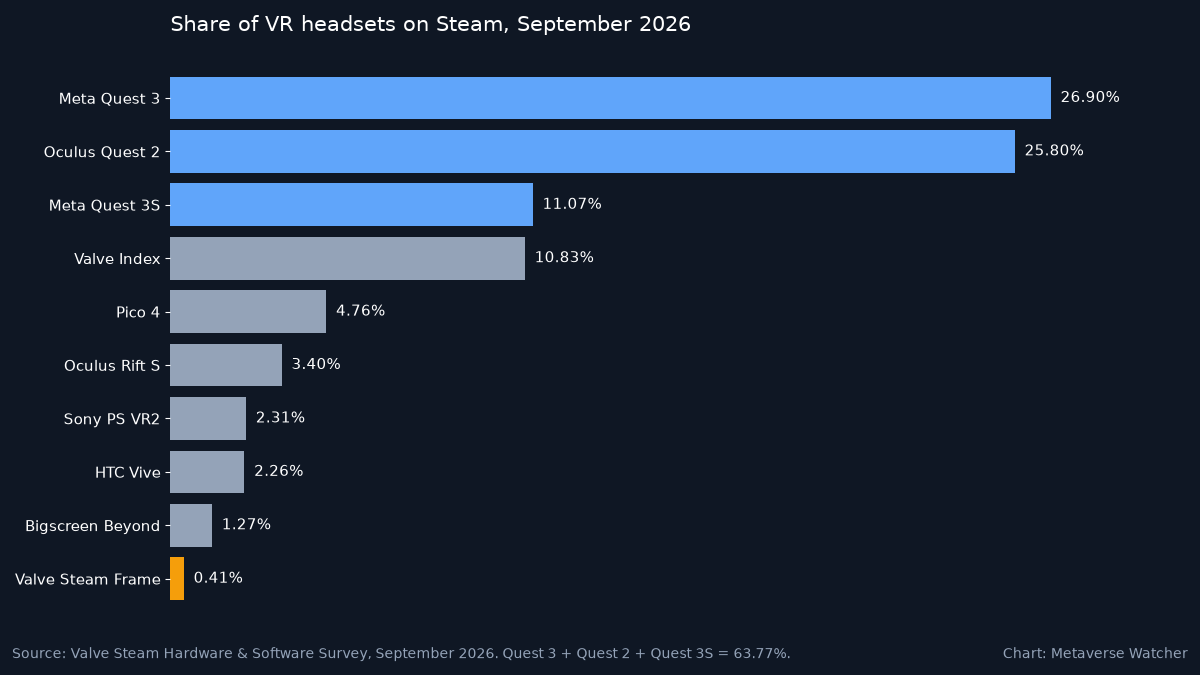
Valve’s own data illustrates both sides of the argument. In the September 2026 Steam Hardware & Software Survey, 1.35% of Steam users reported owning a VR headset, down 0.14 percentage points from the prior month. Within that group, Meta’s standalone headsets dominate.
| Headset | Share of Steam VR users (Sept. 2026) | Monthly change |
|---|---|---|
| Meta Quest 3 | 26.90% | +0.89 |
| Oculus Quest 2 | 25.80% | -1.17 |
| Meta Quest 3S | 11.07% | -0.42 |
| Valve Index | 10.83% | -0.25 |
| Pico 4 | 4.76% | n/a |
| Sony PS VR2 | 2.31% | n/a |
| Bigscreen Beyond | 1.27% | n/a |
| Valve Steam Frame | 0.41% | +0.39 |
Quest 3, Quest 2 and Quest 3S together account for 63.77% of VR headsets on Steam. The Steam Frame registered 0.41%, up 0.39 points as early units reached buyers. The Valve Index, which Valve has stopped producing, still holds 10.83%. Early survey figures for a new device are volatile and depend on shipping volume, so the Frame number says more about supply than demand at this stage.
The data also supports Giardino’s point that Steam VR depends heavily on hardware Valve does not make. Most Steam VR users are on Quest headsets connected over a cable, Steam Link or other streaming tools. Our guide on how to play PC VR games on Quest 3 and 3S explains those options, and projects such as the Venture Quest emulator show how PC players are also pulling standalone content the other way.
Not everyone accepts the framing
Some observers argue that the chicken-and-egg view counts only native VR releases. As one commenter on X put it:
The chicken-and-egg framing only counts native VR releases. That’s the slice of VR Valve can measure, not the whole library. Frame owners playing their regular Steam library on it isn’t a letdown. It’s the product Valve described: a streaming-first headset for your whole …
— Joshua Keith (@joshuakeith) October 28, 2026
That reading matches Giardino’s own observation that many Frame owners use it as a large virtual display. It does not, however, solve the problem the VR studio raised: a headset used mainly for flat games does little to grow the audience for dedicated VR titles. Road to VR and Digital Developer also covered the session, including Valve’s wider comments on curation and low-quality submissions.
Why it matters
Valve is one of the few companies still funding high-end PC VR hardware, and its commitment carries weight for studios deciding where to invest. The Seoul remarks are a reassurance rather than a roadmap: Valve offered no new funding program, price change or content initiative. With Meta’s Reality Labs still reporting large losses, as shown in its Q3 2026 results, the economics of VR remain difficult for platform holders and developers alike.
For buyers, the practical takeaway is unchanged. The Quest 3 and Quest 3S remain the most common way to play Steam VR, while the Steam Frame is a premium option whose value depends on how much you use it for both VR and flat games. Our best VR headsets of 2026 list compares the current choices.