Updated October 21, 2026. Meta has not shipped this device yet, so every figure below comes from Meta’s own announcement, its developer pages, or published hands-on reports. We will update this guide when retail units arrive.
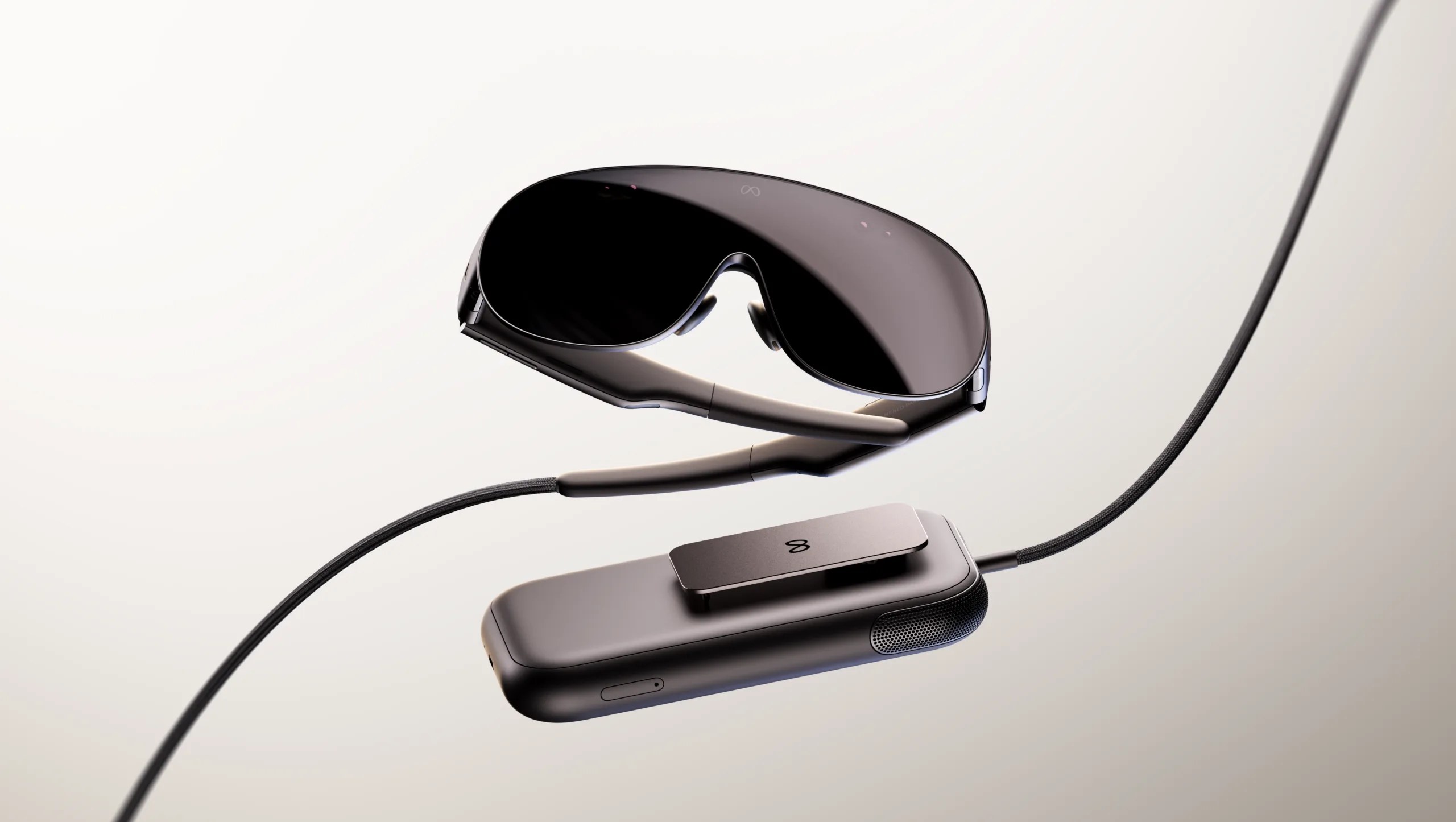
The short answer: Meta VR Glasses go on sale in SPRING 2027 for $1,299.99 in the US. They are a roughly 100-GRAM, glasses-style VR headset that offloads its chip, battery and storage to a separate 300-gram PUCK. Meta pitches them first as a personal cinema and portable workspace, with Quest games as a secondary use rather than the headline.
Meta VR Glasses price and release date
Meta announced the device on September 23, 2026, and its official launch post gives two firm details: an on-sale window of Spring 2027 and a US price of $1,299.99. There is no exact day yet, and preorders have not opened.
- Price: $1,299.99 (US), ONE storage configuration with 128GB.
- Release window: Spring 2027, with no exact date announced.
- Sizes: two head-size SKUs at the same price, according to Road to VR and The Verge.
- Controllers: NOT included. UploadVR reports you can buy Touch Plus controllers separately or pair the ones from a Quest 3 or Quest 3S, and some retailers will sell a bundle.
Accessory deals are already forming. Sandisk says it will be the exclusive “Made for Meta” storage partner, though it has not published card sizes or prices. We covered that in Sandisk’s exclusive VR Glasses storage deal.
Meta VR Glasses specs
The table below combines Meta’s announcement with the spec sheets published by Road to VR and UploadVR. Items Meta has not confirmed are marked as such.
| Spec | Meta VR Glasses |
|---|---|
| Display | Micro-OLED “5K Infinite Display”, 2,412 × 2,288 per eye, up to 120Hz |
| Sharpness | 37 pixels per degree (Quest 3: about 25) |
| Field of view | 70° horizontal × 66° vertical (Quest 3: about 110° × 96°) |
| Lenses | Pancake, manual IPD 56–70mm, Zenni prescription inserts |
| Chip | Qualcomm Snapdragon Reality Elite (described by Road to VR as XR2 Gen 3) |
| Memory and storage | 12GB RAM, 128GB, microSD slot up to 1TB (card not included) |
| Weight | About 100g on the head, plus a 300g puck |
| Battery | Up to THREE hours of media playback, 45W charging, usable while charging |
| Tracking and input | 6DoF, hand tracking, 4-camera eye tracking, voice via Meta AI, optional Touch Plus |
| Passthrough | Full color, about 26 pixels per degree |
| Wi-Fi and Bluetooth versions | Not yet confirmed |
One caution on field of view. Meta’s developer documentation treats 70° × 66° as an upper bound and asks app makers to design for a smaller perceived area of about 58° × 54°. We explained the three different numbers in Meta’s per-eye resolution and field-of-view targets. For buyers, the practical point is simple: the image is sharper than Quest 3, but the window is much NARROWER.
How the design works: glasses plus a puck
Meta says the glasses are five times lighter than Quest 3 because of a two-part system. The magnesium-alloy frame holds only the displays and sensors. A pocketable puck, which UploadVR describes as roughly the size of two phones stacked together, carries the processor, battery and storage, and connects through a thin fiber-optic tether. The sides are OPEN, so you keep some natural peripheral vision, while color passthrough cameras show the room in front of you.
That trade-off is the core of the product. The Verge’s Sean Hollister argued after his hands-on that passthrough glasses could win over people who will not strap on enclosed goggles. We summarized his reasoning in The Verge’s case for passthrough glasses over transparent AR.
What you can do with Meta VR Glasses
Meta leads with VIDEO. The glasses are the FIRST IMAX Enhanced certified VR device, and they support Dolby Vision and Dolby Atmos. Meta says Prime Video, YouTube, DIRECTV, AMC+, Crunchyroll, Plex and Tubi will be available through its TV app, and that Peacock, HBO Max and Paramount+ are offering their 3D catalogs for the first time. Disney+ 3D streaming starts on Quest in November, and the Disney Immersive Cinema by ILM app will arrive with the glasses. Our report on Disney+ 3D movies on Quest covers that rollout, and Meta’s 3D movie plans explains the rental store.
For work, the glasses can show several virtual screens, turn a desk into a surface keyboard and touchpad, and connect to a Mac or Windows PC wirelessly or over USB-C. UploadVR notes that the puck also accepts any USB-C DisplayPort source, such as a phone, laptop or gaming handheld, without a capture card. Meta also promises photorealistic “hologram” avatars for video calls in apps from WhatsApp to Zoom Workplace.
For games, Meta counts more than 75 titles playable with hand gestures at launch, Xbox Cloud Gaming with a Bluetooth gamepad, and the wider Quest catalog once you pair Touch Plus controllers. Meta has been clear that this is NOT a gaming-first device, and it has declined to promise a gaming-focused Quest successor. See Meta’s statement on its headset roadmap.
Meta VR Glasses vs Quest 3, Steam Frame and Vision Pro
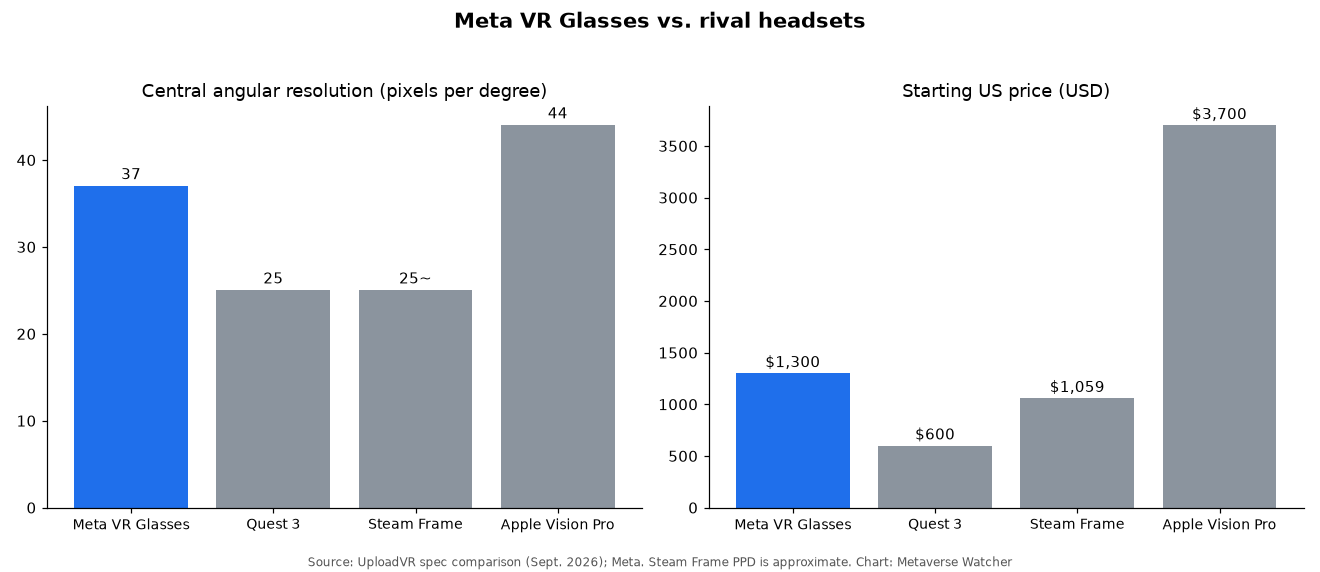
- Quest 3 ($600, 512GB): HALF the price, a FAR WIDER field of view, controllers included and the full game library. It remains the BETTER gaming buy.
- Steam Frame ($1,059, 256GB): built for PC VR and SteamOS tinkerers, with a 110° view and monochrome passthrough. Our Steam Frame vs Quest 3 guide goes deeper.
- Apple Vision Pro ($3,700, 256GB): sharper at about 44 pixels per degree and wider, but close to THREE TIMES the price and far heavier on the face.
Road to VR placed the three Meta and Valve options on one scorecard, which we covered in Meta VR Glasses vs Quest 3 vs Steam Frame. For every headset you can buy today, see our best VR headsets of 2026 guide.
Should you wait for Meta VR Glasses?
Wait if your main use is movies, travel or a private multi-monitor setup, and if comfort has kept you out of VR. The design targets comfort directly by moving the battery and chip off your face. Do not wait if you mostly play games, want the widest view, or need a headset this year: the narrower view, separate controllers and $1,299.99 price make Quest 3 or Steam Frame the stronger value for play.
Three things remain UNKNOWN until reviewers get retail units: real-world battery life beyond Meta’s three-hour media figure, how much the 70° view feels like a limitation over long sessions, and international pricing. Meta has said it will sell the glasses in the US, Canada, Mexico, Germany and Poland first, according to Road to VR, with other markets to follow.
Meta VR Glasses FAQ
When do Meta VR Glasses come out? Spring 2027. Meta has not given an exact date or opened preorders.
How much do Meta VR Glasses cost? $1,299.99 in the US for the 128GB model. Controllers are sold separately.
Are Meta VR Glasses AR glasses? No. They are VR glasses with COLOR PASSTHROUGH cameras and open sides, not see-through lenses like Snap Specs or Meta’s Orion prototype.
Do Meta VR Glasses play Quest games? Yes. They run the same operating system as Quest 3 and can play the Quest catalog with Touch Plus controllers, plus more than 75 hand-tracked games at launch.
Can you wear them with prescription glasses? Meta is offering prescription lens inserts through Zenni Optical, according to Road to VR.
Sources: Meta, Meta Horizon OS Developers, Road to VR, UploadVR, The Verge.