If you wear glasses, the cheapest upgrade to almost any VR headset is a pair of PRESCRIPTION LENS INSERTS. They snap or magnet onto the headset’s own lenses, so you stop pressing frames against the optics, stop fogging, and stop scratching expensive pancake lenses. This guide covers what is actually available for the headsets people are buying in late 2026, what each option costs, which prescriptions are supported, and when you can skip inserts and keep your glasses on. Prices below were checked on the seller pages on November 4, 2026 and are U.S. list prices before any shipping or coating add-ons.
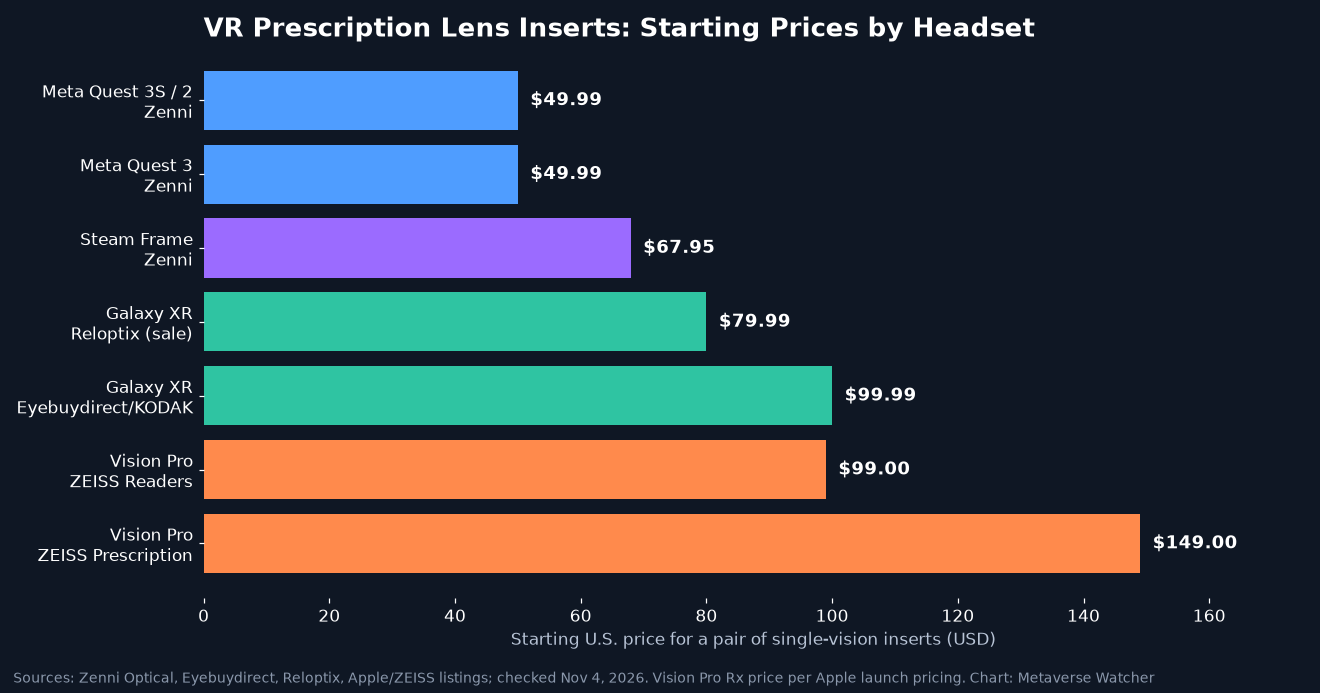
Quick Answer: Inserts by Headset
| Headset | Official or partner insert | Starting price | Prescription range listed | Glasses without inserts? |
|---|---|---|---|---|
| Meta Quest 3 | Zenni (Meta partner) | $49.99 | SPH -10.00 to +6.00, CYL -6.00 to +6.00 | Yes, frames up to 142 mm wide and 50 mm tall |
| Meta Quest 3S / Quest 2 | Zenni (Meta partner) | $49.99 | SPH -10.00 to +6.00, CYL -6.00 to +6.00 | Yes, with the included glasses spacer |
| Valve Steam Frame | Zenni (Steam Frame Compatible) | $67.95 | SPH -8.00 to +2.00, CYL -2.00 to +2.00 | Yes, frames up to 140 mm wide per Valve |
| Samsung Galaxy XR | Eyebuydirect KODAK (Samsung partner) | $99.99 | Not published on the listing; price can rise with prescription | Samsung points glasses wearers to inserts |
| Apple Vision Pro | ZEISS Optical Inserts (Apple) | $99 Readers, $149 Prescription | Wide range, no prism, verified by ZEISS | No, glasses do not fit |
| PlayStation VR2 | None from Sony | n/a | n/a | Yes, Sony designed it for glasses |
Why Inserts Beat Wearing Glasses in VR
Most modern headsets technically accept glasses, but the fit is a compromise. Frames push the headset’s lenses farther from your eyes, which shrinks the field of view and makes the sweet spot harder to find. Hard frames can also rub against and scratch the headset lenses, and glasses fog quickly during active games. Inserts put the correction right on the headset optics, which keeps the eye relief Meta, Valve, Samsung and Apple designed for. On headsets with EYE TRACKING, such as Vision Pro, Galaxy XR and Steam Frame, the headset also needs a clean view of your eyes, which is a big reason Apple and Samsung route glasses wearers to official inserts rather than frames.
One limitation applies across the board: VR optics focus at a single fixed distance, so inserts are SINGLE-VISION distance lenses. Zenni says plainly that it offers no progressives, bifocals or readers for Quest, and its Quest listings note that you should ignore the ADD value on a progressive prescription. If your doctor wrote a multifocal prescription, the distance portion is what matters for VR.
Meta Quest 3 and Quest 3S
Meta’s official route is Zenni. The Meta Quest help page says the inserts can be bought directly from Zenni or with an eVoucher on Meta.com for U.S. customers, and that you have 90 days after ordering to submit a valid prescription before the order is canceled and refunded. Zenni sells two different designs, and they are NOT interchangeable: one fits Quest 3 only, the other fits Quest 3S and Quest 2.
- Price: $49.99 for prescription inserts, or $29.99 for non-prescription lenses, on both Zenni listings checked November 4.
- Coatings: anti-scratch and anti-reflective are included; you choose an anti-fog or oil-resistant coating, which Zenni’s page shows as included with the order.
- Prescription range: sphere -10.00 to +6.00 and cylinder -6.00 to +6.00, with total power capped at -10.00 to +6.00. No pupillary distance measurement is needed.
- Lens material: 1.67 high-index for prescription lenses.
- Payment and returns: Zenni says prescription inserts are eligible for vision insurance and HSA/FSA cards, with a full refund within 14 days of delivery. Rush delivery starts at $19.
If you would rather keep your glasses, Meta’s glasses guidance says frames should be 142 mm wide or less and 50 mm tall or less. Quest 3S and Quest 2 ship with a glasses spacer that sits between the headset and the facial interface; Quest 3 instead has eye-relief buttons that slide the facial interface forward. Put the headset on front to back and take it off by pulling it forward first, so the frames do not drag across the lenses. Still deciding which Quest to buy? See our Quest 3 vs Quest 3S buying guide and our Quest 3 and 3S setup guide.
Valve Steam Frame
Valve does not sell inserts itself. Its Steam Frame store page points glasses wearers to Zenni, which describes itself as an authorized “Steam Frame Compatible” prescription lens provider. The Zenni Steam Frame listing shows $67.95 for single-vision 1.67 high-index inserts with an oil-resistant coating, and no PD required.
The catch is the prescription window. Zenni’s Steam Frame range is NARROWER than its Quest range: sphere -8.00 to +2.00 and cylinder -2.00 to +2.00, with total power no stronger than -8.00. Buyers with stronger farsightedness or astigmatism will need another vendor. When we tracked the launch, AMVR listed its NL2 inserts at $69.99 and VR-Rock at $59, with VR-Rock sold out at the time; see our earlier report on Steam Frame prescription insert options and Zenni’s Steam Frame launch. Those third-party prices were not rechecked for this guide, so confirm them on the seller page.
Glasses are an option too. Valve’s store page lists a maximum eyeglass width of 140 mm and an IPD target range of 60 to 70 mm, as Digital Citizen documented. If you are still waiting on a unit, our guide to checking your Steam Frame order status explains the queue.
Samsung Galaxy XR
Samsung’s partner is Eyebuydirect, which sells KODAK Prescription Lenses for Galaxy XR at $99.99 for single-vision lenses with free shipping and 30-day returns. SamMobile reported at launch that the price can rise depending on the prescription. The inserts ship with a QR code, and Samsung’s support page says the headset prompts you to scan it after installation, or you can register the lenses manually under Settings, Inputs, Eye calibration, Optical inserts. That registration step matters because Galaxy XR relies on eye tracking.
The main third-party alternative is Reloptix, which lists a magnetic prescription kit at a $79.99 sale price (regular $89.99). Reloptix publishes a tiered range: sphere -10 to +4.25 at the base price, with surcharges of $25 to $50 for stronger lenses, and cylinder up to -8.00 at extra cost. Reloptix also warns that very high prescriptions can make eye tracking less reliable and says it does not guarantee eye tracking at high powers. Samsung notes that soft contact lenses also work with the headset.
Apple Vision Pro
Vision Pro is the one headset where glasses are simply not an option, so inserts are mandatory for anyone who needs correction beyond contacts. Apple sells ZEISS Optical Inserts in two types, both compatible with the M5 and M2 models. Readers cost $99 and come in three strengths (+0.75 to +1.25, +1.50 to +1.75, and +2.00 to +2.75). Prescription inserts were priced at $149 when Apple announced them, as 9to5Mac reported; Apple’s store page today shows a starting price of $99 for the product family.
Ordering is stricter than at Zenni. Apple Support says you need a comprehensive, unexpired prescription, and you get a verification email within about one business day; inserts arrive about two weeks after confirmation. The ZEISS prescription guide rules out contact lens, computer and near-vision prescriptions and says ZEISS cannot make inserts with PRISM correction. Apple also warns that adding inserts later may require a different Light Seal size. For the full hardware picture, read our Apple Vision Pro 2026 price and specs guide or our Galaxy XR vs Vision Pro comparison.
PlayStation VR2
Sony does not sell official inserts. The PlayStation Blog FAQ says PS VR2 was designed to be worn with glasses, though very wide or unusually shaped frames may not fit. Sony’s fit guide recommends using the scope adjustment button and lens-distance dial while wearing your glasses, without letting the glasses touch the headset lenses. Third-party inserts exist if you want them, but check fit and return terms before buying. Our PS VR2 on PC guide and best PS VR2 games list cover the rest of the platform.
How to Order the Right Inserts
- Get a current distance prescription. Apple and ZEISS require an unexpired one with the prescriber’s details, and Zenni and Eyebuydirect ask you to upload or enter yours. A contact lens prescription is not the same document.
- Match the exact headset model. Quest 3 and Quest 3S inserts differ, and Galaxy XR, Steam Frame and Vision Pro use their own mounts.
- Check the range before paying. Compare your sphere and cylinder against the listing. Steam Frame’s Zenni range is the tightest of the official options; Quest’s is the widest among the Zenni products.
- Ignore PD for Zenni. Zenni says PD is not needed for its VR inserts. You still set the headset’s IPD or lens spacing yourself after installing them.
- Register them if the headset asks. Galaxy XR and Vision Pro both pair or register inserts so eye tracking calibrates correctly.
- Use HSA/FSA where allowed. Zenni accepts HSA/FSA and vision insurance for prescription inserts, which can lower the effective cost.
Care and Common Problems
Clean inserts with the microfiber cloth they ship with, not paper towels, and keep the headset lenses out of direct sunlight. Zenni says its anti-fog coating is activated with a special cloth and lasts three to six months depending on use, and warns that the activator cloth should not be used on the Quest’s own lenses. If text looks blurry after installing inserts, re-run the headset’s lens spacing or eye calibration before assuming the prescription is wrong. Zenni notes that minor edge distortion is possible only with very high prescriptions. If you still feel eye strain or nausea, our VR motion sickness guide covers the fit and comfort settings that help most.
The Bottom Line
For Quest owners, $49.99 Zenni inserts are the easiest comfort upgrade available and support a wide prescription range. Steam Frame owners pay a little more and should check the narrower range first. Galaxy XR and Vision Pro inserts cost more, but they are effectively part of the headset for glasses wearers because both rely on eye tracking. PS VR2 is the one current headset where glasses remain a perfectly reasonable choice. Shopping for a first headset? Start with our best VR headsets of 2026 and our tracker of upcoming VR headsets.
Prices and prescription ranges were checked on the listed seller pages on November 4, 2026, and can change. Metaverse Watcher has no affiliate relationship with any seller named here.