Google has a published patent application for AR glasses that try to work out your question from where you point and where you look, then attach the answer directly to the object in front of you. The application, US 2026/0319581 A1, was filed on April 9, 2026 and published by the U.S. Patent and Trademark Office on October 15, 2026, according to Patentlyze, which first detailed the filing.
It is a patent application, not a product announcement. Still, it lines up closely with the Gemini-first direction of Android XR, and it shows how Google thinks hands-busy questions should work on a face-worn computer.
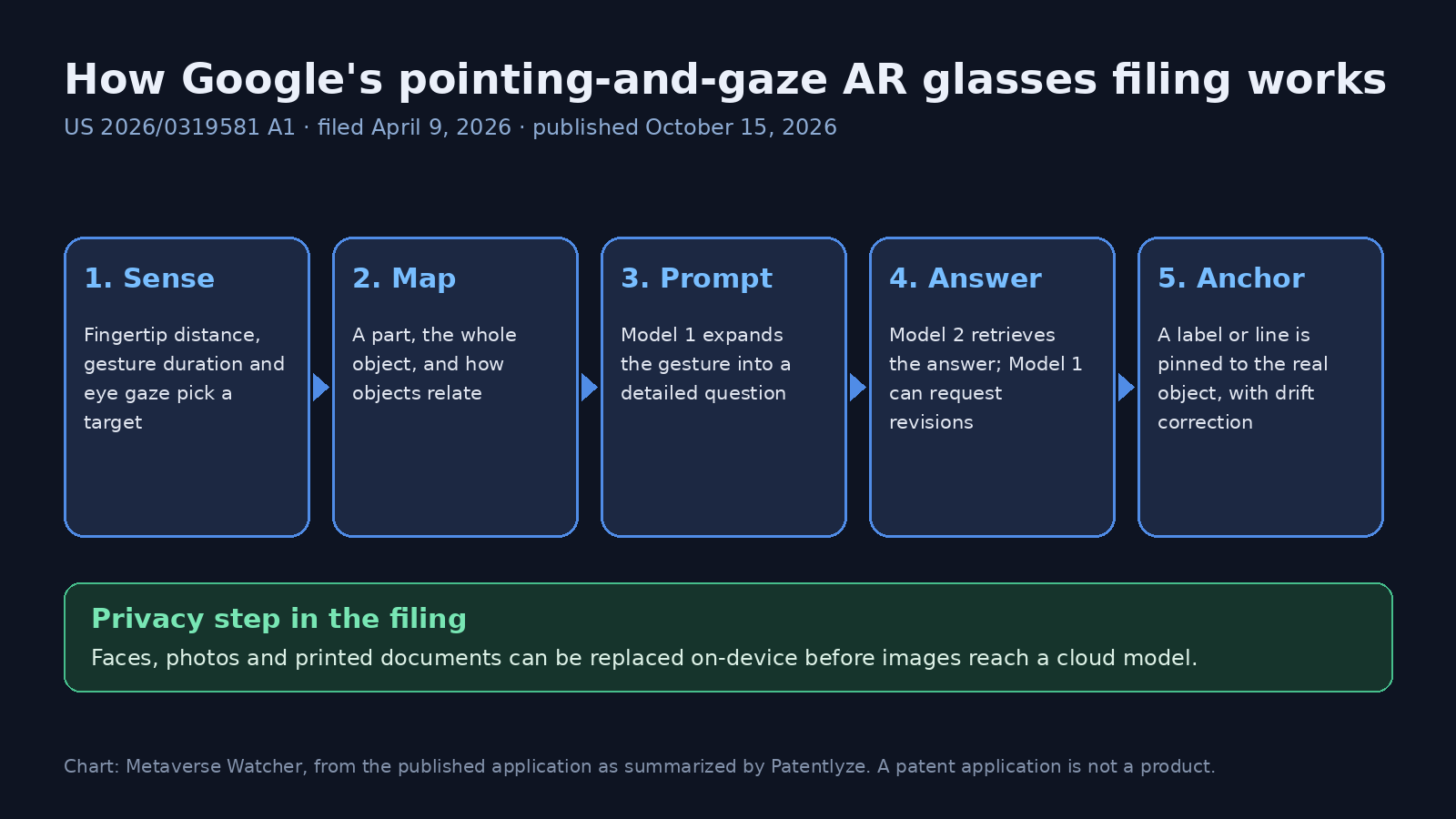
What the Google AR glasses patent describes
The filing’s main example is a familiar one: setting up a router. Instead of squinting at port labels and typing a search on a phone, the wearer points at a port and the glasses infer what is being asked. To do that, the system reads the scene at three “scales of interaction,” which claim 1 spells out:
- A component of an object, such as a single Ethernet port or a printed label.
- The whole object that component belongs to.
- The functional relationship between objects, such as a phone that needs to connect to that router.
Claim 1 describes “identifying a first object in a physical environment at a first scale of interaction corresponding to a component of the first object” and a second object “at a second scale of interaction corresponding to a functional relationship” with other objects in the room.
Two AI models, one checking the other
The core of the method is a pair of models working in sequence. The first model turns what the glasses identified into a written prompt. Patentlyze notes the filing says it can expand a simple gesture into a paragraph-length instruction. The second model uses that prompt to retrieve the answer. The first model can then review that answer and ask for revisions before anything is shown.
The result appears as an overlay, such as a label, a highlight, or a line drawn in the room, pinned to the physical object. If the wearer picks the object up, the overlay is meant to follow it.
How the glasses read intent
Pointing alone is ambiguous, so the application leans on several cues to decide what the wearer means:
- Fingertip distance from the object.
- Gesture duration, meaning how long a point is held.
- Eye gaze, meaning where the wearer’s eyes come to rest.
Supporting claims add a scene graph, a running map of how objects relate that updates when something moves. They also describe digital anchors placed by casting a ray from the camera through a bounding box until it meets a 3D scan of the room, and drift correction from periodic camera snapshots. The filing groups relationships into grouped items, interchangeable items, and step-by-step order.
Other claims cover reading label text with OCR and resolving words like “these” in spoken questions such as “how do these two parts fit together?” from what the wearer has selected. There is also a safety example: a coffee cup set next to a hard drive could prompt a spill warning. Other examples in the filing include lab benches, plant care, and supplement labels.
A privacy step before the cloud
The application says raw camera images can be processed on the device first, with faces, photos, and printed documents replaced by generic boxes before anything reaches a cloud model. That matters because camera-equipped glasses are under growing regulatory pressure. Europe’s privacy regulators have already set out the GDPR duties smart glasses makers carry. Whether any shipped product would use this exact step is unknown.
Where this fits in Google’s glasses plans
The filing reads like a blueprint for a camera-plus-Gemini assistant, and the surrounding evidence points the same way. Android Authority previously found app strings suggesting a “Hey Gemini” hotword and camera activation for Android XR glasses. Android Headlines and iDevice have also covered the application.
The hardware is still catching up. Samsung’s first glasses, based on recent leaks, have no display at all, which would rule out the anchored overlays this filing depends on. XREAL’s Aura, the most visible Android XR glasses-class device so far, is built around its own optics and apps such as Owlchemy’s Hyper Visor. Display-equipped Android glasses that could render these overlays are widely expected later. For the current lineup, see our best smart glasses of 2026 guide.
What to watch
- Examination. Patentlyze lists the application as waiting for an examiner (status as of May 20, 2026). The claims could narrow or be rejected.
- Demos. Look for any pointing or gaze-driven Gemini features in future Android XR developer releases or event demos.
- Display hardware. Anchored overlays need a display. Watch for which partner ships display-equipped Android XR glasses first.
Bottom line: Google’s filing describes a careful, if heavy, answer to a narrow problem: asking about something in front of you when your hands are busy and the right words are hard to find. Like every patent, it shows intent, not a shipping date.
Sources: Patentlyze, Android Headlines, iDevice, Android Authority.