By the Metaverse Watcher newsroom. Published November 20, 2026. Statutes and regulator pages checked November 20, 2026. This guide is general information, not legal advice.
Camera glasses such as Ray-Ban Meta make it easy to take a photo or start a video without lifting a phone, and that convenience is exactly why lawmakers and regulators spent the autumn of 2026 debating them. If you own a pair, or are thinking of buying one, the practical question is simple: when is it legal to record with smart glasses? The answer depends on three things: whether you are capturing audio or only images, whether the people around you have a reasonable expectation of privacy, and what you do with the footage afterwards. This guide sets out the rules that already apply in the United States and Europe, the new proposals that could change them, and a checklist for recording without breaking the law.
Quick Answer
- No country covered here bans smart glasses outright as of November 20, 2026. Norway, Ireland and the UK are considering restrictions; none has been enacted.
- Audio is the main legal risk in the U.S. Federal law allows a participant to record a conversation, but roughly a dozen states require everyone’s consent to record a private conversation in at least some situations.
- Images in public are generally lawful in the U.S., but recording people in places such as bathrooms or changing rooms can be a crime under voyeurism laws.
- In the EU, sharing changes everything. Personal use falls under the GDPR household exemption; posting the clip to a public account can make you a data controller with legal duties.
- Private rules matter too. Employers, schools, hospitals and venues can ban the devices on their premises.
United States: Audio Consent Is the Key Issue
Smart glasses record sound with their video by default, so the most important U.S. rules are wiretapping and eavesdropping laws. At the federal level, 18 U.S.C. § 2511 prohibits intercepting oral communications, but section 2511(2)(d) makes it lawful for a person “not acting under color of law” to record a conversation they are part of, or where one party has consented, unless the purpose is to commit a criminal or tortious act. That is a one-party consent rule.
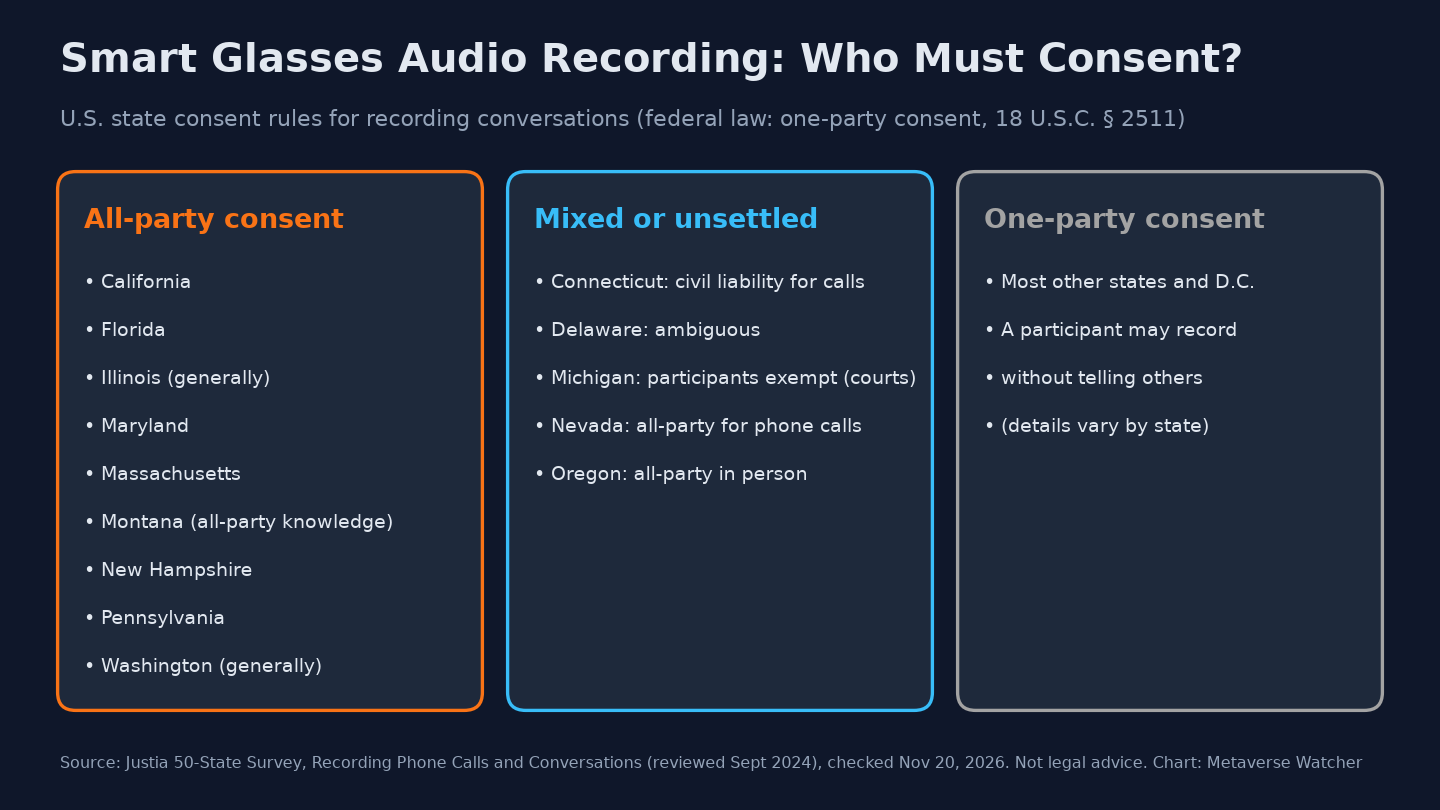
States can be stricter, and several are. According to Justia’s 50-state survey of recording laws, most states follow the one-party model, but a smaller group requires everyone in the conversation to agree. California Penal Code § 632, for example, prohibits recording a “confidential communication” without the consent of all parties, whether the conversation happens in person or by phone.
| Rule | States (per Justia) | What it means for glasses |
|---|---|---|
| All-party consent | California, Florida, Maryland, Massachusetts, New Hampshire, Pennsylvania; Illinois and Washington generally; Montana requires the knowledge of all parties | Do not record a private conversation unless everyone in it knows and agrees |
| Mixed or unsettled | Connecticut (civil liability for calls without all-party consent), Delaware (ambiguous), Michigan (courts exempt participants), Nevada (all-party for phone calls), Oregon (all-party for in-person conversations) | Treat in-person conversations cautiously and check the specific statute |
| One-party consent | Most other states and Washington, D.C. | A participant may record, but not a conversation they are not part of |
Two details matter for glasses wearers. First, most of these laws protect conversations where people expect privacy; a speech at a public rally is treated differently from a quiet talk in a restaurant booth. Second, a one-party rule only helps if you are a party. Recording two strangers talking near you is not covered by your own consent in any state.
Photos and video in private places
Silent images are less restricted, but not unrestricted. The federal Video Voyeurism Prevention Act (18 U.S.C. § 1801) makes it a crime to capture images of a person’s private areas without consent where they have a reasonable expectation of privacy, punishable by up to one year in prison. It applies in federal jurisdictions such as federal land, and states have their own voyeurism statutes. In practice, changing rooms, bathrooms, medical rooms and private homes are places where recording without permission can lead to criminal charges.
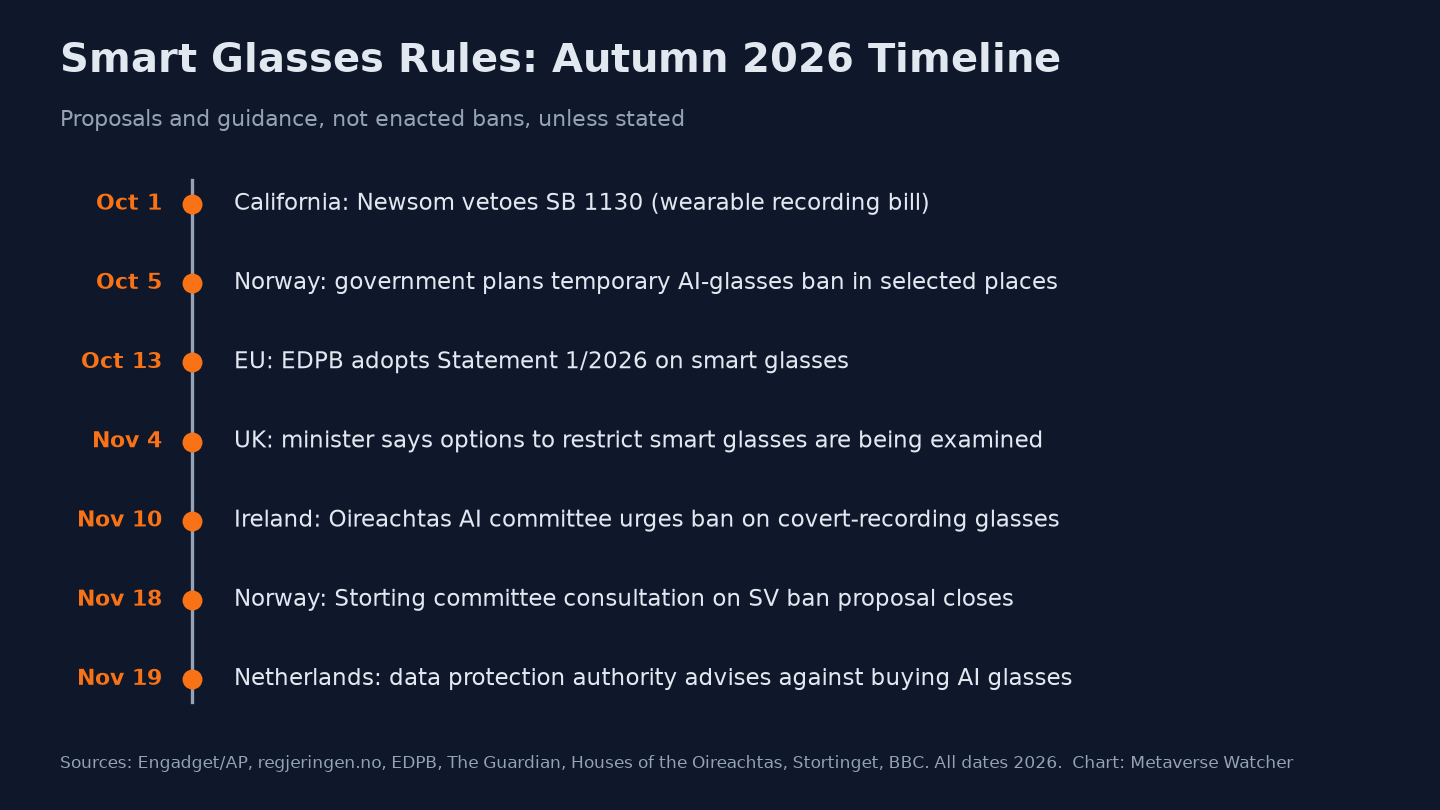
California tried to go further. Senate Bill 1130 would have targeted secret recording with wearables and required device makers to include a recording indicator from 2028, but Governor Gavin Newsom vetoed it on October 1, 2026, saying the definition was too broad and that existing law already bars non-consensual recording where people expect privacy. We covered the veto and the Engadget and AP reporting in our SB 1130 explainer. In Washington, Senators Ron Wyden and Ed Markey have also questioned Meta about bystander privacy, as detailed in our report on their letter.
European Union: The GDPR Household Exemption
Europe approaches the question through data protection law rather than wiretapping law. Article 2(2)(c) of the GDPR says the regulation does not apply to processing “by a natural person in the course of a purely personal or household activity.” On October 13, 2026, the European Data Protection Board adopted Statement 1/2026 on smart glasses, which explains how that exemption applies to camera glasses.
According to the EDPB’s announcement, recording family or friends, or using live translation in a private context, is a purely personal activity. Sharing a photo or video on a public social media account, or using the glasses for professional or political activities, makes the wearer a data controller. The Board adds that “even when the GDPR does not apply, the use of smart glasses may still be subject to criminal, civil, or labour law.” It also states that manufacturers and AI service providers cannot shift their own obligations onto users. The statement is preliminary guidance rather than a new law; our analysis of the EDPB statement covers its recommendations on recording indicators in detail.
Country Proposals to Watch
Several governments moved from general privacy law toward rules written for camera glasses this autumn. None of the measures below is in force yet.
| Country | What happened | Status (Nov 20, 2026) |
|---|---|---|
| Norway | On October 5 the government announced a planned temporary ban on using AI glasses in selected places, such as parks, beaches, schools, health facilities and gyms with changing rooms. A separate opposition proposal (Dokument 8:8 S) would ban sale and use. | No government bill yet. The Storting committee’s deadline for its recommendation on the opposition proposal is January 19, 2027. |
| United Kingdom | Safeguarding minister Satvir Kaur told MPs on November 4 that the government is “already looking into options to restrict smart glasses in certain settings,” according to The Guardian. | Under consideration; no legal text published. |
| Ireland | The Oireachtas Joint Committee on Artificial Intelligence recommended on November 10 that glasses capable of covert recording without consent be prohibited. | Committee recommendation, not law. |
| Netherlands | The data protection authority (Autoriteit Persoonsgegevens) advised consumers on November 19 not to buy AI camera glasses after testing six models, the BBC reported. | Consumer warning; no sales ban. |
For more background, see our explainers on the Norway proposal, Ireland’s committee recommendation, the UK debate and the Dutch regulator’s warning.
Workplaces, Schools and Venues Can Set Their Own Rules
Even where recording is legal, a property owner or employer can ban the device. Southwest Airlines told employees in February 2026 that they may not wear smart glasses or other recording-capable wearables while working, according to Skift. In Australia, the Northern Territory’s health department barred staff from using smart glasses at clinical sites after a privacy breach, ABC News reported. Some schools have added their own bans; our guide to smart glasses at work tracks employer policies and what a workable policy includes. Ignoring a venue or employer rule is usually not a crime by itself, but it can lead to being asked to leave or to disciplinary action.
What the Recording Light Does, and Does Not, Do
Meta says every pair of its AI glasses has a white Capture LED that blinks briefly for photos and keeps blinking during video, and that the glasses disable the camera if they detect the light has been covered or tampered with, according to Meta’s privacy page. That light helps bystanders notice recording, but it is not legal consent. In an all-party consent state, a blinking LED that someone may not see, or may not recognise, does not replace asking. The EDPB has also said that current indicators leave many bystanders unaware they are being recorded. Our comparison of Android XR and Ray-Ban Meta privacy controls looks at how different brands signal recording.
Checklist: Recording Legally With Smart Glasses
| Situation | Lower risk | Higher risk |
|---|---|---|
| Audio | Recording a conversation you are part of, in a one-party consent state, or with everyone’s agreement | Recording a private conversation in an all-party state without consent, or recording strangers’ conversations |
| Location | Streets, parks and public events | Bathrooms, changing rooms, gyms, medical settings, schools, private homes |
| Sharing (EU) | Keeping clips for yourself, family and friends | Posting identifiable people to a public account without a legal basis |
| Premises rules | Places with no stated policy on recording devices | Workplaces, hospitals, exams and venues that prohibit recording devices |
| Indicator | Recording light visible and unobstructed | Covering or disabling the light, which Meta’s glasses are designed to detect |
The simplest rule is to tell people before you record them and to stop if anyone objects. That habit satisfies all-party consent laws, reduces GDPR exposure when you share, and avoids most conflicts with venues.
Frequently Asked Questions
Are smart glasses illegal anywhere? As of November 20, 2026, none of the countries covered in this guide has a general ban in force. Norway, the UK and Ireland are considering restrictions in specific places or for covert-recording devices.
Can I record a conversation with Ray-Ban Meta glasses? In a one-party consent U.S. state, you can generally record a conversation you are part of. In all-party states such as California, Florida, Pennsylvania and Washington, you need everyone’s consent for private conversations.
Is it legal to film people in public with smart glasses? In the U.S., filming in public places is generally allowed, but audio rules still apply. In the EU, filming for personal use is usually covered by the household exemption; publishing identifiable footage may bring GDPR obligations.
Does the recording light count as consent? No. It is a notice to bystanders, not consent under any of the laws described here.
If you are still choosing a pair, our best smart glasses of 2026 list and beginner’s guide to smart glasses explain which models have cameras and which do not.
Sources: 18 U.S.C. § 2511 and § 1801 (Cornell LII); Justia 50-state survey of recording laws; GDPR Article 2; EDPB Statement 1/2026 and announcement (October 13, 2026); regjeringen.no; Stortinget; The Guardian; Houses of the Oireachtas; BBC; Skift; ABC News; Engadget; Meta. All checked November 20, 2026.