Published October 27, 2026. By the Metaverse Watcher staff. We will update this guide when platform numbers or company plans change.
The metaverse is a network of persistent, shared 3D spaces that people enter as avatars to play, socialize, build, shop and work together. It is NOT one app, and it does NOT require a headset: the largest metaverse-style platforms in 2026 are Roblox and Fortnite, which most people use on phones, consoles and PCs. Virtual reality headsets, mixed reality devices and smart glasses are ways into those spaces, not the definition of them.

Where the word comes from
Author Neal Stephenson coined “metaverse” in his 1992 novel Snow Crash, which described a virtual city that people visited through goggles. The term stayed in science fiction and game-industry circles until October 28, 2021, when Facebook renamed its parent company Meta and said building the metaverse was its new long-term mission, as the company explained in its “Introducing Meta” announcement. That rebrand turned a niche idea into a mainstream buzzword, and much of the confusion about what the metaverse is dates from that moment.
What makes something “metaverse” rather than just a game?
There is no official standard, but most working definitions share three traits:
- Persistent. The world keeps running when you log off, and what you build or buy stays there.
- Social. Other real people share the space with you in real time, usually with voice chat.
- Embodied. You appear as an avatar with a position in 3D space, rather than as a username in a chat window.
Many definitions add a fourth trait, user-generated content: the platform supplies the engine, hosting and avatars, while creators build most of the experiences. That is the model behind Roblox, Fortnite Creative, VRChat and Meta’s Horizon Worlds. Interoperability, the ability to carry an avatar or item from one platform to another, is often described as the end goal, but in 2026 it remains largely unrealized; each major platform is its own walled garden.
The main metaverse platforms in 2026
| Platform | Owner | Headset needed? | Best known for | Latest public scale figure |
|---|---|---|---|---|
| Roblox | Roblox Corp. | No (Quest app available) | User-made games, young creators | 123 million daily active users, Q2 2026 |
| Fortnite | Epic Games | No | Battle royale, creator islands, live events | All-time peak of 14.3 million concurrent players |
| VRChat | VRChat Inc. | Optional (best in VR) | Social VR, custom avatars, events | Record 156,716 concurrent users, February 2026 |
| Horizon Worlds | Meta | No (now mobile-first) | Free multiplayer worlds, Horizon Engine | Meta does not publish user totals |
Sources: Roblox Q2 2026 shareholder letter; GameMakers analysis of fortnite.gg data; VRChat via Viewport360; Meta Community Forums.
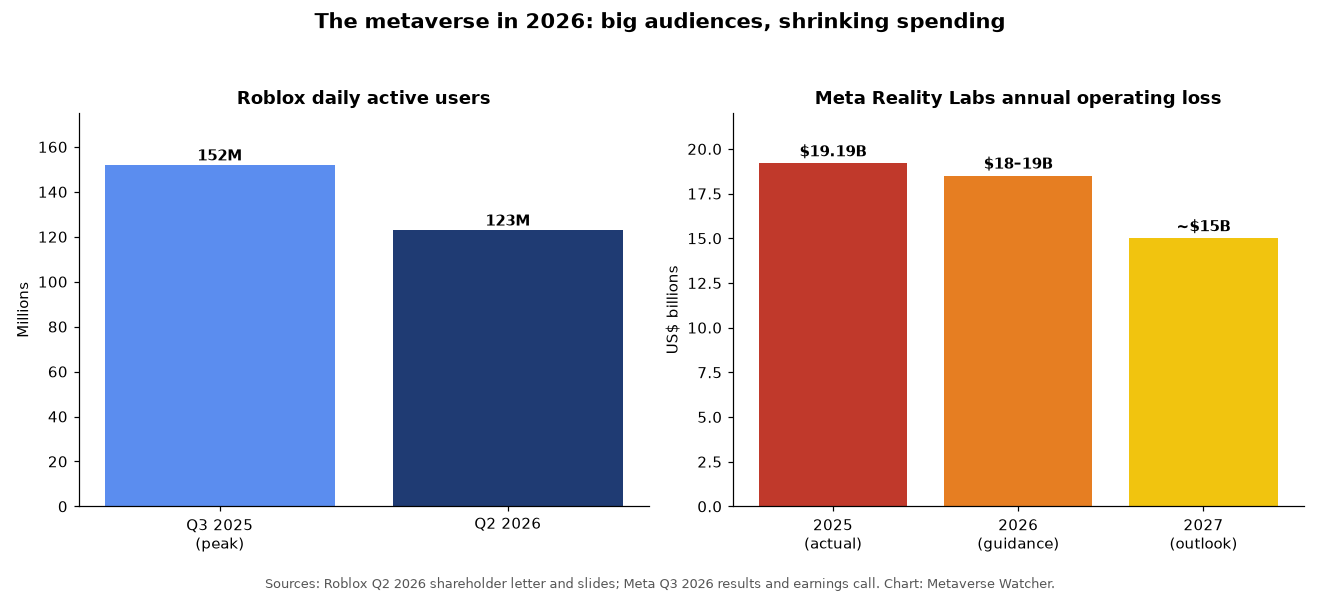
Roblox is the biggest by daily use. The company reported 123 million daily active users and 29 billion hours of engagement in the second quarter of 2026, with revenue up 36% to $1.5 billion, according to its Q2 2026 shareholder letter. That user figure is up 10% year over year but down from a peak of 152 million in the third quarter of 2025, as Investing.com’s review of the earnings slides notes, because several 2025 viral hits cooled.
Fortnite started as a battle royale shooter and has become a platform where creators publish their own islands. Its all-time concurrent peak was 14,343,880 players, but on a Saturday evening in June 2026 the figure was 1,210,150, and most of those players were in battle royale modes rather than creator worlds, according to an analysis by GameMakers using fortnite.gg data.
VRChat is the leading social platform for people in headsets. It set an all-time high of 156,716 concurrent users over Valentine’s Day weekend 2026 during its Sanrio Virtual Festival, beating a New Year’s Eve record of 148,886, Viewport360 reported. That is small next to Roblox, but it is the clearest sign that a dedicated VR social audience exists.
Horizon Worlds was Meta’s flagship virtual world. In 2026 Meta moved it to a mostly mobile product built on its new Horizon Engine, while older worlds remain playable on Quest. Our Horizon Worlds guide explains what changed and how to get in.
Do you need a VR headset?
No. Every platform in the table above runs on hardware people already own, and the largest audiences are on phones, consoles and PCs. A headset changes how the experience feels: you see the world at life size, your hand movements are tracked, and other avatars feel physically present. If you want that, the main options this year are:
- Meta Quest 3 and Quest 3S, the most popular standalone headsets, now $599.99 and from $349.99 respectively. See our Quest 3 vs Quest 3S guide.
- Valve Steam Frame, a $1,059 headset aimed at PC gamers. See Steam Frame vs Quest 3.
- Apple Vision Pro and Android XR headsets such as Samsung Galaxy XR, which focus more on spatial computing than on social worlds. See our Apple Vision Pro guide and what is Android XR.
Our best VR headsets of 2026 guide compares the full field.
Metaverse vs. VR, AR and spatial computing
These terms overlap but are not interchangeable:
- Virtual reality (VR) replaces your view with a fully digital scene. It is a display technology.
- Augmented reality (AR) and mixed reality (MR) place digital objects over the real world, through passthrough cameras on a headset or transparent lenses in glasses.
- Spatial computing is Apple’s preferred term for apps and windows arranged in the space around you. It is about productivity and media as much as social worlds.
- The metaverse is the shared, persistent social layer. You can reach it with any of the above, or with a phone.
Smart glasses are the newest piece. Meta’s Ray-Ban and Oakley glasses put an AI assistant, camera and audio on your face rather than a virtual world in front of your eyes, and they are now the fastest-growing part of Meta’s hardware business. Our best smart glasses of 2026 guide covers the category.
Is the metaverse dead?
The hype cycle is over, but the activity is not. The more accurate reading in 2026 is that the metaverse has SPLIT into two tracks.
The first is mass-market social gaming on Roblox and Fortnite, where hundreds of millions of mostly young users already spend time in persistent 3D worlds without calling it the metaverse. The second is headset-based VR, which is smaller and under more financial pressure. Meta’s Reality Labs division lost $4.13 billion in the third quarter of 2026 on $443 million of revenue, and Meta now expects annual losses to fall from $19.19 billion in 2025 to about $15 billion in 2027 as it shifts spending toward AI, as we reported in our Reality Labs Q3 2026 earnings analysis. Mark Zuckerberg said Meta will now ship new VR devices only when it has “major breakthroughs.”
Market forecasts remain large but should be read with caution, because each firm defines the market differently. Statista projects metaverse spending of $150.1 billion in 2026, counting games, e-commerce, education and hardware, while Global Market Insights puts 2026 at $138.3 billion. Neither is a measure of how many people use VR.
How to try the metaverse today
- On a phone or PC: install Roblox or Fortnite and browse creator-made experiences, or install the free Meta Horizon app to try Horizon Worlds.
- On a Quest headset: download VRChat or Rec Room from the Meta Horizon Store, or open the legacy Worlds app. Our Quest 3 setup guide walks through first-time setup.
- On a PC VR headset: install VRChat through Steam, or follow our guide to playing PC VR games on Quest.
Parents should check each platform’s age ratings and parental controls before younger children join; Roblox, Fortnite and VRChat all offer account-level settings for chat and spending.
The Metaverse Watcher take
The metaverse described in 2021, a single immersive internet that everyone enters through a headset, has NOT arrived and is not close. What exists instead is a set of large, separate virtual worlds that people reach mostly through ordinary screens, plus a smaller but committed VR community. The useful question for 2026 is not whether the metaverse is real, but which of these platforms, and which devices, will matter to you.
Sources
- Roblox: Q2 2026 shareholder letter (SEC filing)
- Investing.com: Roblox Q2 2026 slides
- Meta: Introducing Meta (October 28, 2021)
- GameMakers: So This Is How the Metaverse Dies
- Viewport360: VRChat breaks user records
- Statista: Metaverse market outlook
- Global Market Insights: Metaverse market report